
Black-banded Snake

Black-banded Snake

Scolecophis atrocinctus

Silhouette: Alex Slavenko · PhyloPic

LCLeast ConcernNTVUENCR
Daily sighting probability ~20% · Possible
at Rincón de la Vieja National Park

In 3 days ~60% in a week ~80%

8 Verified sightings at Rincón de la Vieja National Park From 2019 to 2026
8 In 1 park
May Best month
☀️ Diurnal When it's spotted

About the Black-banded Snake

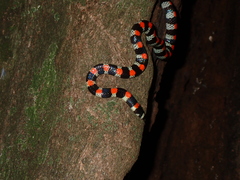
Scolecophis is a genus of snake in the family Colubridae that contains the sole species Scolecophis atrocinctus. Its genus name is derived from Greek: skolex meaning a worm or grub and ophis meaning snake, referring to what it likes to eat. Its species name is derived from Latin ater meaning black and cingula meaning girdle referring to its physical appearance. It is commonly known as the black-banded snake.

It is found in Central America. It ranges from Guatemala, Honduras, El Salvador, Nicaragua, and Costa Rica. Their diet consists of invertebrates such as centipede, arachnids, worms, crickets, millipedes, and grubs. This snake reaches a length of 18–24 in. (45–60 cm.) It is black and white banded with red spots on the white bands down their spine from head to tail. They have tiny eyes and a flat head.

There is still a lot of unknown about this species. Wikipedia →

Global Distribution

Parks Where Found

# Park Country Daily sighting probability
1 Rincón de la Vieja National Park 🇨🇷 Costa Rica
~20%

More parks will be added in future updates.

Cities Where Found

# City Country Daily sighting probability
1 San José 🇨🇷 Costa Rica
<5%

Before you go

What are the chances of seeing a Black-banded Snake in Rincón de la Vieja National Park?

Possible

About 20% of wildlife watchers report a Black-banded Snake sighting in Rincón de la Vieja National Park on a given day, based on 8 verified sightings from GBIF citizen-science data from 2019 to 2026. It is the 8th most-seen of the 17 reptiles we can rate there. Over three days the chance rises to about 60%, and over a week to about 80%, if each day is a fresh chance.

When is the best time to see a Black-banded Snake in Rincón de la Vieja National Park?

January and May

In those months about 50% of wildlife watchers report a Black-banded Snake in Rincón de la Vieja National Park on a given day, against under 5% in February–April, June, August and October–December, the lowest months.

What time of day is best to see a Black-banded Snake?

Between 11 am and 2 pm

Across all the parks we cover, that three-hour window holds the most Black-banded Snake sightings with a recorded time, and about 8 in 10 of them come between 6 am and 6 pm: it is a daytime animal.

Where else can you see a Black-banded Snake?

Only Rincón de la Vieja National Park, in our data

Rincón de la Vieja National Park is the only park on Wallace's Line with enough records to rate Black-banded Snake sightings: about 20% of wildlife watchers there report one on a given day.

Where does the Black-banded Snake sighting chance come from?

GBIF citizen-science records

It is estimated from how often the Black-banded Snake is recorded against all the reptiles logged in Rincón de la Vieja National Park (8 verified sightings from 2019 to 2026), calibrated against known sighting rates. Figures are rounded to the nearest 10% because citizen-science data supports honest approximations, not decimals, and months with records from fewer than five people show "—". How it works.

← Back to Rincón de la Vieja National Park