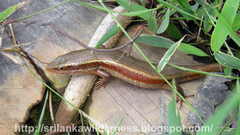
Keeled Indian Mabuya

Keeled Indian Mabuya

Eutropis carinata

Silhouette: PhyloPic

LCLeast ConcernNTVUENCR
Daily sighting probability ~30% · Possible
at Royal Bardia National Park

In 3 days ~70% in a week ~90%

6 Verified sightings at Royal Bardia National Park From 2019 to 2026
23 In all 3 parks
October Best month
☀️ Diurnal When it's spotted

About the Keeled Indian Mabuya

Eutropis carinata, commonly known as the keeled Indian mabuya, many-keeled grass skink or (ambiguously) "golden skink", is a species of skink found in South Asia. Body robust; snout moderate, obtuse. Lower eyelids scaly; vertebral scales smooth. Ear-opening roundish, sub-triangular. Brown to olive or bronze in color above, uniform or with dark-brown or black spots, or longitudinal streaks along the lateral margins of the scales. Sides are dark-brown or chestnut, with or without light spots. A light dorso-lateral line starting from above the eye and continued to the base of the tail. Lower parts whitish or yellowish. Maximum length: 37 cm. and Common length: 25, in which Snout-vent length is 9 cm.

The Sri Lankan lankae is now treated as a full species, Eutropis lankae. Frequently found in Bangladesh, India (except in the North-West), Maldives, Myanmar, & Nepal and Possibly in Bhutan. Diurnal, and terrestrial, frequently seen basking or foraging in open areas. Crickets, caterpillars, beetles, and earthworms and even small vertebrates are known to be consumed.

Oviparous; clutches of 2-20 eggs... Wikipedia →

Global Distribution

Parks Where Found

# Park Country Daily sighting probability
1 Periyar National Park 🇮🇳 India
~40%
2 Eravikulam National Park 🇮🇳 India
~30%
3 Royal Bardia National Park 🇳🇵 Nepal
~30%

Cities Where Found

# City Country Daily sighting probability
1 Thrissur 🇮🇳 India
~30%
2 Jabalpur 🇮🇳 India
~30%
3 Kozhikode 🇮🇳 India
~20%
4 Salem 🇮🇳 India
~20%
5 Kochi 🇮🇳 India
~20%
6 Mumbai 🇮🇳 India
~20%
7 Bengaluru 🇮🇳 India
~20%
8 Hyderabad 🇮🇳 India
~10%
9 Chennai 🇮🇳 India
~10%
10 Pune 🇮🇳 India
~10%

Before you go

What are the chances of seeing a Keeled Indian Mabuya in Royal Bardia National Park?

Possible

About 30% of wildlife watchers report a Keeled Indian Mabuya sighting in Royal Bardia National Park on a given day, based on 6 verified sightings from GBIF citizen-science data from 2019 to 2026. Over three days the chance rises to about 70%, and over a week to about 90%, if each day is a fresh chance.

When is the best time to see a Keeled Indian Mabuya in Royal Bardia National Park?

October

In that month about 50% of wildlife watchers report a Keeled Indian Mabuya in Royal Bardia National Park on a given day, against under 5% in May, the lowest month. That is one of Royal Bardia National Park's driest months, with about 80 mm of rain against 590 mm in July. July to September have too few records to rate.

What time of day is best to see a Keeled Indian Mabuya?

Between 7 and 10 am

Across all the parks we cover, that three-hour window holds the most Keeled Indian Mabuya sightings with a recorded time, and about 8 in 10 of them come between 6 am and 6 pm: it is a daytime animal.

Is Royal Bardia National Park the best place to see a Keeled Indian Mabuya?

3rd of 3

Of the 3 parks where we can rate Keeled Indian Mabuya sightings, Royal Bardia National Park ranks 3rd at about 30%. The best odds are in Periyar National Park (India, about 40%) and Eravikulam National Park (India, about 30%).

Where does the Keeled Indian Mabuya sighting chance come from?

GBIF citizen-science records

It is estimated from how often the Keeled Indian Mabuya is recorded against all the reptiles logged in Royal Bardia National Park (6 verified sightings from 2019 to 2026), calibrated against known sighting rates. Figures are rounded to the nearest 10% because citizen-science data supports honest approximations, not decimals, and months with records from fewer than five people show "—". How it works.

← Back to Royal Bardia National Park