Mottled Wood Owl

Mottled Wood Owl

Strix ocellata

Silhouette: Sharon Wegner-Larsen · PhyloPic

LCLeast ConcernNTVUENCR Endemic
Daily sighting probability <5% · Rare
at Royal Bardia National Park

In 3 days ~10% in a week ~30%

16 Verified sightings at Royal Bardia National Park From 2019 to 2026
374 In all 6 parks
April Best month
🌅 Crepuscular When it's spotted

About the Mottled Wood Owl

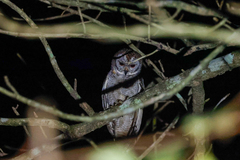
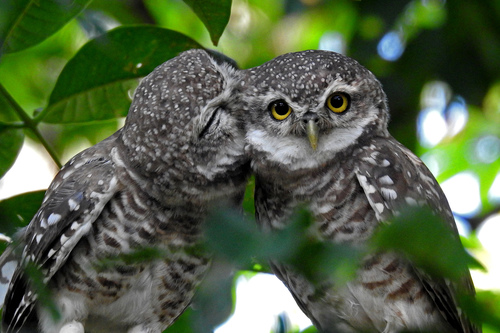
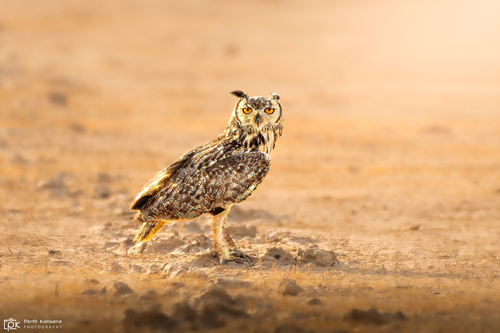
The mottled wood owl (Strix ocellata) is a species of large owl found in India and Nepal. They are found in gardens and thin deciduous forests adjacent to dry thorn forests or farmland. They are easily detected by their distinctive tremulous, eerie calls at dawn and dusk. The characteristic call is a duet of the male and female, while other notes include a low hoot and a screech. Their large size, lack of "ear" tufts and the concentric barring on the face make them easy to identify.

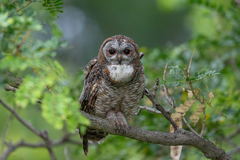
This large owl lacks ear tufts and is mottled and vermiculated in reddish brown and white. The face disc is marked with fine concentric black and white barring. The sexes are alike. The chin is white. The eyelid is orange, and the iris is dark brown. The tail is barred narrowly in brown and black. The concentric barring on the face and mottled crown separate it from the brown wood owl in southern India.

There are three subspecies recognized and there are no sharp demarcations in their distributions. Wikipedia →

Sounds

Call1:04

India · 2023

© Barry Edmonston · XC808577 · CC BY-NC-SA 4.0

Duet0:12

India · 2021

© Saswat Mishra · XC635070 · CC BY-NC-SA 4.0

Song0:19

India · 2019

© Ross Gallardy · XC454348 · CC BY-NC-SA 4.0

Global Distribution

Parks Where Found

# Park Country Daily sighting probability
1 Gir National Park 🇮🇳 India
~10%
2 Bandhavgarh National Park 🇮🇳 India
~10%
3 Royal Bardia National Park 🇳🇵 Nepal
<5%
4 Satpura National Park 🇮🇳 India
<5%
5 Kanha National Park 🇮🇳 India
<5%
6 Nagarhole National Park 🇮🇳 India
<5%

Cities Where Found

# City Country Daily sighting probability
1 Thrissur 🇮🇳 India
~20%
2 Chhatrapati Sambhajinagar 🇮🇳 India
~10%
3 Ponnani 🇮🇳 India
<5%
4 Bengaluru 🇮🇳 India
<5%
5 Lucknow 🇮🇳 India
<5%
6 Prayagraj 🇮🇳 India
<5%
7 Kozhikode 🇮🇳 India
<5%
8 Raipur 🇮🇳 India
<5%
9 Kochi 🇮🇳 India
<5%
10 Hyderabad 🇮🇳 India
<5%

Zoos & Centres Where Found

# Zoo / Centre Country
1 Nehru Zoological Park 🇮🇳 India In captivity
2 Mysore Zoo 🇮🇳 India In captivity

Before you go

What are the chances of seeing a Mottled Wood Owl in Royal Bardia National Park?

Rare

Under 5% of wildlife watchers report a Mottled Wood Owl sighting in Royal Bardia National Park on a given day, based on 16 verified sightings from GBIF citizen-science data from 2019 to 2026. It is the 170th most-seen of the 233 birds we can rate there. Over three days the chance rises to about 10%, and over a week to about 30%, if each day is a fresh chance.

When is the best time to see a Mottled Wood Owl in Royal Bardia National Park?

January, April–May, July and September

In those months about 10% of wildlife watchers report a Mottled Wood Owl in Royal Bardia National Park on a given day, against under 5% in February–March, June and October–December, the lowest months. August has too few records to rate.

What time of day is best to see a Mottled Wood Owl?

Between 7 and 10 am

Across all the parks we cover, that three-hour window holds the most Mottled Wood Owl sightings with a recorded time, and about 6 in 10 of them come between 6 am and 6 pm: it is most active around dawn and dusk.

Is Royal Bardia National Park the best place to see a Mottled Wood Owl?

3rd of 6

Of the 6 parks where we can rate Mottled Wood Owl sightings, Royal Bardia National Park ranks 3rd at under 5%. The best odds are in Gir National Park (India, about 10%) and Bandhavgarh National Park (India, about 10%).

Where does the Mottled Wood Owl sighting chance come from?

GBIF citizen-science records

It is estimated from how often the Mottled Wood Owl is recorded against all the birds logged in Royal Bardia National Park (16 verified sightings from 2019 to 2026), calibrated against known sighting rates. Figures are rounded to the nearest 10% because citizen-science data supports honest approximations, not decimals, and months with records from fewer than five people show "—". How it works.

← Back to Royal Bardia National Park