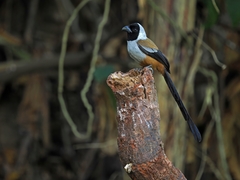
Collared Treepie

Collared Treepie

Dendrocitta frontalis

Silhouette: Sheatherius · PhyloPic

LCLeast ConcernNTVUENCR
Daily sighting probability ~10% · With luck
at Royal Manas National Park

In 3 days ~20% in a week ~30%

67 Verified sightings at Royal Manas National Park From 2019 to 2026
384 In all 2 parks
January Best month
🌅 Crepuscular When it's spotted

About the Collared Treepie

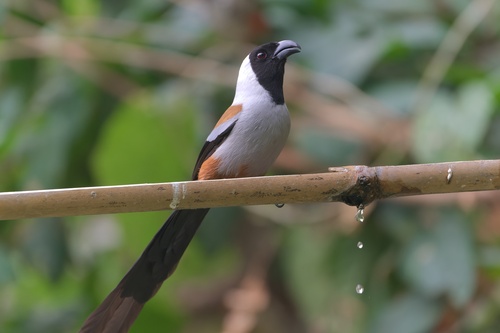
The collared treepie (Dendrocitta frontalis), also known as black-faced treepie or black-browed treepie, is an Asian treepie, a small perching bird of the crow family, Corvidae. This bird is slightly smaller than a blue jay and has the typical compact body and long tail of this group. The forehead, face and bib are black with the chest, neck and shoulders a light silvery or bluish-grey in color. The back is a warm chestnut brown with similar underparts. The wing coverts are white with the primaries and tail black.

It inhabits a broad band (though often very localized) from the north eastern Indian Himalayas, Bangladesh, Nepal and across into Burma (Myanmar) in hill forests often at quite high elevations. It feeds mainly on invertebrates of various types, and hawks for termites in flight; it also eats fruits and berries. It probably takes similar overall food types as the other treepies.

The nest is a small, neat structure often placed in bamboo clumps, small trees or bushes at the edge of a clearing. There are usually 3-5 eggs laid. The voice is described as varied but contains metallic notes as well as the chatter alarm call sounding similar to the other species. Wikipedia →
Sounds

Alarm call0:22

China · 2024

© Dave GUO · XC971283 · CC BY-NC-SA 4.0

Call0:09

India · 2024

© Lars Lachmann · XC881614 · CC BY-NC-SA 4.0

Song0:34

India

© Craig Robson · XC19251 · CC BY-NC-ND 2.5

Global Distribution

Parks Where Found

# Park Country Daily sighting probability
1 Namdapha National Park 🇮🇳 India
~20%
2 Royal Manas National Park 🇧🇹 Bhutan
~10%

Before you go

What are the chances of seeing a Collared Treepie in Royal Manas National Park?

With luck

About 10% of wildlife watchers report a Collared Treepie sighting in Royal Manas National Park on a given day, based on 67 verified sightings from GBIF citizen-science data from 2019 to 2026. It is the 194th most-seen of the 388 birds we can rate there. Over three days the chance rises to about 20%, and over a week to about 30%, if each day is a fresh chance.

When is the best time to see a Collared Treepie in Royal Manas National Park?

January

In that month about 20% of wildlife watchers report a Collared Treepie in Royal Manas National Park on a given day, against under 5% in February–April, June–July and October–November, the lowest months. That is one of Royal Manas National Park's driest months, with about 25 mm of rain against 930 mm in July. August and September have too few records to rate.

What time of day is best to see a Collared Treepie?

Between 1 and 4 am

Across all the parks we cover, that three-hour window holds the most Collared Treepie sightings with a recorded time, and about 6 in 10 of them come between 6 pm and 6 am: it is most active around dawn and dusk.

Is Royal Manas National Park the best place to see a Collared Treepie?

2nd of 2

Of the 2 parks where we can rate Collared Treepie sightings, Royal Manas National Park ranks 2nd at about 10%. The best odds are in Namdapha National Park (India, about 20%).

Where does the Collared Treepie sighting chance come from?

GBIF citizen-science records

It is estimated from how often the Collared Treepie is recorded against all the birds logged in Royal Manas National Park (67 verified sightings from 2019 to 2026), calibrated against known sighting rates. Figures are rounded to the nearest 10% because citizen-science data supports honest approximations, not decimals, and months with records from fewer than five people show "—". How it works.

← Back to Royal Manas National Park