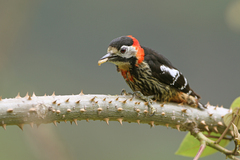
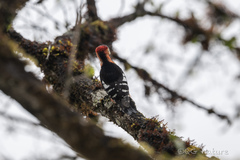
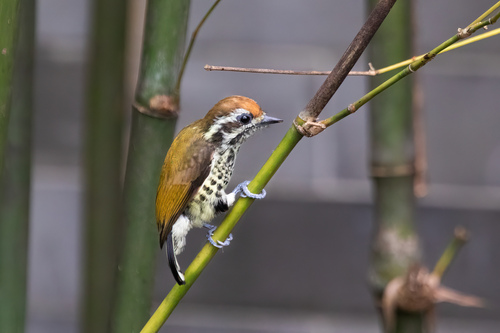
Crimson-breasted Woodpecker

Crimson-breasted Woodpecker

Dryobates cathpharius

Silhouette: Andy Wilson · PhyloPic

LCLeast ConcernNTVUENCR
Daily sighting probability <5% · Rare
at Royal Manas National Park

In 3 days <5% in a week ~10%

15 Verified sightings at Royal Manas National Park From 2019 to 2026
40 In all 2 parks
January Best month
☀️ Diurnal When it's spotted

About the Crimson-breasted Woodpecker

The crimson-naped woodpecker, crimson-breasted woodpecker or scarlet-breasted woodpecker (Dryobates cathpharius) is a species of bird in the family Picidae. It is found in Bhutan, China, India, Myanmar and Nepal. Its natural habitats are subtropical or tropical moist lowland forests and subtropical or tropical moist montane forests. It was previously considered conspecific with necklaced woodpecker.

The taxonomy of this species is somewhat confused. D. cathpharius is sometimes included with Dendrocopos pernyii as a single species, but the two have various amounts of red on head and breast and other distinguishing features, including size. In their Handbook of the Birds of the World Alive, del Hoyo, J. et al. recognises them as separate species. Molecular analysis puts both close to D. minor and D. pubescens.

The mantle, back and wings are black, with some white spotting and light barring on the wings and one... Wikipedia →

Sounds

Drumming1:08

China · 2026

© JJSUN · XC1085395 · CC BY-NC-SA 4.0

Call0:13

China · 2025

© Ding Li Yong · XC1017048 · CC BY-NC-ND 4.0

Song0:14

India · 2013

© Frank Lambert · XC157605 · CC BY-NC-ND 4.0

Global Distribution

Parks Where Found

# Park Country Daily sighting probability
1 Langtang National Park 🇳🇵 Nepal
~10%
2 Royal Manas National Park 🇧🇹 Bhutan
<5%

Before you go

What are the chances of seeing a Crimson-breasted Woodpecker in Royal Manas National Park?

Rare

Under 5% of wildlife watchers report a Crimson-breasted Woodpecker sighting in Royal Manas National Park on a given day, based on 15 verified sightings from GBIF citizen-science data from 2019 to 2026. It is the 298th most-seen of the 388 birds we can rate there. Over three days the chance rises to under 5%, and over a week to about 10%, if each day is a fresh chance.

When is the best time to see a Crimson-breasted Woodpecker in Royal Manas National Park?

January

In that month about 10% of wildlife watchers report a Crimson-breasted Woodpecker in Royal Manas National Park on a given day, against under 5% in February–July and October–December, the lowest months. That is one of Royal Manas National Park's driest months, with about 25 mm of rain against 930 mm in July. August and September have too few records to rate.

What time of day is best to see a Crimson-breasted Woodpecker?

Between 8 and 11 am

Across all the parks we cover, that three-hour window holds the most Crimson-breasted Woodpecker sightings with a recorded time, and about 8 in 10 of them come between 6 am and 6 pm: it is a daytime animal.

Is Royal Manas National Park the best place to see a Crimson-breasted Woodpecker?

2nd of 2

Of the 2 parks where we can rate Crimson-breasted Woodpecker sightings, Royal Manas National Park ranks 2nd at under 5%. The best odds are in Langtang National Park (Nepal, about 10%).

Which relatives of the Crimson-breasted Woodpecker live in Royal Manas National Park?

Same family: Picidae

The closest relatives of the Crimson-breasted Woodpecker that you can see in Royal Manas National Park (family Picidae, Woodpeckers) are Lesser Yellownape (about 30%), Grey-headed Woodpecker (about 20%) and Grey-capped Woodpecker (about 20%), with each one's daily chance of a sighting.

Where does the Crimson-breasted Woodpecker sighting chance come from?

GBIF citizen-science records

It is estimated from how often the Crimson-breasted Woodpecker is recorded against all the birds logged in Royal Manas National Park (15 verified sightings from 2019 to 2026), calibrated against known sighting rates. Figures are rounded to the nearest 10% because citizen-science data supports honest approximations, not decimals, and months with records from fewer than five people show "—". How it works.

← Back to Royal Manas National Park