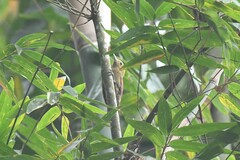
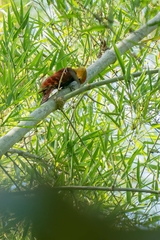

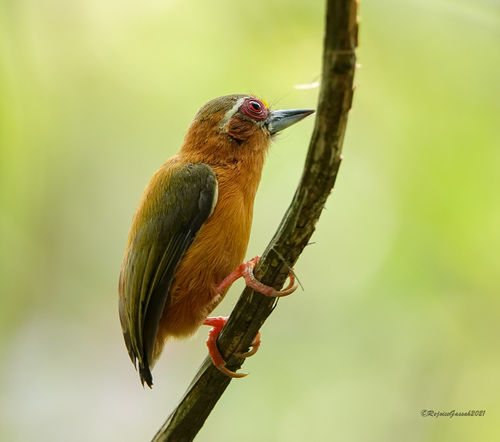
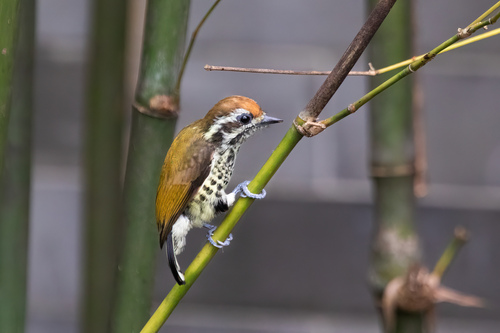
Pale-headed Woodpecker

Pale-headed Woodpecker

Gecinulus grantia

Silhouette: Pepe Reigada · PhyloPic

LCLeast ConcernNTVUENCR
Daily sighting probability ~10% · With luck
at Royal Manas National Park

In 3 days ~30% in a week ~60%

116 Verified sightings at Royal Manas National Park From 2019 to 2026
405 In all 3 parks
November Best month
☀️ Diurnal When it's spotted

About the Pale-headed Woodpecker

The pale-headed woodpecker (Gecinulus grantia) is a species of bird in the family Picidae. It is found in Bangladesh, Bhutan, China, India, Laos, Myanmar, Nepal, Thailand, and Vietnam. Its natural habitats are subtropical or tropical dry forests and subtropical or tropical moist lowland forests. It is a bamboo specialist, and a montane bird.

A molecular phylogenetic study published in 2017 found that the pale-headed woodpecker was embedded within the genus Dinopium and was a sister species to the olive-backed woodpecker (Dinopium rafflesii). Wikipedia →

Sounds

Call0:18

Vietnam · 2026

© Ding Li Yong · XC1106709 · CC BY-NC-ND 4.0

Drumming0:40

India · 2024

© Lars Lachmann · XC892489 · CC BY-NC-SA 4.0

Song0:29

Vietnam · 2010

© Hans Matheve · XC156781 · CC BY-NC-ND 3.0

Global Distribution

Parks Where Found

# Park Country Daily sighting probability
1 Cat Tien National Park 🇻🇳 Vietnam
~10%
2 Royal Manas National Park 🇧🇹 Bhutan
~10%
3 Namdapha National Park 🇮🇳 India
~10%

Before you go

What are the chances of seeing a Pale-headed Woodpecker in Royal Manas National Park?

With luck

About 10% of wildlife watchers report a Pale-headed Woodpecker sighting in Royal Manas National Park on a given day, based on 116 verified sightings from GBIF citizen-science data from 2019 to 2026. It is the 129th most-seen of the 388 birds we can rate there. Over three days the chance rises to about 30%, and over a week to about 60%, if each day is a fresh chance.

When is the best time to see a Pale-headed Woodpecker in Royal Manas National Park?

November

In that month about 30% of wildlife watchers report a Pale-headed Woodpecker in Royal Manas National Park on a given day, against under 5% in May, October and December, the lowest months. That is one of Royal Manas National Park's driest months, with about 15 mm of rain against 930 mm in July. August and September have too few records to rate.

What time of day is best to see a Pale-headed Woodpecker?

Between 3 and 6 pm

Across all the parks we cover, that three-hour window holds the most Pale-headed Woodpecker sightings with a recorded time, and about 9 in 10 of them come between 6 am and 6 pm: it is a daytime animal.

Is Royal Manas National Park the best place to see a Pale-headed Woodpecker?

Among the best

Of the 3 parks where we can rate Pale-headed Woodpecker sightings, Royal Manas National Park ranks 2nd at about 10%, level with the leaders once rounded. The best odds are in Cat Tien National Park (Vietnam, about 10%).

Which relatives of the Pale-headed Woodpecker live in Royal Manas National Park?

Same family: Picidae

The closest relatives of the Pale-headed Woodpecker that you can see in Royal Manas National Park (family Picidae, Woodpeckers) are Lesser Yellownape (about 30%), Grey-headed Woodpecker (about 20%) and Grey-capped Woodpecker (about 20%), with each one's daily chance of a sighting.

Where does the Pale-headed Woodpecker sighting chance come from?

GBIF citizen-science records

It is estimated from how often the Pale-headed Woodpecker is recorded against all the birds logged in Royal Manas National Park (116 verified sightings from 2019 to 2026), calibrated against known sighting rates. Figures are rounded to the nearest 10% because citizen-science data supports honest approximations, not decimals, and months with records from fewer than five people show "—". How it works.

← Back to Royal Manas National Park