Brown Babbler

Brown Babbler

Turdoides plebejus

Silhouette: Sheatherius · PhyloPic

LCLeast ConcernNTVUENCR
Daily sighting probability ~30% · Possible
at Saloum Delta National Park

In 3 days ~60% in a week ~90%

8 Verified sightings at Saloum Delta National Park From 2019 to 2026
439 In all 8 parks
February Best month
☀️ Diurnal When it's spotted

About the Brown Babbler

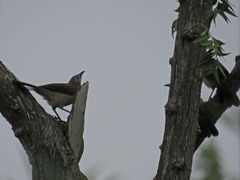
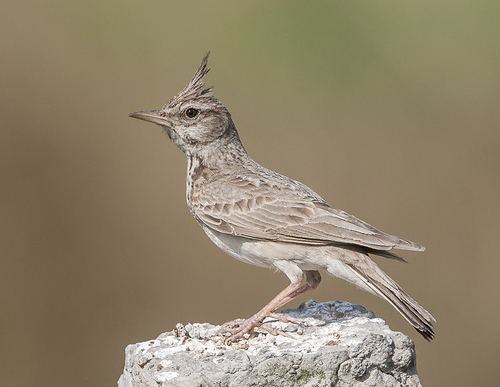
The brown babbler (Turdoides plebejus) is a species of bird in the family Leiothrichidae. It is predominantly found in West Africa, but ranging from the Gambia to Kenya. The species is common across its range. The species is also known as the Sudan babbler.

The brown babbler was described in 1828 by Philipp Jakob Cretzschmar from a specimen collected in the Kordofan Province of Sudan. He originally placed it in the bulbul genus Ixos. The species is closely related to and forms a superspecies with the white-headed babbler of eastern Sudan, Ethiopia and Eritrea, and the arrow-marked babbler of central and southern Africa. The Old World babbler family Timaliidae has been the subject of much research and has been split by some taxonomic authorities. This move would place this species with the laughingthrushes in the family Leiothrichidae.

There are three recognised subspecies, the nominate race, platycirca and cincera. A fourth subspecies, uamensis, is synonymized with cincera. The brown babbler is a medium-sized Turdoides babbler, measuring 22–25 centimetres (8.7–9.8 in) in length and weighs around 52–80 grams (1.8–2.8 oz). The plumage...

Wikipedia →

Sounds

Call0:41

Burkina Faso · 2026

© Marc Languy · XC1186955 · CC BY-NC-SA 4.0

Song0:22

Gambia · 2025

© Sven Kransel · XC1063331 · CC BY-NC-SA 4.0

Call0:54

Ghana · 2022

© Peter Boesman · XC719546 · CC BY-NC-ND 4.0

Global Distribution

Parks Where Found

# Park Country Daily sighting probability
1 Niokolo-Koba National Park 🇸🇳 Senegal
~50%
2 Saloum Delta National Park 🇸🇳 Senegal
~30%
3 Mole National Park 🇬🇭 Ghana
~20%
4 Kidepo Valley National Park 🇺🇬 Uganda
~20%
5 Murchison Falls National Park 🇺🇬 Uganda
~10%
6 Lake Mburo National Park 🇺🇬 Uganda
<5%
7 Queen Elizabeth National Park 🇺🇬 Uganda
<5%
8 Kibale National Park 🇺🇬 Uganda
<5%

Cities Where Found

# City Country Daily sighting probability
1 Accra 🇬🇭 Ghana
~30%
2 Maiduguri 🇳🇬 Nigeria
~30%
3 Ouagadougou 🇧🇫 Burkina Faso
~30%
4 Abuja 🇳🇬 Nigeria
~30%
5 Serrekunda 🇬🇲 Gambia
~20%
6 Cotonou 🇧🇯 Benin
~10%
7 Lomé 🇹🇬 Togo
~10%

Before you go

What are the chances of seeing a Brown Babbler in Saloum Delta National Park?

Possible

About 30% of wildlife watchers report a Brown Babbler sighting in Saloum Delta National Park on a given day, based on 8 verified sightings from GBIF citizen-science data from 2019 to 2026. It is the 47th most-seen of the 70 birds we can rate there. Over three days the chance rises to about 60%, and over a week to about 90%, if each day is a fresh chance.

What time of day is best to see a Brown Babbler?

Between 8 and 11 am

Across all the parks we cover, that three-hour window holds the most Brown Babbler sightings with a recorded time, and about 8 in 10 of them come between 6 am and 6 pm: it is a daytime animal.

Is Saloum Delta National Park the best place to see a Brown Babbler?

2nd of 8

Of the 8 parks where we can rate Brown Babbler sightings, Saloum Delta National Park ranks 2nd at about 30%. The best odds are in Niokolo-Koba National Park (Senegal, about 50%). All parks ranked.

Which relatives of the Brown Babbler live in Saloum Delta National Park?

Same order: Passeriformes

The closest relatives of the Brown Babbler that you can see in Saloum Delta National Park (order Passeriformes, Perching Birds) are Common Bulbul (about 50%), Pied Crow (about 50%) and Long-tailed Glossy Starling (about 40%), with each one's daily chance of a sighting.

Where does the Brown Babbler sighting chance come from?

GBIF citizen-science records

It is estimated from how often the Brown Babbler is recorded against all the birds logged in Saloum Delta National Park (8 verified sightings from 2019 to 2026), calibrated against known sighting rates. Figures are rounded to the nearest 10% because citizen-science data supports honest approximations, not decimals, and months with records from fewer than five people show "—". How it works.

← Back to Saloum Delta National Park