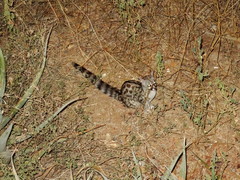
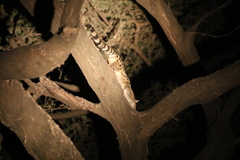
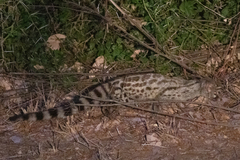
Central African Large-spotted Genet

Central African Large-spotted Genet

Genetta maculata

Daily sighting probability ~20% · Possible
at Samburu National Reserve

In 3 days ~50% in a week ~80%

9 Verified sightings at Samburu National Reserve From 2019 to 2026
251 In all 13 parks
November Best month
🌙 Nocturnal When it's spotted

About the Central African Large-spotted Genet

The rusty-spotted genet (Genetta maculata), also called panther genet and large-spotted genet, is a genet that is widely distributed in sub-Saharan Africa. It is considered common and therefore listed as Least Concern on the IUCN Red List.

The rusty-spotted genet has short whitish grey to pale yellow coloured fur with dark spots and a continuous dark line across the back. The spots of the upper two dorsal rows are round or square, brown in the center and darker outside. In head-to-body length it ranges from 42 to 52 cm (17 to 20 in). Its 40 to 53 cm (16 to 21 in) long tail is ringed and has a dark tip. Its feet are of the same colour as the fur. It weighs from 1.3 to 3 kg (2.9 to 6.6 lb).

Research in southeastern Nigeria revealed that the rusty-spotted genet has an omnivorous diet. It feeds on rodents like giant pouched rats (Cricetomys), Nigerian shrew (Crocidura nigeriae), Temminck's mouse (Mus musculoides), Tullberg's soft-furred mouse (Praomys tulbergi), Peters's striped mouse (Hybomys univittatus), typical striped grass mouse (Lemniscomys striatus), red-eyed dove (Streptopelia semitorquata), common agama (Agama agama), Mabuya skinks...

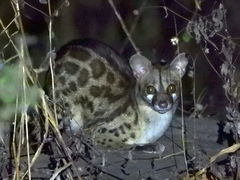
Wikipedia →

Global Distribution

Parks Where Found

# Park Country Daily sighting probability
1 Aberdare National Park 🇰🇪 Kenya
~70%
2 South Luangwa National Park 🇿🇲 Zambia
~40%
3 Liwonde National Park 🇲🇼 Malawi
~40%
4 Chinko Conservation Area 🇨🇫 Central African Republic
~30%
5 Kafue National Park 🇿🇲 Zambia
~30%
6 Samburu National Reserve 🇰🇪 Kenya
~20%
7 Tsavo West National Park 🇰🇪 Kenya
~20%
8 Kruger National Park 🇿🇦 South Africa
~20%
9 Murchison Falls National Park 🇺🇬 Uganda
~20%
10 Moremi Game Reserve 🇧🇼 Botswana
~10%
11 Masai Mara National Reserve 🇰🇪 Kenya
~10%
12 Hluhluwe-Imfolozi Park 🇿🇦 South Africa
~10%
13 iSimangaliso Wetland Park 🇿🇦 South Africa
~10%

Cities Where Found

# City Country Daily sighting probability
1 Durban 🇿🇦 South Africa
~10%

Before you go

What are the chances of seeing a Central African Large-spotted Genet in Samburu National Reserve?

Possible

About 20% of wildlife watchers report a Central African Large-spotted Genet sighting in Samburu National Reserve on a given day, based on 9 verified sightings from GBIF citizen-science data from 2019 to 2026. It is the 24th most-seen of the 27 mammals we can rate there. Over three days the chance rises to about 50%, and over a week to about 80%, if each day is a fresh chance.

When is the best time to see a Central African Large-spotted Genet in Samburu National Reserve?

January and November

In those months about 40% of wildlife watchers report a Central African Large-spotted Genet in Samburu National Reserve on a given day, against under 5% in February–March, May, July, October and December, the lowest months. Those are among Samburu National Reserve's wettest months, with about 55 mm of rain a month against 5 mm in September.

What time of day is best to see a Central African Large-spotted Genet?

Between 7 and 10 pm

Across all the parks we cover, that three-hour window holds the most Central African Large-spotted Genet sightings with a recorded time, and about 9 in 10 of them come between 6 pm and 6 am: it is mostly seen at night.

Where does the Central African Large-spotted Genet sighting chance come from?

GBIF citizen-science records

It is estimated from how often the Central African Large-spotted Genet is recorded against all the mammals logged in Samburu National Reserve (9 verified sightings from 2019 to 2026), calibrated against known sighting rates. Figures are rounded to the nearest 10% because citizen-science data supports honest approximations, not decimals, and months with records from fewer than five people show "—". How it works.

← Back to Samburu National Reserve