Günther's Dik-dik

Günther's Dik-dik

Madoqua guentheri

Silhouette: Kai Caspar · PhyloPic

LCLeast ConcernNTVUENCR
Daily sighting probability ~30% · Possible
at Samburu National Reserve

In 3 days ~70% in a week ~90%

21 Verified sightings at Samburu National Reserve From 2019 to 2026
21 In 1 park
September Best month
☀️ Diurnal When it's spotted

About the Günther's Dik-dik

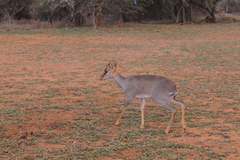
Günther's dik-dik (Madoqua guentheri) is a small antelope found in arid zones of East Africa. Günther's dik-dik is one of the smallest ungulates, weighing 3–5 kilograms (6.6–11.0 lb) when fully grown. It has a yellowish-gray to reddish-brown coat, black hooves, small heads with long necks and large ears with white insides. Belly, chin, breast, throat and inner thighs are cream or white. The tail is short (~3–5 cm). Males are horned, with horn length (~9.8 cm) varying between individuals. Although the horn cores are only present in males, gender identification can be difficult from a distance. Females are larger and lack horns.

Four subspecies have been proposed based on size and pelage features, but have not yet been analyzed genetically. The species is found in the lowlands of Ethiopia, most of the northern and eastern regions of Kenya, Somalia excluding specific regions of the coast, limited regions of southeastern Sudan, and northeastern Uganda. They avoid coastal regions. Typical habitat includes low thicket-type vegetation in thornbush, savanna grassland and riverine woodland biomes, and extends to disturbed and overgrazed areas... Wikipedia →

Global Distribution

Parks Where Found

# Park Country Daily sighting probability
1 Samburu National Reserve 🇰🇪 Kenya
~30%

More parks will be added in future updates.

Zoos & Centres Where Found

# Zoo / Centre Country
1 San Francisco Zoo 🇺🇸 United States In captivity
2 Cameron Park Zoo 🇺🇸 United States In captivity

Before you go

What are the chances of seeing a Günther's Dik-dik in Samburu National Reserve?

Possible

About 30% of wildlife watchers report a Günther's Dik-dik sighting in Samburu National Reserve on a given day, based on 21 verified sightings from GBIF citizen-science data from 2019 to 2026. It is the 19th most-seen of the 25 mammals we can rate there. Over three days the chance rises to about 70%, and over a week to about 90%, if each day is a fresh chance.

When is the best time to see a Günther's Dik-dik in Samburu National Reserve?

September

In that month about 60% of wildlife watchers report a Günther's Dik-dik in Samburu National Reserve on a given day, against under 5% in June, the lowest month. That is one of Samburu National Reserve's driest months, with about 5 mm of rain against 95 mm in April.

What time of day is best to see a Günther's Dik-dik?

Between 2 and 5 pm

Across all the parks we cover, that three-hour window holds the most Günther's Dik-dik sightings with a recorded time, and about 8 in 10 of them come between 6 am and 6 pm: it is a daytime animal.

Where else can you see a Günther's Dik-dik?

Only Samburu National Reserve, in our data

Samburu National Reserve is the only park on Wallace's Line with enough records to rate Günther's Dik-dik sightings: about 30% of wildlife watchers there report one on a given day.

Where does the Günther's Dik-dik sighting chance come from?

GBIF citizen-science records

It is estimated from how often the Günther's Dik-dik is recorded against all the mammals logged in Samburu National Reserve (21 verified sightings from 2019 to 2026), calibrated against known sighting rates. Figures are rounded to the nearest 10% because citizen-science data supports honest approximations, not decimals, and months with records from fewer than five people show "—". How it works.

← Back to Samburu National Reserve