
Golden Pipit

Golden Pipit

Tmetothylacus tenellus

Silhouette: Sheatherius · PhyloPic

LCLeast ConcernNTVUENCR
Daily sighting probability ~30% · Possible
at Samburu National Reserve

In 3 days ~70% in a week ~90%

379 Verified sightings at Samburu National Reserve From 2019 to 2026
943 In all 6 parks
April Best month
☀️ Diurnal When it's spotted

About the Golden Pipit

The golden pipit (Tmetothylacus tenellus) is a distinctive pipit of dry country grassland, savanna and shrubland in eastern Africa. It is native to Ethiopia, Kenya, Somalia, South Sudan, Tanzania and Uganda, and has occurred as a vagrant to Oman, South Africa and Zimbabwe.

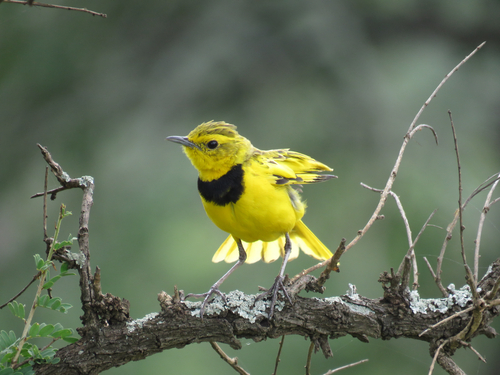
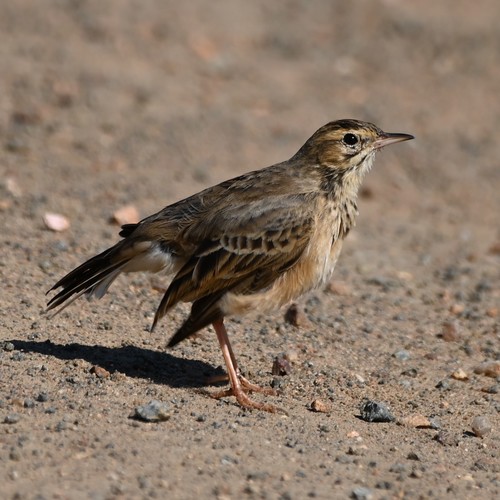
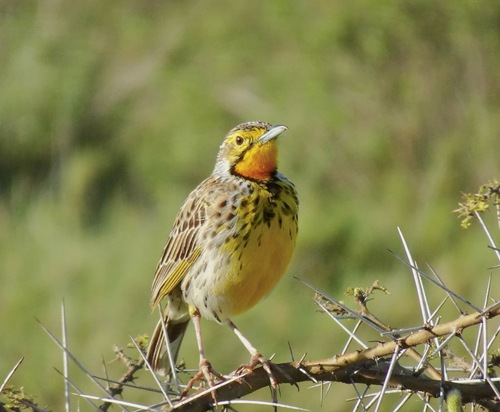
The adult male, unlike most pipits, is very easy to identify. It is yellow below and yellow in the wings. From the front the yellow throat and breast with the dark band does resemble the yellow-throated longclaw or Pangani longclaw, but neither have yellow wings (very obvious in flight) and both have a black line in the face. The female golden pipit is a fairly typical brown pipit but has a yellow underside to the wing.

It is gold in colour. Videos, photos and sounds - Internet Bird Collection Wikipedia →

Sounds

Call0:13

Kenya · 2024

© Peter Boesman · XC948509 · CC BY-NC-ND 4.0

Call0:13

Kenya · 2018

© Frank Lambert · XC455420 · CC BY-NC-ND 4.0

Global Distribution

Parks Where Found

# Park Country Daily sighting probability
1 Tsavo East National Park 🇰🇪 Kenya
~40%
2 Samburu National Reserve 🇰🇪 Kenya
~30%
3 Tsavo West National Park 🇰🇪 Kenya
~20%
4 Meru National Park 🇰🇪 Kenya
~10%
5 Mkomazi National Park 🇹🇿 Tanzania
<5%
6 Amboseli National Park 🇰🇪 Kenya
<5%

Before you go

What are the chances of seeing a Golden Pipit in Samburu National Reserve?

Possible

About 30% of wildlife watchers report a Golden Pipit sighting in Samburu National Reserve on a given day, based on 379 verified sightings from GBIF citizen-science data from 2019 to 2026. It is the 60th most-seen of the 341 birds we can rate there. Over three days the chance rises to about 70%, and over a week to about 90%, if each day is a fresh chance.

When is the best time to see a Golden Pipit in Samburu National Reserve?

February, April, August and October–November

In those months about 40% of wildlife watchers report a Golden Pipit in Samburu National Reserve on a given day, against about 10% in May, the lowest month. Those are among Samburu National Reserve's wettest months, with about 50 mm of rain a month against 5 mm in September.

What time of day is best to see a Golden Pipit?

Between 7 and 10 am

Across all the parks we cover, that three-hour window holds the most Golden Pipit sightings with a recorded time, and about 8 in 10 of them come between 6 am and 6 pm: it is a daytime animal.

Is Samburu National Reserve the best place to see a Golden Pipit?

2nd of 6

Of the 6 parks where we can rate Golden Pipit sightings, Samburu National Reserve ranks 2nd at about 30%. The best odds are in Tsavo East National Park (Kenya, about 40%).

Where does the Golden Pipit sighting chance come from?

GBIF citizen-science records

It is estimated from how often the Golden Pipit is recorded against all the birds logged in Samburu National Reserve (379 verified sightings from 2019 to 2026), calibrated against known sighting rates. Figures are rounded to the nearest 10% because citizen-science data supports honest approximations, not decimals, and months with records from fewer than five people show "—". How it works.

← Back to Samburu National Reserve