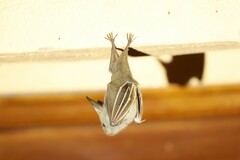
Heart-nosed bat

Heart-nosed bat

Cardioderma cor

Silhouette: T. Michael Keesey · PhyloPic

LCLeast ConcernNTVUENCR
Daily sighting probability ~20% · Possible
at Samburu National Reserve

In 3 days ~50% in a week ~80%

8 Verified sightings at Samburu National Reserve From 2019 to 2026
20 In all 2 parks
June Best month
☀️🌙 Day & Night When it's spotted

About the Heart-nosed bat

The heart-nosed bat (Cardioderma cor) is a species of bat in the family Megadermatidae. It is the only species within the genus Cardioderma. It is found in eastern Sudan, north Tanzania, and south Zambia. In an experiment conducted in 2017, it was concluded that heart-nosed bats emit vocalizations or "sing" as a way to establish their foraging areas and actively defend these territories from other bats of the same species.

The heart-nosed bat typically occupies areas that are in dry lowlands, coastal strips, and river valleys. Places of interest that the bats tend to gather in the daylight hours are abandoned buildings, dry caves, or baobab trees. They are also found living no higher than 940 meters or 3094 feet in elevation. Heart-nosed bats live in large colonies together, but they are very territorial and do not mingle with other bat species.

Heart-nosed bats weigh 21–35 g (0.74–1.23 oz) and are 70–77 mm (2.8–3.0 in) in length. Heart-nosed bats have blueish/grayish fur. Their fur also hangs off of their body and is considered to be long and loose. These bats have no tails, unlike most other species of bats. Some of the most recognizable features of... Wikipedia →

Global Distribution

Parks Where Found

# Park Country Daily sighting probability
1 Tsavo East National Park 🇰🇪 Kenya
~30%
2 Samburu National Reserve 🇰🇪 Kenya
~20%

Before you go

What are the chances of seeing a Heart-nosed bat in Samburu National Reserve?

Possible

About 20% of wildlife watchers report a Heart-nosed bat sighting in Samburu National Reserve on a given day, based on 8 verified sightings from GBIF citizen-science data from 2019 to 2026. It is the 23rd most-seen of the 25 mammals we can rate there. Over three days the chance rises to about 50%, and over a week to about 80%, if each day is a fresh chance.

When is the best time to see a Heart-nosed bat in Samburu National Reserve?

February and June

In those months about 40% of wildlife watchers report a Heart-nosed bat in Samburu National Reserve on a given day, against under 5% in January, March, May, July–August and October–November, the lowest months. Those are among Samburu National Reserve's driest months, with about 10 mm of rain a month against 95 mm in April.

What time of day is best to see a Heart-nosed bat?

Between 10 pm and 1 am

Across all the parks we cover, that three-hour window holds the most Heart-nosed bat sightings with a recorded time, and about half of them come between 6 pm and 6 am: it is seen both by day and at night.

Is Samburu National Reserve the best place to see a Heart-nosed bat?

2nd of 2

Of the 2 parks where we can rate Heart-nosed bat sightings, Samburu National Reserve ranks 2nd at about 20%. The best odds are in Tsavo East National Park (Kenya, about 30%).

Where does the Heart-nosed bat sighting chance come from?

GBIF citizen-science records

It is estimated from how often the Heart-nosed bat is recorded against all the mammals logged in Samburu National Reserve (8 verified sightings from 2019 to 2026), calibrated against known sighting rates. Figures are rounded to the nearest 10% because citizen-science data supports honest approximations, not decimals, and months with records from fewer than five people show "—". How it works.

← Back to Samburu National Reserve