
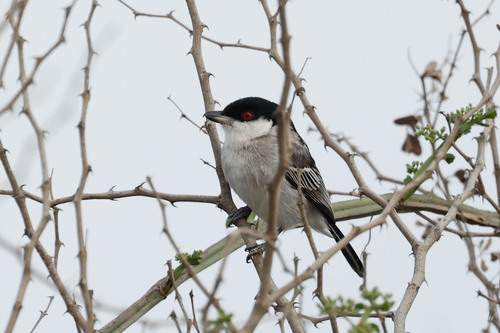
Three-streaked Tchagra

Three-streaked Tchagra

Tchagra jamesi

Silhouette: Sheatherius · PhyloPic

LCLeast ConcernNTVUENCR
Daily sighting probability ~10% · With luck
at Samburu National Reserve

In 3 days ~20% in a week ~40%

82 Verified sightings at Samburu National Reserve From 2019 to 2026
255 In all 5 parks
July Best month
☀️ Diurnal When it's spotted

About the Three-streaked Tchagra

The three-streaked tchagra (Tchagra jamesi) is a species of bird in the family Malaconotidae, which is an uncommon resident of semi-desert regions in the eastern Afrotropics. The binomial of this bird commemorates the explorer Frank Linsly James, who also had the Frank James Memorial Hospital built in his honour.

It is found in Ethiopia, Kenya, Somalia, South Sudan, Tanzania, and Uganda. Its natural habitats are dry savanna and subtropical or tropical dry shrubland. It is a small tchagra, measuring 16–17 cm from bill tip to tail tip. They are distinct from other tchagra species in having a narrow, black median stripe over the crown, without any superciliary stripe. In addition the tertials and rectrices are mouse-brown in colour.

The male displays by fripping the wings in flight, followed by a series of down-slurred whistles. They feed to a large extent on insects, but may in addition prey on chicks of other birds. Wikipedia →

Sounds

Call0:15

Kenya · 2018

© Frank Lambert · XC451534 · CC BY-NC-ND 4.0

Call0:27

Ethiopia · 2015

© Andrew Spencer · XC210001 · CC BY-NC-SA 4.0

Call0:14

Kenya · 2024

© Peter Boesman · XC948494 · CC BY-NC-ND 4.0

Global Distribution

Parks Where Found

# Park Country Daily sighting probability
1 Tsavo West National Park 🇰🇪 Kenya
~20%
2 Samburu National Reserve 🇰🇪 Kenya
~10%
3 Tsavo East National Park 🇰🇪 Kenya
~10%
4 Meru National Park 🇰🇪 Kenya
~10%
5 Kidepo Valley National Park 🇺🇬 Uganda
<5%

Before you go

What are the chances of seeing a Three-streaked Tchagra in Samburu National Reserve?

With luck

About 10% of wildlife watchers report a Three-streaked Tchagra sighting in Samburu National Reserve on a given day, based on 82 verified sightings from GBIF citizen-science data from 2019 to 2026. It is the 174th most-seen of the 341 birds we can rate there. Over three days the chance rises to about 20%, and over a week to about 40%, if each day is a fresh chance.

When is the best time to see a Three-streaked Tchagra in Samburu National Reserve?

July

In that month about 20% of wildlife watchers report a Three-streaked Tchagra in Samburu National Reserve on a given day, against under 5% in February–March, May and October, the lowest months. That is one of Samburu National Reserve's driest months, with about 10 mm of rain against 95 mm in April.

What time of day is best to see a Three-streaked Tchagra?

Between 8 and 11 am

Across all the parks we cover, that three-hour window holds the most Three-streaked Tchagra sightings with a recorded time, and about 8 in 10 of them come between 6 am and 6 pm: it is a daytime animal.

Is Samburu National Reserve the best place to see a Three-streaked Tchagra?

2nd of 5

Of the 5 parks where we can rate Three-streaked Tchagra sightings, Samburu National Reserve ranks 2nd at about 10%. The best odds are in Tsavo West National Park (Kenya, about 20%).

Which relatives of the Three-streaked Tchagra live in Samburu National Reserve?

Same family: Malaconotidae

The closest relatives of the Three-streaked Tchagra that you can see in Samburu National Reserve (family Malaconotidae, Bushshrikes and Allies) are Slate-colored Boubou (about 50%), Rosy-patched Bushshrike (about 50%) and Brubru (about 40%), with each one's daily chance of a sighting.

Where does the Three-streaked Tchagra sighting chance come from?

GBIF citizen-science records

It is estimated from how often the Three-streaked Tchagra is recorded against all the birds logged in Samburu National Reserve (82 verified sightings from 2019 to 2026), calibrated against known sighting rates. Figures are rounded to the nearest 10% because citizen-science data supports honest approximations, not decimals, and months with records from fewer than five people show "—". How it works.

← Back to Samburu National Reserve