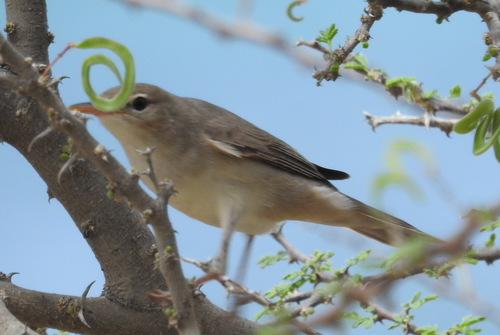
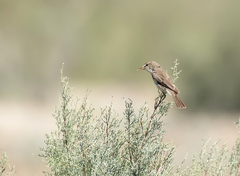
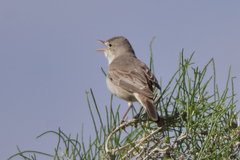
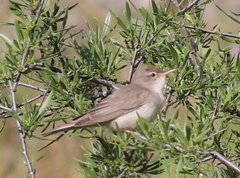
Upcher's Warbler

Upcher's Warbler

Hippolais languida

Silhouette: John Gerrard Keulemans · PhyloPic

LCLeast ConcernNTVUENCR
Daily sighting probability <5% · Rare
at Samburu National Reserve

In 3 days <5% in a week ~10%

13 Verified sightings at Samburu National Reserve From 2019 to 2026
134 In all 4 parks
January Best month
☀️ Diurnal When it's spotted

About the Upcher's Warbler

Upcher's warbler (Hippolais languida) is an Old World warbler in the tree warbler genus Hippolais. It breeds in an area from Turkey south and east to Pakistan. It is migratory, wintering in eastern Africa, from Eritrea and Somalia south to Tanzania.

This small passerine bird is a species found in semi-desert habitats, frequenting bushy scrub and thickets of tamarisk. Four or five eggs are laid in a nest in bushes and low trees. This is a medium-sized warbler, similar in size to the icterine warbler, with a slightly longer bill and shorter wings and a longer tail. Its frequent tail movement is reminiscent of a Sylvia warbler or a chat. Its rather grey plumage is similar to the olivaceous warbler, but tail movements are diagnostic.

It feeds on invertebrates. Its song is similar to that of other Hippolais warblers, but distinctive and unmistakable, and entirely different from that of the olivaceous warbler. Ehrenberg's original description of this bird was 'rather vague' and it was redescribed by Henry Baker Tristram in 1864, naming it Hippolais upcheri after his friend Henry Morris Upcher. This is the origin of the bird's common name. Wikipedia →

Sounds

Call1:04

Kenya · 2020

© isaac kilusu · XC615096 · CC BY-NC-SA 4.0

Song0:14

Armenia · 2019

© Dave Pullan · XC484843 · CC BY-NC-SA 4.0

Song1:08

Kenya · 2018

© Frank Lambert · XC468982 · CC BY-NC-ND 4.0

Global Distribution

Parks Where Found

# Park Country Daily sighting probability
1 Tsavo West National Park 🇰🇪 Kenya
~10%
2 Tsavo East National Park 🇰🇪 Kenya
<5%
3 Samburu National Reserve 🇰🇪 Kenya
<5%
4 Tarangire National Park 🇹🇿 Tanzania
<5%

Cities Where Found

# City Country Daily sighting probability
1 Riyadh 🇸🇦 Saudi Arabia
<5%
2 Kuwait City 🇰🇼 Kuwait
<5%
3 Doha 🇶🇦 Qatar
<5%
4 Abu Dhabi 🇦🇪 United Arab Emirates
<5%
5 Jerusalem 🇮🇱 Israel
<5%
6 Dubai 🇦🇪 United Arab Emirates
<5%

Before you go

What are the chances of seeing an Upcher's Warbler in Samburu National Reserve?

Rare

Under 5% of wildlife watchers report an Upcher's Warbler sighting in Samburu National Reserve on a given day, based on 13 verified sightings from GBIF citizen-science data from 2019 to 2026. It is the 287th most-seen of the 341 birds we can rate there. Over three days the chance rises to under 5%, and over a week to about 10%, if each day is a fresh chance.

When is the best time to see an Upcher's Warbler in Samburu National Reserve?

January

In that month about 10% of wildlife watchers report an Upcher's Warbler in Samburu National Reserve on a given day, against under 5% in February to December, the lowest months. That is one of Samburu National Reserve's driest months, with about 20 mm of rain against 95 mm in April.

What time of day is best to see an Upcher's Warbler?

Between 6 and 9 am

Across all the parks we cover, that three-hour window holds the most Upcher's Warbler sightings with a recorded time, and about 8 in 10 of them come between 6 am and 6 pm: it is a daytime animal.

Is Samburu National Reserve the best place to see an Upcher's Warbler?

3rd of 4

Of the 4 parks where we can rate Upcher's Warbler sightings, Samburu National Reserve ranks 3rd at under 5%. The best odds are in Tsavo West National Park (Kenya, about 10%) and Tsavo East National Park (Kenya, under 5%).

Where does the Upcher's Warbler sighting chance come from?

GBIF citizen-science records

It is estimated from how often the Upcher's Warbler is recorded against all the birds logged in Samburu National Reserve (13 verified sightings from 2019 to 2026), calibrated against known sighting rates. Figures are rounded to the nearest 10% because citizen-science data supports honest approximations, not decimals, and months with records from fewer than five people show "—". How it works.

← Back to Samburu National Reserve