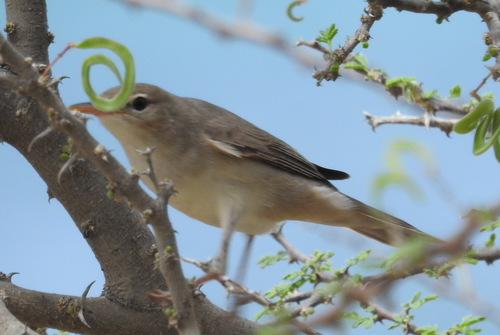
Olive-tree Warbler

Olive-tree Warbler

Hippolais olivetorum

Silhouette: John Gerrard Keulemans · PhyloPic

LCLeast ConcernNTVUENCR
Daily sighting probability <5% · Rare
at Samburu National Reserve

In 3 days <5%

6 Verified sightings at Samburu National Reserve From 2019 to 2026
125 In all 3 parks
February Best month
☀️ Diurnal When it's spotted

About the Olive-tree Warbler

The olive-tree warbler (Hippolais olivetorum) is a species of passerine bird in the family Acrocephalidae, the reed and tree warblers. It breeds in southeast Europe and the Near East. It is migratory, wintering in eastern and southern Africa, from Kenya south to South Africa.

The olive-tree warbler was first formally described as Salicaria olivetorum in 1837 by the English geologist, ornithologist, naturalist and systematist Hugh Strickland with its type locality given as Zante in the Ionian Islands, Western Greece. This species is now classified in the genus Hippolais, the tree warblers, within the family Acrocephalidae. All the "Old World warblers" were formerly classified within the wastebin taxon known as Sylviidae sensu lato but in the late 20th Century molecular studies resulted in this taxon being divided into a number of families.

The olive-tree warbler belongs to the genus Hippolais, this name is from Ancient Greek hupolais, as misspelt by Linnaeus. It referred to a small bird mentioned by Aristotle and others and may be onomatopoeic or derived from hupo,"under", and laas, "stone". The specific name olivetorum is Latin for "of the olive groves... Wikipedia →

Sounds

Song0:37

Croatia · 2025

© Domagoj Tomičić · XC1003183 · CC BY-NC-SA 4.0

Call0:15

Israel · 2016

© Heidi Vibe Frederiksen · XC336507 · CC BY-NC-SA 4.0

Song0:18

Zambia · 2024

© Dries Van de Loock · XC958793 · CC BY-NC-ND 4.0

Global Distribution

Parks Where Found

# Park Country Daily sighting probability
1 Tsavo West National Park 🇰🇪 Kenya
<5%
2 Kruger National Park 🇿🇦 South Africa
<5%
3 Samburu National Reserve 🇰🇪 Kenya
<5%

Cities Where Found

# City Country Daily sighting probability
1 Jerusalem 🇮🇱 Israel
~10%
2 Ramallah 🇵🇸 Palestine
<5%
3 Tel Aviv 🇮🇱 Israel
<5%

Before you go

What are the chances of seeing an Olive-tree Warbler in Samburu National Reserve?

Rare

Under 5% of wildlife watchers report an Olive-tree Warbler sighting in Samburu National Reserve on a given day, based on 6 verified sightings from GBIF citizen-science data from 2019 to 2026. It is the 333rd most-seen of the 341 birds we can rate there. Over three days the chance rises to under 5%, if each day is a fresh chance.

When is the best time to see an Olive-tree Warbler in Samburu National Reserve?

Any time of year

In every month with enough records, under 5% of wildlife watchers report an Olive-tree Warbler in Samburu National Reserve on a given day, so our monthly data shows no clear season.

What time of day is best to see an Olive-tree Warbler?

Between 7 and 10 am

Across all the parks we cover, that three-hour window holds the most Olive-tree Warbler sightings with a recorded time, and about 9 in 10 of them come between 6 am and 6 pm: it is a daytime animal.

Is Samburu National Reserve the best place to see an Olive-tree Warbler?

Among the best

Of the 3 parks where we can rate Olive-tree Warbler sightings, Samburu National Reserve ranks 3rd at under 5%, level with the leaders once rounded. The best odds are in Tsavo West National Park (Kenya, under 5%) and Kruger National Park (South Africa, under 5%).

Where does the Olive-tree Warbler sighting chance come from?

GBIF citizen-science records

It is estimated from how often the Olive-tree Warbler is recorded against all the birds logged in Samburu National Reserve (6 verified sightings from 2019 to 2026), calibrated against known sighting rates. Figures are rounded to the nearest 10% because citizen-science data supports honest approximations, not decimals, and months with records from fewer than five people show "—". How it works.

← Back to Samburu National Reserve