
Central American Rattlesnake

Central American Rattlesnake

Crotalus simus

Silhouette: Bill Bouton (source photo) & T. Michael Keesey (vectorization) · PhyloPic

LCLeast ConcernNTVUENCR
Daily sighting probability ~40% · Likely
at Santa Rosa National Park

In 3 days ~80% in a week >90%

39 Verified sightings at Santa Rosa National Park From 2019 to 2026
53 In all 3 parks
February Best month
☀️🌙 Day & Night When it's spotted

About the Central American Rattlesnake

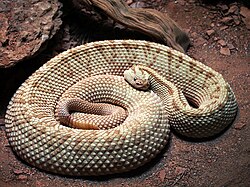
Common names: Middle American rattlesnake, Central American rattlesnake, tzabcan (local name for subspecies C. s. tzabcan) Crotalus simus is a venomous pit viper species found in Mexico and Central America. The specific epithet is Latin for "flat-nosed", likely because its head is blunt compared with lanceheads (Bothrops).

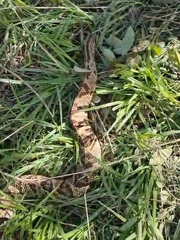
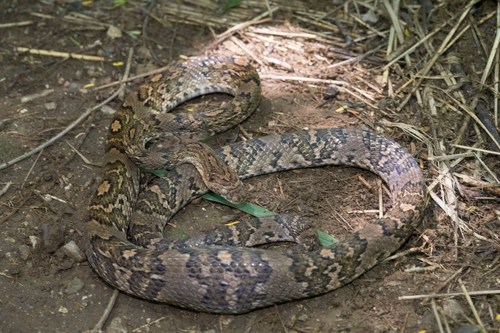
Adults commonly exceed 130 cm (51 in) in length, with males growing larger than females. Large males reach 140–160 cm (55–63 in) in some populations. The maximum length is 180 cm (71 in). The body has a rough appearance because the dorsal scale keels are accentuated into protuberances or tuberculations. This is most apparent on the scale rows on either side of the body with a decreasing intensity in the lower rows. The vertebral scales are about as prominently keeled as the fourth row down on the flanks (with the vertebral scales as the first row).

The species is found from Mexico in southwestern Michoacán on the Pacific coast, and Veracruz and the Yucatan Peninsula on the Atlantic coast, south through Belize, Guatemala, El Salvador, Honduras, and Nicaragua to west-central Costa Rica. It is absent from Panama, but apparently... Wikipedia →

Global Distribution

Parks Where Found

# Park Country Daily sighting probability
1 Santa Rosa National Park 🇨🇷 Costa Rica
~40%
2 Celaque National Park 🇭🇳 Honduras
~30%
3 Ostional Wildlife Refuge 🇨🇷 Costa Rica
~20%

Zoos & Centres Where Found

# Zoo / Centre Country
1 Zoológico de Brasília 🇧🇷 Brazil In captivity
2 Guadalajara Zoo 🇲🇽 Mexico In captivity
3 La Paz Waterfall Gardens 🇨🇷 Costa Rica In captivity
4 Safari Masai Mara 🇲🇽 Mexico In captivity
5 Zoológico Thomas Belt 🇳🇮 Nicaragua In captivity
6 Parque Zoológico Nacional Simón Bolívar 🇨🇷 Costa Rica In captivity
7 La Aurora Zoo 🇬🇹 Guatemala In captivity
8 Monteverde Theme Park 🇨🇷 Costa Rica In captivity
9 Zoológico Miguél Álvarez del Toro 🇲🇽 Mexico In captivity

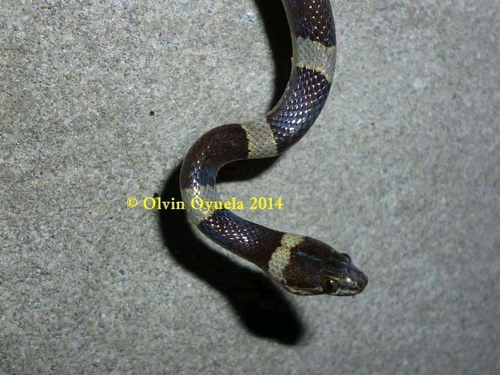
Closest Relatives at Santa Rosa National Park

Before you go

What are the chances of seeing a Central American Rattlesnake in Santa Rosa National Park?

Likely

About 40% of wildlife watchers report a Central American Rattlesnake sighting in Santa Rosa National Park on a given day, based on 39 verified sightings from GBIF citizen-science data from 2019 to 2026. It is the 5th most-seen of the 37 reptiles we can rate there. Over three days the chance rises to about 80%, and over a week to over 90%, if each day is a fresh chance.

When is the best time to see a Central American Rattlesnake in Santa Rosa National Park?

February

In that month about 60% of wildlife watchers report a Central American Rattlesnake in Santa Rosa National Park on a given day, against about 30% in March–April, July and October, the lowest months. That is one of Santa Rosa National Park's driest months, with almost no rain against 450 mm in October.

What time of day is best to see a Central American Rattlesnake?

Between 2 and 5 pm

Across all the parks we cover, that three-hour window holds the most Central American Rattlesnake sightings with a recorded time, and about 7 in 10 of them come between 6 am and 6 pm: it is seen both by day and at night.

Is Santa Rosa National Park the best place to see a Central American Rattlesnake?

Yes

Of the 3 parks where we can rate Central American Rattlesnake sightings, Santa Rosa National Park has the highest daily chance: about 40%. Next come Celaque National Park (Honduras, about 30%) and Ostional Wildlife Refuge (Costa Rica, about 20%).

Where does the Central American Rattlesnake sighting chance come from?

GBIF citizen-science records

It is estimated from how often the Central American Rattlesnake is recorded against all the reptiles logged in Santa Rosa National Park (39 verified sightings from 2019 to 2026), calibrated against known sighting rates. Figures are rounded to the nearest 10% because citizen-science data supports honest approximations, not decimals, and months with records from fewer than five people show "—". How it works.

← Back to Santa Rosa National Park