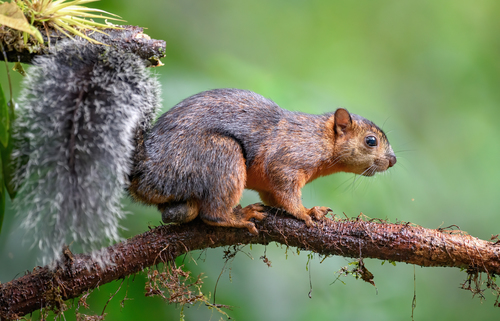
Salvin's Spiny Pocket Mouse

Salvin's Spiny Pocket Mouse

Liomys salvini

Silhouette: T. Michael Keesey · PhyloPic

Daily sighting probability ~20% · Possible
at Santa Rosa National Park

In 3 days ~40% in a week ~70%

6 Verified sightings at Santa Rosa National Park From 2019 to 2026
6 In 1 park
March Best month
☀️🌙 Day & Night When it's spotted

About the Salvin's Spiny Pocket Mouse

Salvin's spiny pocket mouse (Heteromys salvini) is a small to medium-sized rodent in the family Heteromyidae. It was formerly placed in the genus Liomys, which is now recognized to be paraphyletic and has been subsumed into Heteromys.

Like other pocket mice, it has external, fur-lined pouches in its cheeks for carrying seeds and other materials. Although the darkness of the fur can vary quite a bit geographically, it is always grey or grey-brown dorsally with cream-colored underparts, forelegs, and feet. The darker dorsal fur is meshed with dark spiny hairs and lighter, cream-colored hairs. The tail is approximately equal to the body length, bi-color, and nearly hairless (although it may have a short terminal hair cluster). In regions of overlap, H. salvini can be distinguished from other species by the lack of orange side stripes and a lack of dark forelimbs.

Head and body length: 103–140 mm (4.1–5.5 in) Tail length: 97–144 mm (3.8–5.7 in) Hind foot length: 26–30 mm (1.0–1.2 in) Ear length: 12–16 mm (0.47–0.63 in) It occupies much of the Pacific coast and adjacent mountains of Central America (from Costa Rica to Guatemala... Wikipedia →


Global Distribution

Parks Where Found

# Park Country Daily sighting probability
1 Santa Rosa National Park 🇨🇷 Costa Rica
~20%

More parks will be added in future updates.

Before you go

What are the chances of seeing a Salvin's Spiny Pocket Mouse in Santa Rosa National Park?

Possible

About 20% of wildlife watchers report a Salvin's Spiny Pocket Mouse sighting in Santa Rosa National Park on a given day, based on 6 verified sightings from GBIF citizen-science data from 2019 to 2026. It is the 12th most-seen of the 17 mammals we can rate there. Over three days the chance rises to about 40%, and over a week to about 70%, if each day is a fresh chance.

When is the best time to see a Salvin's Spiny Pocket Mouse in Santa Rosa National Park?

March

In that month about 30% of wildlife watchers report a Salvin's Spiny Pocket Mouse in Santa Rosa National Park on a given day, against under 5% in May, August–September and November–January, the lowest months. That is one of Santa Rosa National Park's driest months, with about 10 mm of rain against 450 mm in October.

What time of day is best to see a Salvin's Spiny Pocket Mouse?

Between 7 and 10 pm

Across all the parks we cover, that three-hour window holds the most Salvin's Spiny Pocket Mouse sightings with a recorded time, and about 6 in 10 of them come between 6 pm and 6 am: it is seen both by day and at night.

Where else can you see a Salvin's Spiny Pocket Mouse?

Only Santa Rosa National Park, in our data

Santa Rosa National Park is the only park on Wallace's Line with enough records to rate Salvin's Spiny Pocket Mouse sightings: about 20% of wildlife watchers there report one on a given day.

Which relatives of the Salvin's Spiny Pocket Mouse live in Santa Rosa National Park?

Same order: Rodentia

The closest relatives of the Salvin's Spiny Pocket Mouse that you can see in Santa Rosa National Park (order Rodentia, Rodents) are Central American Agouti (about 60%), Big-eared Climbing Rat (about 30%) and Variegated Squirrel (about 20%), with each one's daily chance of a sighting.

Where does the Salvin's Spiny Pocket Mouse sighting chance come from?

GBIF citizen-science records

It is estimated from how often the Salvin's Spiny Pocket Mouse is recorded against all the mammals logged in Santa Rosa National Park (6 verified sightings from 2019 to 2026), calibrated against known sighting rates. Figures are rounded to the nearest 10% because citizen-science data supports honest approximations, not decimals, and months with records from fewer than five people show "—". How it works.

← Back to Santa Rosa National Park