
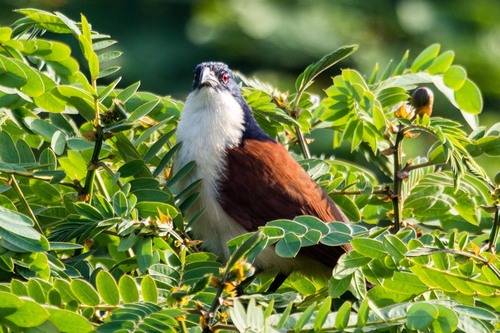
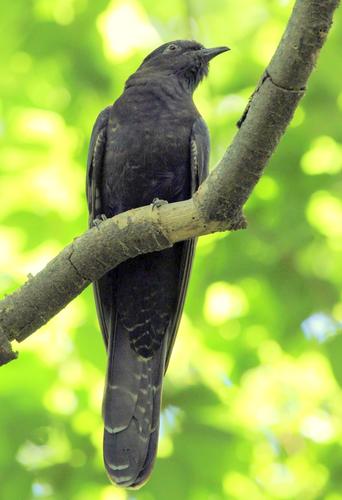
Dusky Long-tailed Cuckoo

Dusky Long-tailed Cuckoo

Cercococcyx mechowi

Silhouette: Nicolas Huet le Jeune and Jean-Gabriel Prêtre (vectorized by T. Michael Keesey) · PhyloPic

LCLeast ConcernNTVUENCR
Daily sighting probability ~30% · Possible
at Semuliki National Park

In 3 days ~60% in a week ~90%

123 Verified sightings at Semuliki National Park From 2019 to 2026
778 In all 3 parks
December Best month
☀️ Diurnal When it's spotted

About the Dusky Long-tailed Cuckoo

The dusky long-tailed cuckoo (Cercococcyx mechowi) is a species of cuckoo in the family Cuculidae. It is found in forests in Central Africa. The IUCN has assessed it as a least-concern species. The species was described by Jean Cabanis in 1882. It is monotypic. The specific epithet mechowi honours Friedrich Wilhelm Alexander von Mechow, a Prussian explorer. The name occidentalis for a population with different songs is a nomen nudum.

The dusky long-tailed cuckoo is about 33 cm (13 in) long and weighs 50–61 g (1.8–2.2 oz). The head, nape and upperparts are dark brown, washed sooty-grey and with a purple-blue iridescence. The wings are dark brown, with buff and white spots. The underparts are white, with blackish-brown bars, and the vent is buff. The tail is long and graduated. The eyes are dark brown, the beak is greenish-black and the feet are yellow. The male and female are alike. The juvenile bird has a blackish throat and rufous bars on its upperparts. The nestling's skin is black, and it has a yellow rump and pale feet.

This cuckoo has a discontinuous distribution and is found in Angola, most of Cameroon, the Central... Wikipedia →

Sounds

Song0:29

Uganda · 2026

© isaac kilusu · XC1142033 · CC BY-NC-SA 4.0

Call0:09

Sierra Leone · 2022

© Brendan Sloan · XC912830 · CC BY-NC-ND 4.0

Uncertain1:04

Gabon · 2021

© BurBenj · XC681707 · CC BY-NC-SA 4.0

Global Distribution

Parks Where Found

# Park Country Daily sighting probability
1 Semuliki National Park 🇺🇬 Uganda
~30%
2 Kibale National Park 🇺🇬 Uganda
~20%
3 Bwindi Impenetrable National Park 🇺🇬 Uganda
~20%

Before you go

What are the chances of seeing a Dusky Long-tailed Cuckoo in Semuliki National Park?

Possible

About 30% of wildlife watchers report a Dusky Long-tailed Cuckoo sighting in Semuliki National Park on a given day, based on 123 verified sightings from GBIF citizen-science data from 2019 to 2026. It is the 54th most-seen of the 280 birds we can rate there. Over three days the chance rises to about 60%, and over a week to about 90%, if each day is a fresh chance.

When is the best time to see a Dusky Long-tailed Cuckoo in Semuliki National Park?

December

In that month about 60% of wildlife watchers report a Dusky Long-tailed Cuckoo in Semuliki National Park on a given day, against about 10% in July and August, the lowest months. That is one of Semuliki National Park's driest months, with about 40 mm of rain against 140 mm in May.

What time of day is best to see a Dusky Long-tailed Cuckoo?

Between 8 and 11 am

Across all the parks we cover, that three-hour window holds the most Dusky Long-tailed Cuckoo sightings with a recorded time, and nearly all of them come between 6 am and 6 pm: it is a daytime animal.

Is Semuliki National Park the best place to see a Dusky Long-tailed Cuckoo?

Yes

Of the 3 parks where we can rate Dusky Long-tailed Cuckoo sightings, Semuliki National Park has the highest daily chance: about 30%. Next come Kibale National Park (Uganda, about 20%) and Bwindi Impenetrable National Park (Uganda, about 20%).

Which relatives of the Dusky Long-tailed Cuckoo live in Semuliki National Park?

Same family: Cuculidae

The closest relatives of the Dusky Long-tailed Cuckoo that you can see in Semuliki National Park (family Cuculidae, Cuckoos) are Yellow-throated Cuckoo (about 40%), Red-chested Cuckoo (about 30%) and African Emerald Cuckoo (about 30%), with each one's daily chance of a sighting.

Where does the Dusky Long-tailed Cuckoo sighting chance come from?

GBIF citizen-science records

It is estimated from how often the Dusky Long-tailed Cuckoo is recorded against all the birds logged in Semuliki National Park (123 verified sightings from 2019 to 2026), calibrated against known sighting rates. Figures are rounded to the nearest 10% because citizen-science data supports honest approximations, not decimals, and months with records from fewer than five people show "—". How it works.

← Back to Semuliki National Park