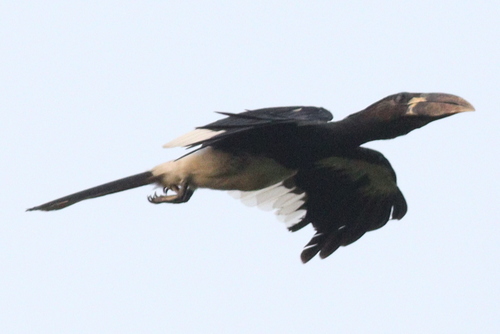
Spot-breasted Ibis

Spot-breasted Ibis

Bostrychia rara

Silhouette: Sheatherius · PhyloPic

LCLeast ConcernNTVUENCR
Daily sighting probability <5% · Rare
at Semuliki National Park

In 3 days <5% in a week ~10%

6 Verified sightings at Semuliki National Park From 2019 to 2026
6 In 1 park
January Best month
☀️ Diurnal When it's spotted

About the Spot-breasted Ibis

The spot-breasted ibis (Bostrychia rara) is a small, forest-dwelling ibis found in African lowland forests and swampy forested areas. Its preference for dense rainforests in tropical Africa means that it is seldom seen and is vulnerable to deforestation.

The spot-breasted ibis is a small, dark ibis (around 47 cm (19 in)), with long legs and a long red bill. The adult has a long, loose crest at the back of its head, which is dark brown to black and glossy green. Its plumage varies, but most usually tends to be brownish-blue. The mantle is brown and edged buff, but with a shiny green color. The rump and tail are blue-green, and the tail is slightly blue-green. It has blue-black wings and black underwing. The scapulars and the inner secondaries have an iridescent bronze green.

The best distinguishing feature is suggested by its name: the buff-spotted neck, breast and belly that are used as a diagnostic tool to identify the species. Otherwise, the upperparts are uniformly dark, with turquoise green spots in front of and behind the eyes (smaller in females); a similar colored streak crosses the face in line with the bill.

Their wing length is 270–290 mm, their bill length... Wikipedia →

Sounds

Flight call0:15

Congo (Democratic Republic) · 2023

© Deville Tanguy · XC824109 · CC BY-NC-SA 4.0

Call0:24

Zambia · 2019

© Peter Boesman · XC508738 · CC BY-NC-ND 4.0

Flight call0:11

Zambia · 2020

© Dries Van de Loock · XC581108 · CC BY-NC-SA 4.0

Global Distribution

Parks Where Found

# Park Country Daily sighting probability
1 Semuliki National Park 🇺🇬 Uganda
<5%

More parks will be added in future updates.

Before you go

What are the chances of seeing a Spot-breasted Ibis in Semuliki National Park?

Rare

Under 5% of wildlife watchers report a Spot-breasted Ibis sighting in Semuliki National Park on a given day, based on 6 verified sightings from GBIF citizen-science data from 2019 to 2026. It is the 259th most-seen of the 280 birds we can rate there. Over three days the chance rises to under 5%, and over a week to about 10%, if each day is a fresh chance.

When is the best time to see a Spot-breasted Ibis in Semuliki National Park?

January

In that month about 10% of wildlife watchers report a Spot-breasted Ibis in Semuliki National Park on a given day, against under 5% in February to December, the lowest months. That is one of Semuliki National Park's driest months, with about 5 mm of rain against 140 mm in May.

What time of day is best to see a Spot-breasted Ibis?

Between 10 am and 1 pm

Across all the parks we cover, that three-hour window holds the most Spot-breasted Ibis sightings with a recorded time, and about 8 in 10 of them come between 6 am and 6 pm: it is a daytime animal.

Where else can you see a Spot-breasted Ibis?

Only Semuliki National Park, in our data

Semuliki National Park is the only park on Wallace's Line with enough records to rate Spot-breasted Ibis sightings: under 5% of wildlife watchers there report one on a given day.

Where does the Spot-breasted Ibis sighting chance come from?

GBIF citizen-science records

It is estimated from how often the Spot-breasted Ibis is recorded against all the birds logged in Semuliki National Park (6 verified sightings from 2019 to 2026), calibrated against known sighting rates. Figures are rounded to the nearest 10% because citizen-science data supports honest approximations, not decimals, and months with records from fewer than five people show "—". How it works.

← Back to Semuliki National Park