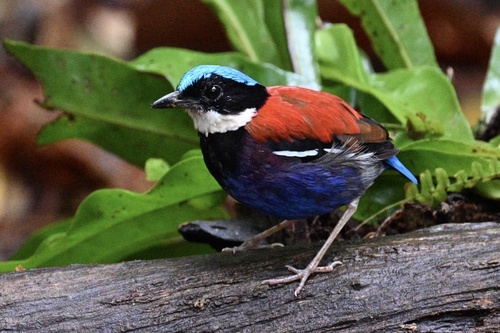
Black-headed Pitta

Black-headed Pitta

Erythropitta ussheri

Silhouette: Prin Pattawaro (photo), John E. McCormack, Michael G. Harvey, Brant C. Faircloth, Nicholas G. Crawford, Travis C. Glenn, Robb T. Brumfield & T. Michael Keesey · PhyloPic

LCLeast ConcernNTVUENCR Endemic
Daily sighting probability ~30% · Possible
at Sepilok

In 3 days ~70% in a week ~90%

908 Verified sightings at Sepilok From 2019 to 2026
1,734 In all 3 parks
October Best month
🌅 Crepuscular When it's spotted

About the Black-headed Pitta

The black-crowned pitta (Erythropitta ussheri), also known as the black-headed pitta, black-and-crimson pitta, black-and-scarlet pitta or black-crowned garnet pitta, is a brightly coloured, ground-dwelling, bird species in the pitta family Pittidae. It is endemic to the Southeast Asian island of Borneo.

The black-crowned pitta was formally described in 1877 by the English ornithologist John Gould based on specimens that had been collected near the Lawas River in northern Borneo and sent to London by the British colonial administrator Herbert Taylor Ussher. Gould used the binomial name Pitta ussheri with the specific epithet chosen to honour Ussher who had supplied the specimens. The English ornithologist Richard Bowdler Sharpe published a description later in the same year. The black-crowned pitta is now one of 13 species placed in the genus Erythropitta that was introduced in 1854 by the French naturalist Charles Lucien Bonaparte. The species is monotypic: no subspecies are recognised.

The pitta was formerly considered a subspecies of the garnet pitta (Erythropitta granatina) but was split because of morphological and vocal differences as well as apparent parapatry.... Wikipedia →

Sounds

Call0:25

Malaysia · 2022

© Wai Loon Wong · XC774912 · CC BY-NC-SA 4.0

Song0:41

Malaysia · 2008

© Hans Matheve · XC520246 · CC BY-NC-ND 4.0

Song1:05

Malaysia · 2017

© Peter Boesman · XC359728 · CC BY-NC-ND 4.0

Global Distribution

Parks Where Found

# Park Country Daily sighting probability
1 Danum Valley Conservation Area 🇲🇾 Malaysia
~40%
2 Sepilok 🇲🇾 Malaysia
~30%
3 Kinabatangan Wildlife Sanctuary 🇲🇾 Malaysia
<5%

Before you go

What are the chances of seeing a Black-headed Pitta in Sepilok?

Possible

About 30% of wildlife watchers report a Black-headed Pitta sighting in Sepilok on a given day, based on 908 verified sightings from GBIF citizen-science data from 2019 to 2026. It is the 26th most-seen of the 242 birds we can rate there. Over three days the chance rises to about 70%, and over a week to about 90%, if each day is a fresh chance.

When is the best time to see a Black-headed Pitta in Sepilok?

July–August, October and December

In those months about 40% of wildlife watchers report a Black-headed Pitta in Sepilok on a given day, against about 20% in April, the lowest month.

What time of day is best to see a Black-headed Pitta?

Between 1 and 4 am

Across all the parks we cover, that three-hour window holds the most Black-headed Pitta sightings with a recorded time, and about half of them come between 6 am and 6 pm: it is most active around dawn and dusk.

Is Sepilok the best place to see a Black-headed Pitta?

2nd of 3

Of the 3 parks where we can rate Black-headed Pitta sightings, Sepilok ranks 2nd at about 30%. The best odds are in Danum Valley Conservation Area (Malaysia, about 40%).

Where does the Black-headed Pitta sighting chance come from?

GBIF citizen-science records

It is estimated from how often the Black-headed Pitta is recorded against all the birds logged in Sepilok (908 verified sightings from 2019 to 2026), calibrated against known sighting rates. Figures are rounded to the nearest 10% because citizen-science data supports honest approximations, not decimals, and months with records from fewer than five people show "—". How it works.

← Back to Sepilok