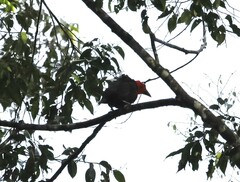
Bornean Bristlehead

Bornean Bristlehead

Pityriasis gymnocephala

Silhouette: Sheatherius · PhyloPic

LCNTVUVulnerableENCR
Daily sighting probability ~10% · With luck
at Sepilok

In 3 days ~30% in a week ~60%

270 Verified sightings at Sepilok From 2019 to 2026
606 In all 2 parks
January Best month
☀️ Diurnal When it's spotted

About the Bornean Bristlehead

The Bornean bristlehead (Pityriasis gymnocephala), also variously known as the bristled shrike, bald-headed crow or the bald-headed wood-shrike, is the only member of the passerine family Pityriasidae and genus Pityriasis. This enigmatic and vulnerable species is endemic to the southeast Asian island of Borneo, where it lives in small groups in the rainforest canopy.

The relationships of this species have been controversial. At times it has been placed in the Prionopidae, the Cracticidae, the Artamidae or the Corvidae. A more recent suggestion has been to include it in the Tephrodornithidae, a new family that includes Hemipus and Tephrodornis.

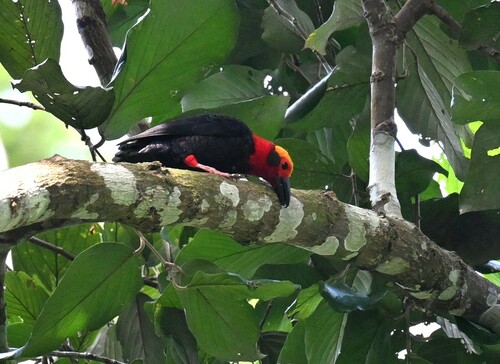
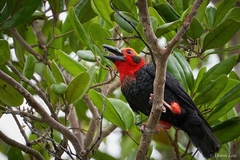
The Bornean bristlehead is a medium-sized bird, c. 25 cm (9.8 in) in length. It is mostly black, with bright red thighs, head, throat and neck, and grey ear-coverts. The featherless crown is deep yellow and covered in short, 3–4 mm long, bristle-like skin projections, giving it a bald appearance from afar. This gives the species its common name "bristlehead", genus name Pityriasis (from Greek, "having dandruff") and specific name gymnocephala (from Greek, "bald-headed"). Red flank patches are present in all females... Wikipedia →
Sounds

Call0:49

Malaysia · 2019

© Kinsy Sekina · XC501703 · CC BY-NC-SA 4.0

Song0:27

Malaysia · 2011

© David Edwards · XC86943 · CC BY-NC-SA 3.0

Call0:54

Malaysia · 2015

© Marc Anderson · XC266100 · CC BY-NC-ND 4.0

Global Distribution

Parks Where Found

# Park Country Daily sighting probability
1 Danum Valley Conservation Area 🇲🇾 Malaysia
~20%
2 Sepilok 🇲🇾 Malaysia
~10%

Before you go

What are the chances of seeing a Bornean Bristlehead in Sepilok?

With luck

About 10% of wildlife watchers report a Bornean Bristlehead sighting in Sepilok on a given day, based on 270 verified sightings from GBIF citizen-science data from 2019 to 2026. It is the 100th most-seen of the 242 birds we can rate there. Over three days the chance rises to about 30%, and over a week to about 60%, if each day is a fresh chance.

When is the best time to see a Bornean Bristlehead in Sepilok?

January

In that month about 30% of wildlife watchers report a Bornean Bristlehead in Sepilok on a given day, against under 5% in June, the lowest month.

What time of day is best to see a Bornean Bristlehead?

Between 7 and 10 am

Across all the parks we cover, that three-hour window holds the most Bornean Bristlehead sightings with a recorded time, and about 9 in 10 of them come between 6 am and 6 pm: it is a daytime animal.

Is Sepilok the best place to see a Bornean Bristlehead?

2nd of 2

Of the 2 parks where we can rate Bornean Bristlehead sightings, Sepilok ranks 2nd at about 10%. The best odds are in Danum Valley Conservation Area (Malaysia, about 20%).

Which relatives of the Bornean Bristlehead live in Sepilok?

Same order: Passeriformes

The closest relatives of the Bornean Bristlehead that you can see in Sepilok (order Passeriformes, Perching Birds) are Ashy Tailorbird (about 60%), Red-eyed Bulbul (about 50%) and Asian Glossy Starling (about 50%), with each one's daily chance of a sighting.

Where does the Bornean Bristlehead sighting chance come from?

GBIF citizen-science records

It is estimated from how often the Bornean Bristlehead is recorded against all the birds logged in Sepilok (270 verified sightings from 2019 to 2026), calibrated against known sighting rates. Figures are rounded to the nearest 10% because citizen-science data supports honest approximations, not decimals, and months with records from fewer than five people show "—". How it works.

← Back to Sepilok