Wrentit

Wrentit

Chamaea fasciata

Silhouette: Sheatherius · PhyloPic

LCLeast ConcernNTVUENCR
Daily sighting probability ~10% · With luck
at Sequoia and Kings Canyon National Parks

In 3 days ~10% in a week ~30%

89 Verified sightings at Sequoia and Kings Canyon National Parks From 2019 to 2026
1,099 In all 4 parks
April Best month
☀️ Diurnal When it's spotted

About the Wrentit

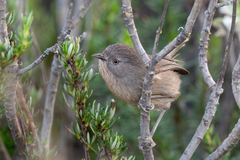
The wrentit (Chamaea fasciata) is a small bird that lives in chaparral, oak woodlands, and bushland on the western coast of North America, from Oregon south through California to northern Baja California. It is the only species in the genus Chamaea.

Its systematics have been the subject of much debate, the wrentit having been placed in many different families by different authors for as long as it has been known to science. Its common name reflects the uncertainty, and its external resemblance to both tits and wrens. It is not related to either, however. More recent and comprehensive phylogenetic studies support it belonging to the parrotbill family Paradoxornithidae.

The wrentit is a small, 14–16 cm (5.5–6.3 in) bird with uniform dull olive, brown, or grayish plumage. It has short wings and a long tail often held high (hence the comparison to wrens). It has a short bill and a pale iris. Given its retiring nature and loud voice, the wrentit is more likely to be detected by its call than by sight. The distinct sound that it makes is similar to the sound of a ping-pong ball falling on the table.

The wrentit when first described by William Gambel in... Wikipedia →

Sounds

Alarm call1:26

United States · 2023

© Thomas G. Graves · XC817097 · CC BY-NC-SA 4.0

Duet0:25

United States · 2021

© Denise Wight · XC698635 · CC BY-NC-SA 4.0

Song0:20

United States · 2021

© Paul Marvin · XC634664 · CC BY-NC-SA 4.0

Global Distribution

Parks Where Found

# Park Country Daily sighting probability
1 Redwood National Park 🇺🇸 United States
~30%
2 Sequoia and Kings Canyon National Parks 🇺🇸 United States
~10%
3 Channel Islands National Park 🇺🇸 United States
<5%
4 Yosemite National Park 🇺🇸 United States
<5%

Cities Where Found

# City Country Daily sighting probability
1 San Diego 🇺🇸 United States
~20%
2 Los Angeles 🇺🇸 United States
~10%
3 San Francisco 🇺🇸 United States
<5%
4 Sacramento 🇺🇸 United States
<5%

Before you go

What are the chances of seeing a Wrentit in Sequoia and Kings Canyon National Parks?

With luck

About 10% of wildlife watchers report a Wrentit sighting in Sequoia and Kings Canyon National Parks on a given day, based on 89 verified sightings from GBIF citizen-science data from 2019 to 2026. It is the 91st most-seen of the 152 birds we can rate there. Over three days the chance rises to about 10%, and over a week to about 30%, if each day is a fresh chance.

When is the best time to see a Wrentit in Sequoia and Kings Canyon National Parks?

April

In that month about 20% of wildlife watchers report a Wrentit in Sequoia and Kings Canyon National Parks on a given day, against under 5% in January, March and June–November, the lowest months.

What time of day is best to see a Wrentit?

Between 8 and 11 am

Across all the parks we cover, that three-hour window holds the most Wrentit sightings with a recorded time, and about 9 in 10 of them come between 6 am and 6 pm: it is a daytime animal.

Is Sequoia and Kings Canyon National Parks the best place to see a Wrentit?

2nd of 4

Of the 4 parks where we can rate Wrentit sightings, Sequoia and Kings Canyon National Parks ranks 2nd at about 10%. The best odds are in Redwood National Park (United States, about 30%).

Which relatives of the Wrentit live in Sequoia and Kings Canyon National Parks?

Same order: Passeriformes

The closest relatives of the Wrentit that you can see in Sequoia and Kings Canyon National Parks (order Passeriformes, Perching Birds) are Common Raven (about 70%), Dark-eyed Junco (about 70%) and Yellow-rumped Warbler (about 60%), with each one's daily chance of a sighting.

Where does the Wrentit sighting chance come from?

GBIF citizen-science records

It is estimated from how often the Wrentit is recorded against all the birds logged in Sequoia and Kings Canyon National Parks (89 verified sightings from 2019 to 2026), calibrated against known sighting rates. Figures are rounded to the nearest 10% because citizen-science data supports honest approximations, not decimals, and months with records from fewer than five people show "—". How it works.

← Back to Sequoia and Kings Canyon National Parks