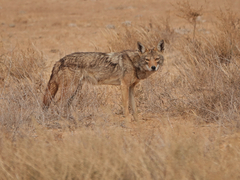
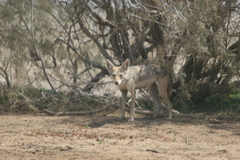
African Golden Wolf

African Golden Wolf

Canis lupaster

Silhouette: Susan Murphy (original photograph), T. Michael Keesey (vectorization) · PhyloPic

LCLeast ConcernNTVUENCR
Daily sighting probability ~30% · Possible
at Serengeti National Park

In 3 days ~60% in a week ~90%

60 Verified sightings at Serengeti National Park From 2019 to 2026
270 In all 3 parks
January Best month
☀️ Diurnal When it's spotted

About the African Golden Wolf

The African wolf (Canis lupaster) is a canine native to North Africa, West Africa, the Sahel, northern East Africa, and the Horn of Africa. It is listed as least concern on the IUCN Red List. It is primarily a predator of invertebrates and mammals as large as gazelle fawns, though larger animals are sometimes taken. Its diet also includes animal carcasses, human refuse, and fruit. It is monogamous and territorial; offspring remain with the parents to assist in raising their parents' younger pups.

The African wolf was previously classified as an African variant of the golden jackal, though a series of analyses on the species' mitochondrial DNA and nuclear genome in 2015 demonstrated that it is a distinct species more closely related to the gray wolf and coyote. It is nonetheless still close enough to the golden jackal to produce hybrid offspring, as indicated through genetic tests on jackals in Israel, and a 19th-century captive crossbreeding experiment. Further studies demonstrated that it is the descendant of a genetically admixed canid of 72% gray wolf and 28% Ethiopian wolf ancestry.

It plays a prominent role in some African cultures; it was considered sacred in ancient Egypt, particularly in Lycopolis, where it was venerated as a god. In North African folklore, it is viewed as an untrustworthy animal whose body parts can be used for medicinal or ritualistic purposes, while it is held in high esteem in Senegal's Serer religion as being the first creature to be created by the god Roog. Wikipedia →

Sounds

Call0:42

Tunisia · 2016

© Cedric Mroczko · XC505360 · CC BY-NC-SA 4.0

Recording0:25

Morocco · 2025

© Demian Hiß · iNaturalist · CC BY 4.0

Recording0:15

Algeria · 2024

© Bernard Noguès · iNaturalist · CC BY-NC 4.0

Global Distribution

Parks Where Found

# Park Country Daily sighting probability
1 Ngorongoro Conservation Area 🇹🇿 Tanzania
~60%
2 Serengeti National Park 🇹🇿 Tanzania
~30%
3 Amboseli National Park 🇰🇪 Kenya
~20%

Zoos & Centres Where Found

# Zoo / Centre Country
1 Friguia Park 🇹🇳 Tunisia In captivity

Before you go

What are the chances of seeing an African Golden Wolf in Serengeti National Park?

Possible

About 30% of wildlife watchers report an African Golden Wolf sighting in Serengeti National Park on a given day, based on 60 verified sightings from GBIF citizen-science data from 2019 to 2026. It is the 27th most-seen of the 41 mammals we can rate there. Over three days the chance rises to about 60%, and over a week to about 90%, if each day is a fresh chance.

When is the best time to see an African Golden Wolf in Serengeti National Park?

January–February and April

In those months about 40% of wildlife watchers report an African Golden Wolf in Serengeti National Park on a given day, against about 10% in March, the lowest month. Those are among Serengeti National Park's wettest months, with about 95 mm of rain a month against 5 mm in July.

What time of day is best to see an African Golden Wolf?

Between 4 and 7 pm

Across all the parks we cover, that three-hour window holds the most African Golden Wolf sightings with a recorded time, and about 7 in 10 of them come between 6 am and 6 pm: it is a daytime animal.

Is Serengeti National Park the best place to see an African Golden Wolf?

2nd of 3

Of the 3 parks where we can rate African Golden Wolf sightings, Serengeti National Park ranks 2nd at about 30%. The best odds are in Ngorongoro Conservation Area (Tanzania, about 60%).

Where does the African Golden Wolf sighting chance come from?

GBIF citizen-science records

It is estimated from how often the African Golden Wolf is recorded against all the mammals logged in Serengeti National Park (60 verified sightings from 2019 to 2026), calibrated against known sighting rates. Figures are rounded to the nearest 10% because citizen-science data supports honest approximations, not decimals, and months with records from fewer than five people show "—". How it works.

← Back to Serengeti National Park