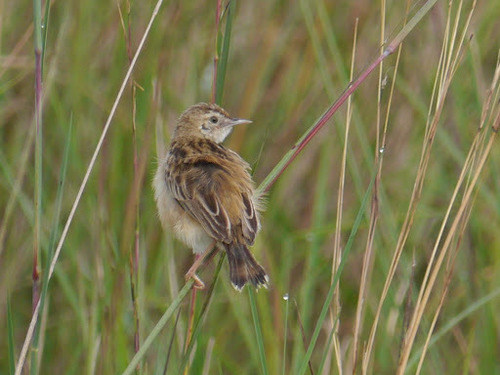
Black-necked Cisticola

Black-necked Cisticola

Cisticola eximius

Silhouette: Sheatherius · PhyloPic

LCLeast ConcernNTVUENCR
Daily sighting probability <5% · Rare
at Serengeti National Park

In 3 days <5%

10 Verified sightings at Serengeti National Park From 2019 to 2026
132 In all 3 parks
November Best month
☀️ Diurnal When it's spotted

About the Black-necked Cisticola

The black-backed cisticola or black-necked cisticola (Cisticola eximius) is a species of passerine bird in the family Cisticolidae. It is found in Burkina Faso, Chad, Republic of the Congo, Democratic Republic of the Congo, Ivory Coast, Eritrea, Ethiopia, Ghana, Guinea, Guinea-Bissau, Kenya, Mali, Nigeria, Senegal, Sierra Leone, South Sudan, Tanzania, Togo, and Uganda.

Its natural habitats are subtropical or tropical dry lowland grassland and subtropical or tropical seasonally wet or flooded lowland grassland. The black-backed cisticola was described by the German explorer and ornithologist Theodor von Heuglin in 1869 from a specimen collected near the Bahr el Ghazal River in South Sudan. He coined the binomial name Drymoeca eximia. The specific epithet eximius is the Latin for "select" or "distinguished". The species is now placed in the genus Cisticola which was erected by the German naturalist Johann Jakob Kaup in 1829.

Three subspecies are recognised: Wikipedia →

Global Distribution

Parks Where Found

# Park Country Daily sighting probability
1 Kidepo Valley National Park 🇺🇬 Uganda
<5%
2 Masai Mara National Reserve 🇰🇪 Kenya
<5%
3 Serengeti National Park 🇹🇿 Tanzania
<5%

Before you go

What are the chances of seeing a Black-necked Cisticola in Serengeti National Park?

Rare

Under 5% of wildlife watchers report a Black-necked Cisticola sighting in Serengeti National Park on a given day, based on 10 verified sightings from GBIF citizen-science data from 2019 to 2026. It is the 433rd most-seen of the 469 birds we can rate there. Over three days the chance rises to under 5%, if each day is a fresh chance.

When is the best time to see a Black-necked Cisticola in Serengeti National Park?

Any time of year

In every month with enough records, under 5% of wildlife watchers report a Black-necked Cisticola in Serengeti National Park on a given day, so our monthly data shows no clear season.

What time of day is best to see a Black-necked Cisticola?

Between 3 and 6 pm

Across all the parks we cover, that three-hour window holds the most Black-necked Cisticola sightings with a recorded time, and about 9 in 10 of them come between 6 am and 6 pm: it is a daytime animal.

Is Serengeti National Park the best place to see a Black-necked Cisticola?

Among the best

Of the 3 parks where we can rate Black-necked Cisticola sightings, Serengeti National Park ranks 3rd at under 5%, level with the leaders once rounded. The best odds are in Kidepo Valley National Park (Uganda, under 5%) and Masai Mara National Reserve (Kenya, under 5%).

Which relatives of the Black-necked Cisticola live in Serengeti National Park?

Same genus: Cisticola

The closest relatives of the Black-necked Cisticola that you can see in Serengeti National Park (genus Cisticola, Cisticolas) are Rattling Cisticola (about 50%), Zitting Cisticola (about 20%) and Winding Cisticola (about 20%), with each one's daily chance of a sighting.

Where does the Black-necked Cisticola sighting chance come from?

GBIF citizen-science records

It is estimated from how often the Black-necked Cisticola is recorded against all the birds logged in Serengeti National Park (10 verified sightings from 2019 to 2026), calibrated against known sighting rates. Figures are rounded to the nearest 10% because citizen-science data supports honest approximations, not decimals, and months with records from fewer than five people show "—". How it works.

← Back to Serengeti National Park