Boomslang

Boomslang

Dispholidus typus

Silhouette: Alex Slavenko · PhyloPic

LCLeast ConcernNTVUENCR
Daily sighting probability ~10% · With luck
at Serengeti National Park

In 3 days ~20% in a week ~40%

7 Verified sightings at Serengeti National Park From 2019 to 2026
335 In all 8 parks
May Best month
☀️ Diurnal When it's spotted

About the Boomslang

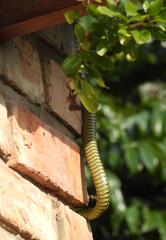
The boomslang ( or; Dispholidus typus) is a highly venomous snake in the family Colubridae. The species is native to Sub-Saharan Africa. Its common name means "tree snake" in Dutch and Afrikaans – boom meaning "tree", and slang meaning "snake". In Afrikaans, the name is pronounced [ˈbuəmslaŋ].

The boomslang is a colubrid snake within the subfamily Colubrinae. It belongs to the genus Dispholidus, which contains two other species, D. pembae and D. punctatus. The boomslang is thought to be closely related to members of the genera Thelotornis, Thrasops, Rhamnophis, and Xyelodontophis, with which it forms the taxonomic tribe Dispholidini.

Close relationships can be shown in the cladogram below: The trinomial authority in parentheses for D. t. typus indicates that the subspecies was originally described in a genus other than Dispholidus. The average adult boomslang is 100–160 centimetres (3.3–5.2 ft) in total length (including tail). Some exceed 183 centimetres (6.00 ft). The eyes are exceptionally... Wikipedia →

Global Distribution

Parks Where Found

# Park Country Daily sighting probability
1 West Coast National Park 🇿🇦 South Africa
~30%
2 De Hoop Nature Reserve 🇿🇦 South Africa
~20%
3 Garden Route National Park 🇿🇦 South Africa
~20%
4 Kruger National Park 🇿🇦 South Africa
~10%
5 Table Mountain National Park 🇿🇦 South Africa
~10%
6 Addo Elephant National Park 🇿🇦 South Africa
~10%
7 Serengeti National Park 🇹🇿 Tanzania
~10%
8 Masai Mara National Reserve 🇰🇪 Kenya
~10%

Cities Where Found

# City Country Daily sighting probability
1 Cape Town 🇿🇦 South Africa
~10%
2 Durban 🇿🇦 South Africa
~10%

Zoos & Centres Where Found

# Zoo / Centre Country
1 Johannesburg Zoo 🇿🇦 South Africa In captivity
2 National Zoological Garden of South Africa 🇿🇦 South Africa In captivity
3 Houston Zoo 🇺🇸 United States In captivity
4 Giraffe House 🇿🇦 South Africa In captivity
5 Reptile Gardens 🇺🇸 United States In captivity
6 Hartbeespoort Dam Snake and Animal Park 🇿🇦 South Africa In captivity
7 Universeum 🇸🇪 Sweden In captivity

Before you go

What are the chances of seeing a Boomslang in Serengeti National Park?

With luck

About 10% of wildlife watchers report a Boomslang sighting in Serengeti National Park on a given day, based on 7 verified sightings from GBIF citizen-science data from 2019 to 2026. It is the 9th most-seen of the 11 reptiles we can rate there. Over three days the chance rises to about 20%, and over a week to about 40%, if each day is a fresh chance.

When is the best time to see a Boomslang in Serengeti National Park?

May

In that month about 20% of wildlife watchers report a Boomslang in Serengeti National Park on a given day, against under 5% in August to March, the lowest months.

What time of day is best to see a Boomslang?

Between 11 am and 2 pm

Across all the parks we cover, that three-hour window holds the most Boomslang sightings with a recorded time, and about 9 in 10 of them come between 6 am and 6 pm: it is a daytime animal.

Where does the Boomslang sighting chance come from?

GBIF citizen-science records

It is estimated from how often the Boomslang is recorded against all the reptiles logged in Serengeti National Park (7 verified sightings from 2019 to 2026), calibrated against known sighting rates. Figures are rounded to the nearest 10% because citizen-science data supports honest approximations, not decimals, and months with records from fewer than five people show "—". How it works.

← Back to Serengeti National Park