Tanzanian Red-billed Hornbill

Tanzanian Red-billed Hornbill

Tockus ruahae

Silhouette: Andy Wilson · PhyloPic

Daily sighting probability ~10% · With luck
at Serengeti National Park

In 3 days ~30% in a week ~50%

326 Verified sightings at Serengeti National Park From 2019 to 2026
570 In all 4 parks
April Best month
☀️ Diurnal When it's spotted

About the Tanzanian Red-billed Hornbill

The Tanzanian red-billed hornbill (Tockus ruahae) is a species of hornbill in the family Bucerotidae. It is found in central Tanzania and was discovered by Robert Glen and Sue Stolberger in Ruaha National Park All five red-billed hornbills were formerly considered conspecific.

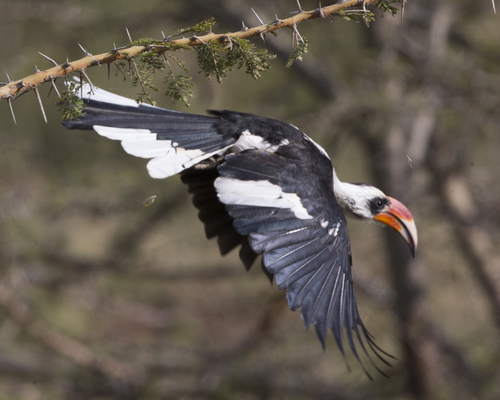
Tanzanian red-billed hornbills (Tockus ruahae) are small hornbills in the group of the red-billed hornbills. They have curved, bright red bills that end in a small dot of dark orange. Their sclera can vary from light orange to dark yellow and their pupils are usually dark black. Like most species of hornbills, they support medium-sized circles of black skin around their eyes, both in females and males. They have greyish-white necks and bellies and their wings, like all red billed hornbills, have large and small spots of white surrounded by black feathers. Their tail feathers are long and black on the exterior and white on the interior.

Tanzanian red-billed hornbills can be found in central Tanzania. They are usually found resting or nesting in trees in forests or savannahs where their food is plentiful. Kemp, A.C. and W. Delport. 2002. Comments... Wikipedia →

Sounds

Call0:47

Tanzania · 2024

© Barry Edmonston · XC899405 · CC BY-NC-SA 4.0

Song0:15

Tanzania · 2018

© Stein Ø. Nilsen · XC460480 · CC BY-NC-SA 4.0

Song0:26

Tanzania · 2017

© Frank Lambert · XC429738 · CC BY-NC-ND 4.0

Global Distribution

Parks Where Found

# Park Country Daily sighting probability
1 Ruaha National Park 🇹🇿 Tanzania
~70%
2 Serengeti National Park 🇹🇿 Tanzania
~10%
3 Lake Manyara National Park 🇹🇿 Tanzania
<5%
4 Ngorongoro Conservation Area 🇹🇿 Tanzania
<5%

Zoos & Centres Where Found

# Zoo / Centre Country
1 Reserva Zoológica Oasys MiniHollywood 🇪🇸 Spain In captivity

Before you go

What are the chances of seeing a Tanzanian Red-billed Hornbill in Serengeti National Park?

With luck

About 10% of wildlife watchers report a Tanzanian Red-billed Hornbill sighting in Serengeti National Park on a given day, based on 326 verified sightings from GBIF citizen-science data from 2019 to 2026. It is the 156th most-seen of the 469 birds we can rate there. Over three days the chance rises to about 30%, and over a week to about 50%, if each day is a fresh chance.

When is the best time to see a Tanzanian Red-billed Hornbill in Serengeti National Park?

April

In that month about 30% of wildlife watchers report a Tanzanian Red-billed Hornbill in Serengeti National Park on a given day, against under 5% in October and December, the lowest months. That is one of Serengeti National Park's wettest months, with about 140 mm of rain against 5 mm in July.

What time of day is best to see a Tanzanian Red-billed Hornbill?

Between 5 and 8 am

Across all the parks we cover, that three-hour window holds the most Tanzanian Red-billed Hornbill sightings with a recorded time, and about 8 in 10 of them come between 6 am and 6 pm: it is a daytime animal.

Is Serengeti National Park the best place to see a Tanzanian Red-billed Hornbill?

2nd of 4

Of the 4 parks where we can rate Tanzanian Red-billed Hornbill sightings, Serengeti National Park ranks 2nd at about 10%. The best odds are in Ruaha National Park (Tanzania, about 70%).

Where does the Tanzanian Red-billed Hornbill sighting chance come from?

GBIF citizen-science records

It is estimated from how often the Tanzanian Red-billed Hornbill is recorded against all the birds logged in Serengeti National Park (326 verified sightings from 2019 to 2026), calibrated against known sighting rates. Figures are rounded to the nearest 10% because citizen-science data supports honest approximations, not decimals, and months with records from fewer than five people show "—". How it works.

← Back to Serengeti National Park