Brasília Tapaculo

Brasília Tapaculo

Scytalopus novacapitalis

Silhouette: Ferran Sayol · PhyloPic

LCNTVUENEndangeredCR Endemic
Daily sighting probability ~20% · Possible
at Serra da Canastra National Park

In 3 days ~50% in a week ~80%

137 Verified sightings at Serra da Canastra National Park From 2019 to 2026
137 In 1 park
September Best month
☀️ Diurnal When it's spotted

About the Brasília Tapaculo

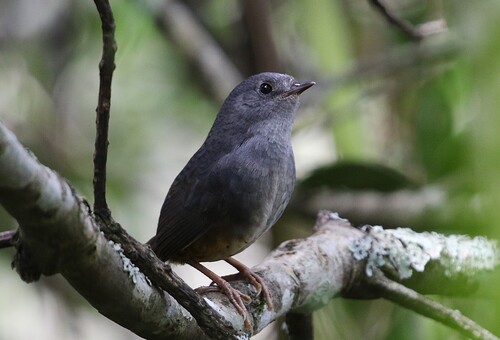
The Brasília tapaculo (Scytalopus novacapitalis) is a species of bird in the family Rhinocryptidae. It is endemic to southern Brazil. The Brasília tapaculo is most closely related to the Planalto tapaculo (Scytalopus pachecoi). Those two species, rock tapaculo (S. petrophilus), and Diamantina tapaculo (S. diamantinensis) form a clade. It was originally thought to be closely related to the white-breasted tapaculo (Eleoscytalopus indigoticus).

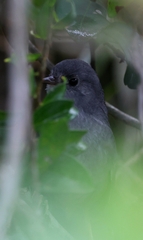
The Brasília tapaculo is 11 cm (4.3 in) long. One male weighed 19.2 g (0.68 oz) and two unsexed specimens weighed 15.6 and 18.6 g (0.55 and 0.66 oz). The adult is blue-gray above and whitish to pale gray below. The lower back and rump are reddish brown and the vent is rufous with gray barring. The juvenile has not been described.

The Brasília tapaculo is found in disjunct areas in eastern Goiás, the Distrito Federal, and western Minas Gerais. It inhabits gallery forest, primarily permanently flooded areas with Blechnum ferns and Euterpe palms. It has a fairly narrow elevational range of 800 to 1,000 m (2,600 to 3,300 ft).

The Brasília tapaculo... Wikipedia →

Sounds

Song1:28

Brazil · 2026

© Robson Silva e Silva · XC1151602 · CC BY-NC-SA 4.0

Call0:27

Brazil · 2024

© JAYRSON ARAUJO DE OLIVEIRA · XC898243 · CC BY-NC-SA 4.0

Alarm call1:08

Brazil · 2019

© Lia Nahomi Kajiki · XC599235 · CC BY-NC-SA 4.0

Global Distribution

Parks Where Found

# Park Country Daily sighting probability
1 Serra da Canastra National Park 🇧🇷 Brazil
~20%

More parks will be added in future updates.

Before you go

What are the chances of seeing a Brasília Tapaculo in Serra da Canastra National Park?

Possible

About 20% of wildlife watchers report a Brasília Tapaculo sighting in Serra da Canastra National Park on a given day, based on 137 verified sightings from GBIF citizen-science data from 2019 to 2026. It is the 79th most-seen of the 294 birds we can rate there. Over three days the chance rises to about 50%, and over a week to about 80%, if each day is a fresh chance.

When is the best time to see a Brasília Tapaculo in Serra da Canastra National Park?

January, May and September–November

In those months about 30% of wildlife watchers report a Brasília Tapaculo in Serra da Canastra National Park on a given day, against about 10% in March and June, the lowest months.

What time of day is best to see a Brasília Tapaculo?

Between 7 and 10 am

Across all the parks we cover, that three-hour window holds the most Brasília Tapaculo sightings with a recorded time, and about 8 in 10 of them come between 6 am and 6 pm: it is a daytime animal.

Where else can you see a Brasília Tapaculo?

Only Serra da Canastra National Park, in our data

Serra da Canastra National Park is the only park on Wallace's Line with enough records to rate Brasília Tapaculo sightings: about 20% of wildlife watchers there report one on a given day.

Which relatives of the Brasília Tapaculo live in Serra da Canastra National Park?

Same order: Passeriformes

The closest relatives of the Brasília Tapaculo that you can see in Serra da Canastra National Park (order Passeriformes, Perching Birds) are Rufous-collared Sparrow (about 80%), Saffron Finch (about 80%) and Chalk-browed Mockingbird (about 60%), with each one's daily chance of a sighting.

Where does the Brasília Tapaculo sighting chance come from?

GBIF citizen-science records

It is estimated from how often the Brasília Tapaculo is recorded against all the birds logged in Serra da Canastra National Park (137 verified sightings from 2019 to 2026), calibrated against known sighting rates. Figures are rounded to the nearest 10% because citizen-science data supports honest approximations, not decimals, and months with records from fewer than five people show "—". How it works.

← Back to Serra da Canastra National Park