
Campo Miner

Campo Miner

Geositta poeciloptera

Silhouette: Sheatherius · PhyloPic

LCNTVUVulnerableENCR
Daily sighting probability ~10% · With luck
at Serra da Canastra National Park

In 3 days ~30% in a week ~60%

71 Verified sightings at Serra da Canastra National Park From 2019 to 2026
71 In 1 park
January Best month
☀️ Diurnal When it's spotted

About the Campo Miner

The campo miner (Geositta poeciloptera) is a Vulnerable species of bird in the subfamily Sclerurinae, the leaftossers and miners, of the ovenbird family Furnariidae. It is found in Bolivia and Brazil, and as a vagrant in Paraguay.

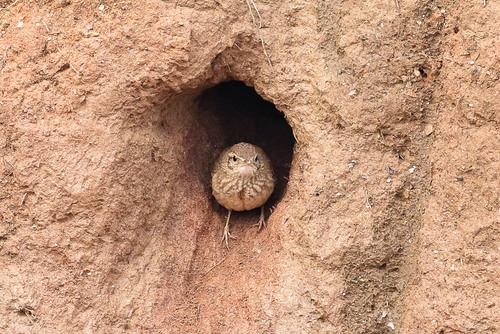
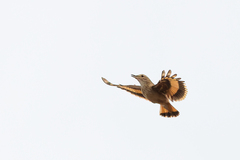
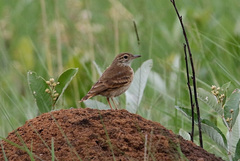
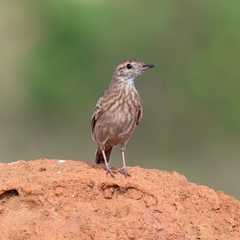
The campo miner was originally placed alone in genus Geobates and has sometimes been treated there since, but genetic data place it firmly in Geositta. It is monotypic. The campo miner is a small member of its genus. It is 11 to 12 cm (4.3 to 4.7 in) long and weighs 17 to 19 g (0.60 to 0.67 oz). The sexes are alike. It has a dull rufescent brown face with a buff supercilium. It is dull grayish brown from its crown to its rump; the crown has vague brown spots and its rump and uppertail coverts have a rufescent tinge. Its tail is short; its feathers are rufous with a blackish brown band near the end. Its wing coverts are dark brownish with paler edges. Its axillaries ("wing pits") are cinnamon. Its flight feathers are blackish with a wide chestnut-rufous band that shows in flight. Its throat is whitish, its upper breast dull buff with brown flecks, its lower breast and belly whitish, and its flanks and undertail... Wikipedia →

Sounds

Song0:08

Brazil · 2018

© Luiz Fernando Matos · XC656894 · CC BY-NC-SA 4.0

Flight call0:55

Brazil · 2007

© Dante Buzzetti · XC550386 · CC BY-NC-SA 4.0

Call0:55

Brazil · 2012

© LUCIO DOS REIS OLIVEIRA · XC148643 · CC BY-NC-SA 3.0

Global Distribution

Parks Where Found

# Park Country Daily sighting probability
1 Serra da Canastra National Park 🇧🇷 Brazil
~10%

More parks will be added in future updates.

Before you go

What are the chances of seeing a Campo Miner in Serra da Canastra National Park?

With luck

About 10% of wildlife watchers report a Campo Miner sighting in Serra da Canastra National Park on a given day, based on 71 verified sightings from GBIF citizen-science data from 2019 to 2026. It is the 140th most-seen of the 294 birds we can rate there. Over three days the chance rises to about 30%, and over a week to about 60%, if each day is a fresh chance.

When is the best time to see a Campo Miner in Serra da Canastra National Park?

January and August–October

In those months about 20% of wildlife watchers report a Campo Miner in Serra da Canastra National Park on a given day, against under 5% in March, May and July, the lowest months.

What time of day is best to see a Campo Miner?

Between 8 and 11 am

Across all the parks we cover, that three-hour window holds the most Campo Miner sightings with a recorded time, and about 8 in 10 of them come between 6 am and 6 pm: it is a daytime animal.

Where else can you see a Campo Miner?

Only Serra da Canastra National Park, in our data

Serra da Canastra National Park is the only park on Wallace's Line with enough records to rate Campo Miner sightings: about 10% of wildlife watchers there report one on a given day.

Which relatives of the Campo Miner live in Serra da Canastra National Park?

Same family: Furnariidae

The closest relatives of the Campo Miner that you can see in Serra da Canastra National Park (family Furnariidae, Ovenbirds and Woodcreepers) are Firewood-gatherer (about 30%), Spix's Spinetail (about 30%) and Rufous Hornero (about 30%), with each one's daily chance of a sighting.

Where does the Campo Miner sighting chance come from?

GBIF citizen-science records

It is estimated from how often the Campo Miner is recorded against all the birds logged in Serra da Canastra National Park (71 verified sightings from 2019 to 2026), calibrated against known sighting rates. Figures are rounded to the nearest 10% because citizen-science data supports honest approximations, not decimals, and months with records from fewer than five people show "—". How it works.

← Back to Serra da Canastra National Park