
Dwarf Tinamou

Dwarf Tinamou

Taoniscus nanus

Silhouette: George Edward Lodge · PhyloPic

LCNTVUENEndangeredCR
Daily sighting probability ~10% · With luck
at Serra da Canastra National Park

In 3 days ~20% in a week ~50%

44 Verified sightings at Serra da Canastra National Park From 2019 to 2026
44 In 1 park
January Best month

About the Dwarf Tinamou

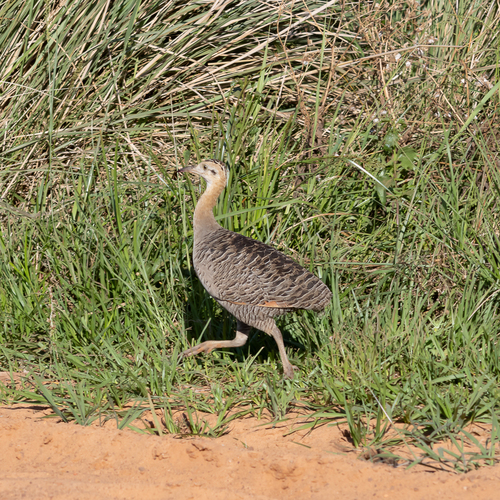
The dwarf tinamou (Taoniscus nanus), also known as the least tinamou, is a small, superficially partridge-like bird with short tail and wings, found only in Brazil. This tinamou is the only member of the genus Taoniscus and it is considered an endangered species.

All tinamou are from the family Tinamidae, and in the larger scheme are also ratites. Unlike other ratites, tinamous can fly, although in general, they are not strong fliers. All ratites evolved from prehistoric flying birds, and tinamous are the closest living relative of these birds. The dwarf tinamou is the only member of the genus Taoniscus and is a monotypic species.

A phylogenetic study published in 2022 found that the dwarf tinamou was embedded within the genus Nothura. It is approximately 16 cm (6.3 in) long. It is greyish-brown with a pale throat, boldly patterned neck and upper parts, and it has brown-barred buff underparts and a blackish crown. Some individuals are significantly darker and greyer than others, but it remains unclear if these plumage variations are morphs or differences between the sexes. The iris and legs are dull yellowish. It resembles a small dumpy... Wikipedia →

Sounds

Song0:30

Brazil · 2024

© Lia Nahomi Kajiki · XC862513 · CC BY-NC-SA 4.0

Call0:13

Brazil · 2005

© Robson Silva e Silva · XC350171 · CC BY-NC-SA 4.0

Alarm call0:04

Brazil · 2013

© Nunes D'Acosta · XC144885 · CC BY-NC-SA 3.0

Global Distribution

Parks Where Found

# Park Country Daily sighting probability
1 Serra da Canastra National Park 🇧🇷 Brazil
~10%

More parks will be added in future updates.

Before you go

What are the chances of seeing a Dwarf Tinamou in Serra da Canastra National Park?

With luck

About 10% of wildlife watchers report a Dwarf Tinamou sighting in Serra da Canastra National Park on a given day, based on 44 verified sightings from GBIF citizen-science data from 2019 to 2026. It is the 166th most-seen of the 294 birds we can rate there. Over three days the chance rises to about 20%, and over a week to about 50%, if each day is a fresh chance.

When is the best time to see a Dwarf Tinamou in Serra da Canastra National Park?

January

In that month about 20% of wildlife watchers report a Dwarf Tinamou in Serra da Canastra National Park on a given day, against under 5% in July–August and December, the lowest months. That is one of Serra da Canastra National Park's wettest months, with about 280 mm of rain against almost none in July.

Where else can you see a Dwarf Tinamou?

Only Serra da Canastra National Park, in our data

Serra da Canastra National Park is the only park on Wallace's Line with enough records to rate Dwarf Tinamou sightings: about 10% of wildlife watchers there report one on a given day.

Which relatives of the Dwarf Tinamou live in Serra da Canastra National Park?

Same family: Tinamidae

The closest relatives of the Dwarf Tinamou that you can see in Serra da Canastra National Park (family Tinamidae, Tinamous) are Red-winged Tinamou (about 30%), Spotted Nothura (about 30%) and Small-billed Tinamou (about 10%), with each one's daily chance of a sighting.

Where does the Dwarf Tinamou sighting chance come from?

GBIF citizen-science records

It is estimated from how often the Dwarf Tinamou is recorded against all the birds logged in Serra da Canastra National Park (44 verified sightings from 2019 to 2026), calibrated against known sighting rates. Figures are rounded to the nearest 10% because citizen-science data supports honest approximations, not decimals, and months with records from fewer than five people show "—". How it works.

← Back to Serra da Canastra National Park