Black-and-gold Cotinga

Black-and-gold Cotinga

Lipaugus ater

Silhouette: Edwin Price · PhyloPic

LCLeast ConcernNTVUENCR Endemic
Daily sighting probability ~10% · With luck
at Serra dos Órgãos National Park

In 3 days ~40% in a week ~70%

114 Verified sightings at Serra dos Órgãos National Park From 2019 to 2026
476 In all 2 parks
February Best month
☀️ Diurnal When it's spotted

About the Black-and-gold Cotinga

The black-and-gold cotinga (Lipaugus ater) is a species of bird in the family Cotingidae. It is endemic to Brazil. The black-and-gold cotinga was originally described as Tijuca atra. By the late 1900s there were suggestions that genus Tijuca was a sister genus to Lipaugus. A molecular phylogenetic study published in 2014 found that Tijuca was embedded within Lipaugus so taxonomic systems subsumed Tijuca into Lipaugus.

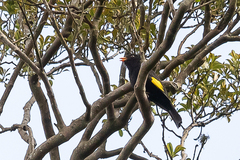
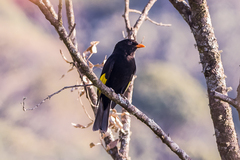
The black-and-gold cotinga is monotypic. The black-and-gold cotinga is 25 to 28 cm (9.8 to 11 in) long. The sexes are strongly sexually dimorphic. Adult males are entirely black but for a large golden yellow patch on the wing's flight feathers (remiges). They have a reddish brown iris, a bright orange bill with a slight hook on the end, and dark brown legs and feet. Females are overall dull olive-green which is yellower on the edges of the flight feathers and belly. They much resemble the monomorphic grey-winged cotinga (L. condita) and their ranges overlap. Their bill is a duller orange than the male's.

The black-and-gold cotinga is found in southeastern Brazil, ranging intermittently in extreme... Wikipedia →

Sounds

Song0:32

Brazil · 2022

© Pritam Baruah · XC753347 · CC BY-NC-SA 4.0

Canto0:43

Brazil · 2019

© Caio Brito · XC556636 · CC BY-NC-SA 4.0

Call0:28

Brazil · 2002

© Jeremy Minns · XC82435 · CC BY-NC-SA 3.0

Global Distribution

Parks Where Found

# Park Country Daily sighting probability
1 Itatiaia National Park 🇧🇷 Brazil
~20%
2 Serra dos Órgãos National Park 🇧🇷 Brazil
~10%

Before you go

What are the chances of seeing a Black-and-gold Cotinga in Serra dos Órgãos National Park?

With luck

About 10% of wildlife watchers report a Black-and-gold Cotinga sighting in Serra dos Órgãos National Park on a given day, based on 114 verified sightings from GBIF citizen-science data from 2019 to 2026. It is the 138th most-seen of the 336 birds we can rate there. Over three days the chance rises to about 40%, and over a week to about 70%, if each day is a fresh chance.

When is the best time to see a Black-and-gold Cotinga in Serra dos Órgãos National Park?

February

In that month about 30% of wildlife watchers report a Black-and-gold Cotinga in Serra dos Órgãos National Park on a given day, against about 10% in January, March, May, July and September–November, the lowest months. That is one of Serra dos Órgãos National Park's wettest months, with about 260 mm of rain against 50 mm in July.

What time of day is best to see a Black-and-gold Cotinga?

Between 8 and 11 am

Across all the parks we cover, that three-hour window holds the most Black-and-gold Cotinga sightings with a recorded time, and about 9 in 10 of them come between 6 am and 6 pm: it is a daytime animal.

Is Serra dos Órgãos National Park the best place to see a Black-and-gold Cotinga?

2nd of 2

Of the 2 parks where we can rate Black-and-gold Cotinga sightings, Serra dos Órgãos National Park ranks 2nd at about 10%. The best odds are in Itatiaia National Park (Brazil, about 20%).

Which relatives of the Black-and-gold Cotinga live in Serra dos Órgãos National Park?

Same family: Cotingidae

The closest relatives of the Black-and-gold Cotinga that you can see in Serra dos Órgãos National Park (family Cotingidae, Cotingas) are Chestnut-crowned Becard (about 40%), Black-capped Becard (about 20%) and Bare-throated Bellbird (about 10%), with each one's daily chance of a sighting.

Where does the Black-and-gold Cotinga sighting chance come from?

GBIF citizen-science records

It is estimated from how often the Black-and-gold Cotinga is recorded against all the birds logged in Serra dos Órgãos National Park (114 verified sightings from 2019 to 2026), calibrated against known sighting rates. Figures are rounded to the nearest 10% because citizen-science data supports honest approximations, not decimals, and months with records from fewer than five people show "—". How it works.

← Back to Serra dos Órgãos National Park