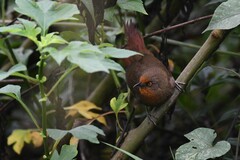
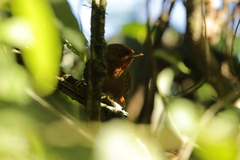
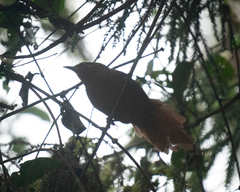

Orange-eyed Thornbird

Orange-eyed Thornbird

Phacellodomus erythrophthalmus

Silhouette: Sheatherius · PhyloPic

LCLeast ConcernNTVUENCR Endemic
Daily sighting probability ~10% · With luck
at Serra dos Órgãos National Park

In 3 days ~30% in a week ~50%

62 Verified sightings at Serra dos Órgãos National Park From 2019 to 2026
242 In all 2 parks
December Best month
☀️ Diurnal When it's spotted

About the Orange-eyed Thornbird

The orange-eyed thornbird (Phacellodomus erythrophthalmus) is a species of bird in the Furnariinae subfamily of the ovenbird family Furnariidae. It is endemic to Brazil. The orange-eyed thornbird is monotypic. However, what is now the orange-breasted thornbird (P. ferrugineigula) was previously treated as a subspecies of it under the common name red-eyed thornbird. In addition to differences in eye and plumage color, the two taxa have different voices and are locally sympatric in São Paulo state without evidence of interbreeding. For a while after the two were split, some taxonomic systems continued to use "red-eyed" for P. erythrophthalmus and others used it for P. ferrugineigula. The current "orange-eyed" and "orange-breasted" English names were adopted to avoid confusion with the former "red-eyed".

To further complicate matters, for a time in the early twentieth century some authors placed the former two-subspecies red-eyed thornbird alone in genus Drioctistes. Later some authors, but not all, merged that genus into Phacellodomus. A 2011 publication placed the two current species firmly in Phacellodomus.

The orange-eyed thornbird... Wikipedia →

Sounds

Canto/chamado1:04

Brazil · 2019

© Caio Brito · XC556480 · CC BY-NC-SA 4.0

Song0:11

Brazil · 2018

© Fernando Igor de Godoy · XC422987 · CC BY-NC-SA 4.0

Call0:09

Brazil · 2015

© Jerome Fischer · XC294521 · CC BY-NC-SA 4.0

Global Distribution

Parks Where Found

# Park Country Daily sighting probability
1 Itatiaia National Park 🇧🇷 Brazil
~10%
2 Serra dos Órgãos National Park 🇧🇷 Brazil
~10%

Cities Where Found

# City Country Daily sighting probability
1 São Paulo 🇧🇷 Brazil
<5%

Before you go

What are the chances of seeing an Orange-eyed Thornbird in Serra dos Órgãos National Park?

With luck

About 10% of wildlife watchers report an Orange-eyed Thornbird sighting in Serra dos Órgãos National Park on a given day, based on 62 verified sightings from GBIF citizen-science data from 2019 to 2026. It is the 168th most-seen of the 336 birds we can rate there. Over three days the chance rises to about 30%, and over a week to about 50%, if each day is a fresh chance.

When is the best time to see an Orange-eyed Thornbird in Serra dos Órgãos National Park?

December

In that month about 20% of wildlife watchers report an Orange-eyed Thornbird in Serra dos Órgãos National Park on a given day, against under 5% in April and June–July, the lowest months. That is one of Serra dos Órgãos National Park's wettest months, with about 270 mm of rain against 50 mm in July.

What time of day is best to see an Orange-eyed Thornbird?

Between 7 and 10 am

Across all the parks we cover, that three-hour window holds the most Orange-eyed Thornbird sightings with a recorded time, and about 9 in 10 of them come between 6 am and 6 pm: it is a daytime animal.

Is Serra dos Órgãos National Park the best place to see an Orange-eyed Thornbird?

Among the best

Of the 2 parks where we can rate Orange-eyed Thornbird sightings, Serra dos Órgãos National Park ranks 2nd at about 10%, level with the leaders once rounded. The best odds are in Itatiaia National Park (Brazil, about 10%).

Where does the Orange-eyed Thornbird sighting chance come from?

GBIF citizen-science records

It is estimated from how often the Orange-eyed Thornbird is recorded against all the birds logged in Serra dos Órgãos National Park (62 verified sightings from 2019 to 2026), calibrated against known sighting rates. Figures are rounded to the nearest 10% because citizen-science data supports honest approximations, not decimals, and months with records from fewer than five people show "—". How it works.

← Back to Serra dos Órgãos National Park