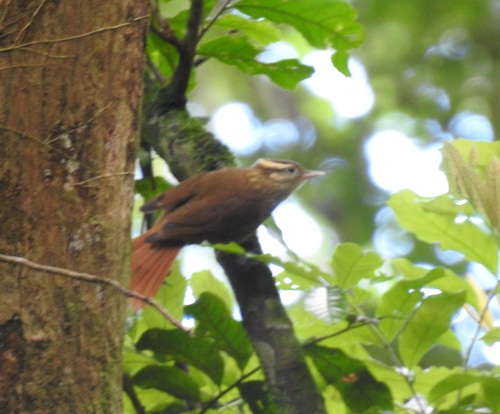
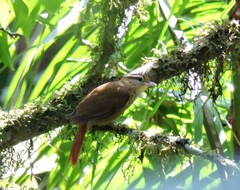
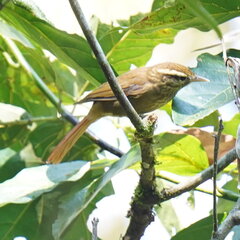
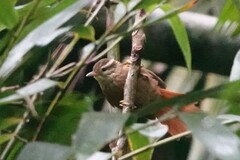
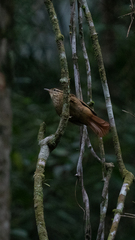

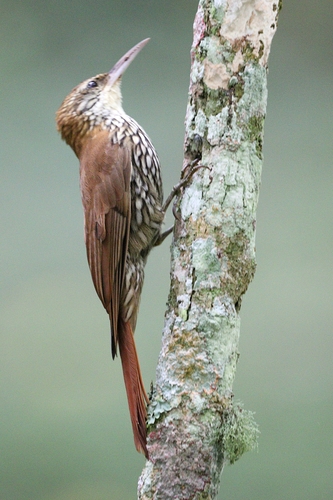
White-browed Foliage-gleaner

White-browed Foliage-gleaner

Anabacerthia amaurotis

Silhouette: Sheatherius · PhyloPic

LCLeast ConcernNTVUENCR
Daily sighting probability ~10% · With luck
at Serra dos Órgãos National Park

In 3 days ~30% in a week ~60%

64 Verified sightings at Serra dos Órgãos National Park From 2019 to 2026
169 In all 2 parks
May Best month
☀️ Diurnal When it's spotted

About the White-browed Foliage-gleaner

The white-browed foliage-gleaner (Anabacerthia amaurotis) is a species of bird in the Furnariinae subfamily of the ovenbird family Furnariidae. It is native to the Atlantic Forest. The white-browed foliage-gleaner was previously included in genus Philydor but a 2011 paper made it plain that it did not belong there. The same paper found the ochre-breasted foliage-gleaner (A. lichtensteini) and the white-browed to be sister species.

The white-browed foliage gleaner is monotypic. The white-browed foliage-gleaner is 15 to 16 cm (5.9 to 6.3 in) long. It is a medium-sized furnariid with a wedge-shaped bill. The sexes have the same plumage. Adults have a wide buff-white supercilium, a dark brown band behind the eye, and an indistinct brown "moustache" on an otherwise lightly flecked and streaked, light buff, face. Their crown is brown with black-edged white feathers at the center of the back, and they have a narrow pale buff collar that extends onto the side of their neck. Their back is rich medium brown, their rump a slightly paler brown, and their uppertail coverts rufous. Their tail is rufous with bare shafts at the very end of the feathers... Wikipedia →

Sounds

Call0:08

Brazil · 2026

© Miguel Angelo Biz · XC1084015 · CC BY-NC-SA 4.0

Song0:56

Brazil · 2024

© Lia Nahomi Kajiki · XC897591 · CC BY-NC-SA 4.0

Chamado0:37

Brazil · 2019

© Caio Brito · XC556128 · CC BY-NC-SA 4.0

Global Distribution

Parks Where Found

# Park Country Daily sighting probability
1 Serra dos Órgãos National Park 🇧🇷 Brazil
~10%
2 Itatiaia National Park 🇧🇷 Brazil
~10%

Before you go

What are the chances of seeing a White-browed Foliage-gleaner in Serra dos Órgãos National Park?

With luck

About 10% of wildlife watchers report a White-browed Foliage-gleaner sighting in Serra dos Órgãos National Park on a given day, based on 64 verified sightings from GBIF citizen-science data from 2019 to 2026. It is the 158th most-seen of the 336 birds we can rate there. Over three days the chance rises to about 30%, and over a week to about 60%, if each day is a fresh chance.

When is the best time to see a White-browed Foliage-gleaner in Serra dos Órgãos National Park?

April–May and August

In those months about 20% of wildlife watchers report a White-browed Foliage-gleaner in Serra dos Órgãos National Park on a given day, against under 5% in July and October, the lowest months.

What time of day is best to see a White-browed Foliage-gleaner?

Between 9 am and noon

Across all the parks we cover, that three-hour window holds the most White-browed Foliage-gleaner sightings with a recorded time, and about 9 in 10 of them come between 6 am and 6 pm: it is a daytime animal.

Is Serra dos Órgãos National Park the best place to see a White-browed Foliage-gleaner?

Yes

Of the 2 parks where we can rate White-browed Foliage-gleaner sightings, Serra dos Órgãos National Park has the highest daily chance: about 10%. Next come Itatiaia National Park (Brazil, about 10%).

Which relatives of the White-browed Foliage-gleaner live in Serra dos Órgãos National Park?

Same family: Furnariidae

The closest relatives of the White-browed Foliage-gleaner that you can see in Serra dos Órgãos National Park (family Furnariidae, Ovenbirds and Woodcreepers) are Olivaceous Woodcreeper (about 60%), Lesser Woodcreeper (about 50%) and White-throated Woodcreeper (about 30%), with each one's daily chance of a sighting.

Where does the White-browed Foliage-gleaner sighting chance come from?

GBIF citizen-science records

It is estimated from how often the White-browed Foliage-gleaner is recorded against all the birds logged in Serra dos Órgãos National Park (64 verified sightings from 2019 to 2026), calibrated against known sighting rates. Figures are rounded to the nearest 10% because citizen-science data supports honest approximations, not decimals, and months with records from fewer than five people show "—". How it works.

← Back to Serra dos Órgãos National Park