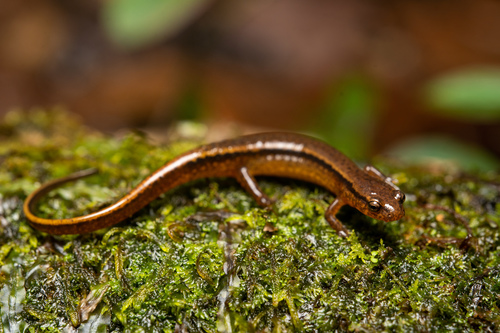
Dusky Salamander

Dusky Salamander

Desmognathus fuscus

Silhouette: Beth Reinke · PhyloPic

LCLeast ConcernNTVUENCR
Daily sighting probability ~20% · Possible
at Shenandoah National Park

In 3 days ~60% in a week ~90%

84 Verified sightings at Shenandoah National Park From 2019 to 2026
84 In 1 park
October Best month
☀️ Diurnal When it's spotted

About the Dusky Salamander

Desmognathus fuscus is a species of amphibian in the family Plethodontidae (lungless salamanders). The species is commonly called the dusky salamander or northern dusky salamander to distinguish it from populations in the southern United States which form several distinct species, the southern dusky salamanders (D. auriculatus, D. valentinei). The northern dusky salamander is the most widespread representative of its genus in Canada. It can be found in eastern North America from extreme eastern Canada in New Brunswick south to South Carolina. The size of the species' total population is unknown, but is assumed to easily exceed 100,000. The species' habitat differs somewhat geographically; dusky salamanders in the northern part of the range prefer rocky woodland streams, seepages, and springs, while those in the south favor floodplains, sloughs, and muddy places along upland streams. They are most common where water is running or trickling. They hide under various objects, such as leaves or rocks, either in or near water. Alternatively, they may enter burrows for protection. The dusky salamander lays its eggs close to water under moss or rocks, in logs, or in stream-bank cavities. The larval stage which follows is normally aquatic. Wikipedia →

Global Distribution

Parks Where Found

# Park Country Daily sighting probability
1 Shenandoah National Park 🇺🇸 United States
~20%

More parks will be added in future updates.

Cities Where Found

# City Country Daily sighting probability
1 Washington 🇺🇸 United States
<5%
2 New York City 🇺🇸 United States
<5%

Closest Relatives at Shenandoah National Park

Before you go

What are the chances of seeing a Dusky Salamander in Shenandoah National Park?

Possible

About 20% of wildlife watchers report a Dusky Salamander sighting in Shenandoah National Park on a given day, based on 84 verified sightings from GBIF citizen-science data from 2019 to 2026. It is the 9th most-seen of the 20 amphibians we can rate there. Over three days the chance rises to about 60%, and over a week to about 90%, if each day is a fresh chance.

When is the best time to see a Dusky Salamander in Shenandoah National Park?

October

In that month about 40% of wildlife watchers report a Dusky Salamander in Shenandoah National Park on a given day, against under 5% in November to February, the lowest months.

What time of day is best to see a Dusky Salamander?

Between 11 am and 2 pm

Across all the parks we cover, that three-hour window holds the most Dusky Salamander sightings with a recorded time, and about 8 in 10 of them come between 6 am and 6 pm: it is a daytime animal.

Where else can you see a Dusky Salamander?

Only Shenandoah National Park, in our data

Shenandoah National Park is the only park on Wallace's Line with enough records to rate Dusky Salamander sightings: about 20% of wildlife watchers there report one on a given day.

Where does the Dusky Salamander sighting chance come from?

GBIF citizen-science records

It is estimated from how often the Dusky Salamander is recorded against all the amphibians logged in Shenandoah National Park (84 verified sightings from 2019 to 2026), calibrated against known sighting rates. Figures are rounded to the nearest 10% because citizen-science data supports honest approximations, not decimals, and months with records from fewer than five people show "—". How it works.

← Back to Shenandoah National Park