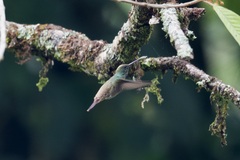

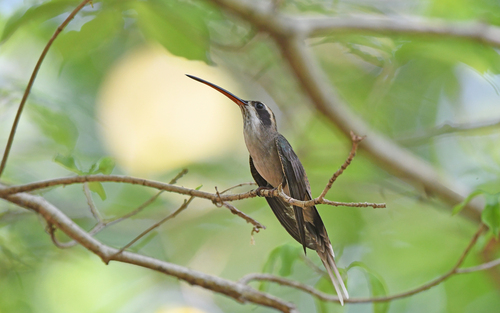
Green-bellied Hummingbird

Green-bellied Hummingbird

Saucerottia viridigaster

Silhouette: Ferran Sayol · PhyloPic

LCLeast ConcernNTVUENCR
Daily sighting probability <5% · Rare
at Sierra de la Macarena National Park

In 3 days ~10% in a week ~20%

23 Verified sightings at Sierra de la Macarena National Park From 2019 to 2026
23 In 1 park
March Best month
☀️ Diurnal When it's spotted

About the Green-bellied Hummingbird

The green-bellied hummingbird (Saucerottia viridigaster) is a species of hummingbird in the "emeralds" tribe Trochilini of subfamily Trochilinae. It is found in Colombia and Venezuela. The green-bellied hummingbird was formerly placed in the genus Amazilia. A molecular phylogenetic study published in 2014 found that the genus Amazilia was polyphyletic. In the revised classification to create monophyletic genera, the green-bellied hummingbird was moved by most taxonomic systems to the resurrected genus Saucerottia.

The green-bellied hummingbird previously was assigned six subspecies. By early 2023 most taxonomic systems had created the copper-tailed hummingbird (S. cupreicauda) containing four of them. However, the South American Classification Committee of the American Ornithological Society does not recognize the copper-tailed hummingbird as a separate species.

The green-bellied hummingbird is 8 to 10.5 cm (3.1 to 4.1 in) long and weighs 4.5 to 6.7 g (0.16 to 0.24 oz). Both sexes of both subspecies... Wikipedia →

Sounds

Call0:11

Brazil · 2019

© GABRIEL LEITE · XC457481 · CC BY-NC-SA 4.0

Song0:09

Guyana · 2022

© Raphaël Jordan · XC729655 · CC BY-NC-SA 4.0

Song0:10

Venezuela · 1994

© Peter Boesman · XC218330 · CC BY-NC-ND 4.0

Global Distribution

Parks Where Found

# Park Country Daily sighting probability
1 Sierra de la Macarena National Park 🇨🇴 Colombia
<5%

More parks will be added in future updates.

Before you go

What are the chances of seeing a Green-bellied Hummingbird in Sierra de la Macarena National Park?

Rare

Under 5% of wildlife watchers report a Green-bellied Hummingbird sighting in Sierra de la Macarena National Park on a given day, based on 23 verified sightings from GBIF citizen-science data from 2019 to 2026. It is the 253rd most-seen of the 418 birds we can rate there. Over three days the chance rises to about 10%, and over a week to about 20%, if each day is a fresh chance.

When is the best time to see a Green-bellied Hummingbird in Sierra de la Macarena National Park?

March and October

In those months about 10% of wildlife watchers report a Green-bellied Hummingbird in Sierra de la Macarena National Park on a given day, against under 5% in April–September and November–February, the lowest months.

What time of day is best to see a Green-bellied Hummingbird?

Between 9 am and noon

Across all the parks we cover, that three-hour window holds the most Green-bellied Hummingbird sightings with a recorded time, and about 9 in 10 of them come between 6 am and 6 pm: it is a daytime animal.

Where else can you see a Green-bellied Hummingbird?

Only Sierra de la Macarena National Park, in our data

Sierra de la Macarena National Park is the only park on Wallace's Line with enough records to rate Green-bellied Hummingbird sightings: under 5% of wildlife watchers there report one on a given day.

Which relatives of the Green-bellied Hummingbird live in Sierra de la Macarena National Park?

Same family: Trochilidae

The closest relatives of the Green-bellied Hummingbird that you can see in Sierra de la Macarena National Park (family Trochilidae, Hummingbirds) are Sooty-capped Hermit (about 10%), Glittering-throated Emerald (about 10%) and White-vented Plumeleteer (about 10%), with each one's daily chance of a sighting.

Where does the Green-bellied Hummingbird sighting chance come from?

GBIF citizen-science records

It is estimated from how often the Green-bellied Hummingbird is recorded against all the birds logged in Sierra de la Macarena National Park (23 verified sightings from 2019 to 2026), calibrated against known sighting rates. Figures are rounded to the nearest 10% because citizen-science data supports honest approximations, not decimals, and months with records from fewer than five people show "—". How it works.

← Back to Sierra de la Macarena National Park