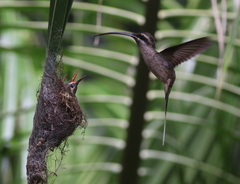
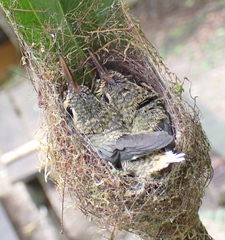
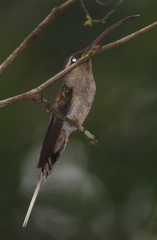
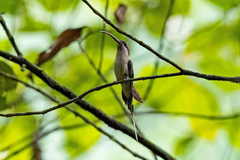
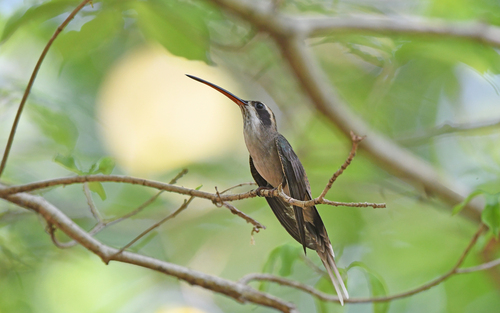
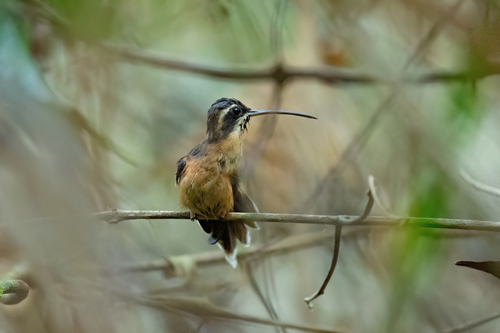
Great-billed Hermit

Great-billed Hermit

Phaethornis malaris

Silhouette: Andy Wilson · PhyloPic

LCLeast ConcernNTVUENCR
Daily sighting probability <5% · Rare
at Sierra de la Macarena National Park

In 3 days ~10% in a week ~30%

47 Verified sightings at Sierra de la Macarena National Park From 2019 to 2026
1,070 In all 8 parks
January Best month
☀️ Diurnal When it's spotted

About the Great-billed Hermit

The great-billed hermit (Phaethornis malaris) is a species of hummingbird in the family Trochilidae. It is found in Bolivia, Brazil, Colombia, Ecuador, French Guiana, Peru, Suriname, and Venezuela. The great-billed hermit's taxonomy is confusing. What are now the long-billed hermit (P. longirostris) and long-tailed hermit (P. superciliosus) were considered conspecific and included many subspecies that are now assigned to the great-billed hermit. A satisfactory taxonomic treatment of the entire P. longirostris/P. superciliosus/P. malaris group is still lacking according to some Neotropical ornithologists.

These six subspecies of great-billed hermit are generally recognized: At least two other populations within the existing subspecies have been suggested as additional subspecies. ��2... Wikipedia →

Sounds

Song0:31

Ecuador · 2026

© Daan van der Hoeven · XC1165277 · CC BY-NC-SA 4.0

Call0:36

Ecuador · 2023

© Barry Edmonston · XC817463 · CC BY-NC-SA 4.0

Flight call0:19

Ecuador · 2019

© Jerome Fischer · XC476024 · CC BY-NC-SA 4.0

Global Distribution

Parks Where Found

# Park Country Daily sighting probability
1 Yasuní National Park 🇪🇨 Ecuador
~10%
2 Manu National Park 🇵🇪 Peru
~10%
3 Amboró National Park 🇧🇴 Bolivia
~10%
4 Sierra de la Macarena National Park 🇨🇴 Colombia
<5%
5 Amacayacu National Natural Park 🇨🇴 Colombia
<5%
6 Cuyabeno Wildlife Reserve 🇪🇨 Ecuador
<5%
7 Tambopata National Reserve 🇵🇪 Peru
<5%
8 Podocarpus National Park 🇪🇨 Ecuador
<5%

Before you go

What are the chances of seeing a Great-billed Hermit in Sierra de la Macarena National Park?

Rare

Under 5% of wildlife watchers report a Great-billed Hermit sighting in Sierra de la Macarena National Park on a given day, based on 47 verified sightings from GBIF citizen-science data from 2019 to 2026. It is the 194th most-seen of the 418 birds we can rate there. Over three days the chance rises to about 10%, and over a week to about 30%, if each day is a fresh chance.

When is the best time to see a Great-billed Hermit in Sierra de la Macarena National Park?

December and January

In those months about 20% of wildlife watchers report a Great-billed Hermit in Sierra de la Macarena National Park on a given day, against under 5% in February–April and June–November, the lowest months. Those are among Sierra de la Macarena National Park's driest months, with about 120 mm of rain a month against 430 mm in May.

What time of day is best to see a Great-billed Hermit?

Between 11 am and 2 pm

Across all the parks we cover, that three-hour window holds the most Great-billed Hermit sightings with a recorded time, and about 8 in 10 of them come between 6 am and 6 pm: it is a daytime animal.

Is Sierra de la Macarena National Park the best place to see a Great-billed Hermit?

4th of 8

Of the 8 parks where we can rate Great-billed Hermit sightings, Sierra de la Macarena National Park ranks 4th at under 5%. The best odds are in Yasuní National Park (Ecuador, about 10%), Manu National Park (Peru, about 10%) and Amboró National Park (Bolivia, about 10%).

Which relatives of the Great-billed Hermit live in Sierra de la Macarena National Park?

Same genus: Phaethornis

The closest relatives of the Great-billed Hermit that you can see in Sierra de la Macarena National Park (genus Phaethornis, Typical Hermits) are Sooty-capped Hermit (about 10%) and Gray-chinned Hermit (about 10%), with each one's daily chance of a sighting.

Where does the Great-billed Hermit sighting chance come from?

GBIF citizen-science records

It is estimated from how often the Great-billed Hermit is recorded against all the birds logged in Sierra de la Macarena National Park (47 verified sightings from 2019 to 2026), calibrated against known sighting rates. Figures are rounded to the nearest 10% because citizen-science data supports honest approximations, not decimals, and months with records from fewer than five people show "—". How it works.

← Back to Sierra de la Macarena National Park