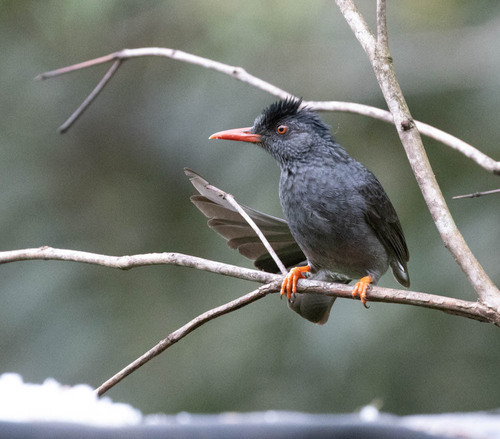
Ashy-headed Laughingthrush

Ashy-headed Laughingthrush

Garrulax cinereifrons

Silhouette: Jiekun He · PhyloPic

Daily sighting probability ~40% · Likely
at Sinharaja Forest Reserve

In 3 days ~80% in a week >90%

649 Verified sightings at Sinharaja Forest Reserve From 2019 to 2026
649 In 1 park
February Best month
☀️ Diurnal When it's spotted

About the Ashy-headed Laughingthrush

The ashy-headed laughingthrush (Argya cinereifrons) is a member of the family Leiothrichidae. The laughingthrushes are a large family of Old World passerine birds characterised by soft fluffy plumage. These are birds of tropical areas, with the greatest variety in southeast Asia.

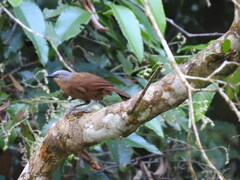
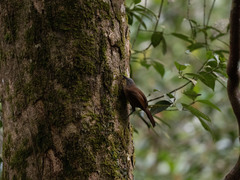
The ashy-headed laughingthrush was formerly placed in the genus Garrulax, but following the publication of an extensive molecular phylogenetic study in 2018, it was moved to the resurrected genus Argya. The ashy-headed laughingthrush is a rangy bird, 23 centimetres (9 in) in length with a long floppy tail. It is rufous brown above and deep buff below, with a grey head and white throat. Like other babblers, these are noisy birds, and the characteristic laughing calls are often the best indication that they are present, since they are usually difficult to see in their preferred habitat.

The ashy-headed laughingthrush is a resident breeding bird endemic to Sri Lanka. Its habitat is rainforest, and it is rarely seen away from deep jungle or dense bamboo thickets in the wet zone. This species, like most babblers, is not migratory, and has short rounded... Wikipedia →

Global Distribution

Parks Where Found

# Park Country Daily sighting probability
1 Sinharaja Forest Reserve 🇱🇰 Sri Lanka
~40%

More parks will be added in future updates.

Before you go

What are the chances of seeing an Ashy-headed Laughingthrush in Sinharaja Forest Reserve?

Likely

About 40% of wildlife watchers report an Ashy-headed Laughingthrush sighting in Sinharaja Forest Reserve on a given day, based on 649 verified sightings from GBIF citizen-science data from 2019 to 2026. It is the 28th most-seen of the 156 birds we can rate there. Over three days the chance rises to about 80%, and over a week to over 90%, if each day is a fresh chance.

When is the best time to see an Ashy-headed Laughingthrush in Sinharaja Forest Reserve?

February and May–July

In those months about 50% of wildlife watchers report an Ashy-headed Laughingthrush in Sinharaja Forest Reserve on a given day, against about 30% in March and November, the lowest months.

What time of day is best to see an Ashy-headed Laughingthrush?

Between 6 and 9 am

Across all the parks we cover, that three-hour window holds the most Ashy-headed Laughingthrush sightings with a recorded time, and about 9 in 10 of them come between 6 am and 6 pm: it is a daytime animal.

Where else can you see an Ashy-headed Laughingthrush?

Only Sinharaja Forest Reserve, in our data

Sinharaja Forest Reserve is the only park on Wallace's Line with enough records to rate Ashy-headed Laughingthrush sightings: about 40% of wildlife watchers there report one on a given day.

Which relatives of the Ashy-headed Laughingthrush live in Sinharaja Forest Reserve?

Same family: Leiothrichidae

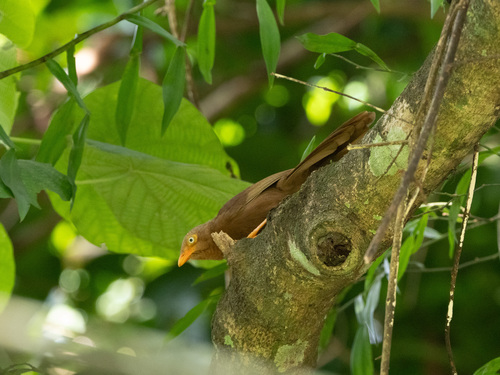
The closest relatives of the Ashy-headed Laughingthrush that you can see in Sinharaja Forest Reserve (family Leiothrichidae, Laughingthrushes and Allies) are Orange-billed Babbler (about 70%) and Yellow-billed Babbler (about 30%), with each one's daily chance of a sighting.

Where does the Ashy-headed Laughingthrush sighting chance come from?

GBIF citizen-science records

It is estimated from how often the Ashy-headed Laughingthrush is recorded against all the birds logged in Sinharaja Forest Reserve (649 verified sightings from 2019 to 2026), calibrated against known sighting rates. Figures are rounded to the nearest 10% because citizen-science data supports honest approximations, not decimals, and months with records from fewer than five people show "—". How it works.

← Back to Sinharaja Forest Reserve