Layard's Parakeet

Layard's Parakeet

Psittacula calthrapae

Silhouette: Farelli (photo), John E. McCormack, Michael G. Harvey, Brant C. Faircloth, Nicholas G. Crawford, Travis C. Glenn, Robb T. Brumfield & T. Michael Keesey · PhyloPic

Endemic
Daily sighting probability ~50% · Likely
at Sinharaja Forest Reserve

In 3 days ~90% in a week >90%

1,013 Verified sightings at Sinharaja Forest Reserve From 2019 to 2026
1,013 In 1 park
October Best month
🌅 Crepuscular When it's spotted

About the Layard's Parakeet

Layard's parakeet or the emerald-collared parakeet, (Psittacula calthrapae) is a parrot which is a resident endemic breeder in Sri Lanka. The common name of this bird commemorates the British naturalist Edgar Leopold Layard; his first wife, Barbara Anne Calthrop, whom he married in 1845, is commemorated in the specific epithet.

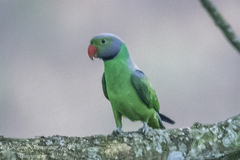
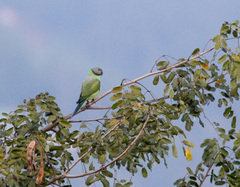
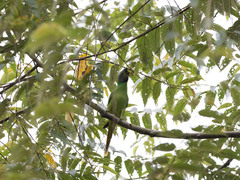
Layard's parakeet is a green parrot, 29 cm (11 in) long including a tail up to 13 cm (5.1 in). The adult has a bluish-grey head and back, separated by a green collar. There is a broad black chin stripe and the tail is blue tipped yellow. The upper mandible of the male's bill is red and the lower mandible is brown.

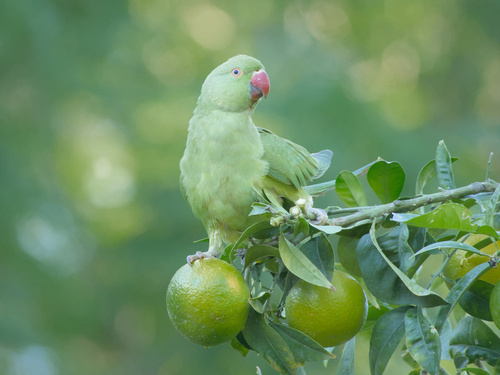
The female is similar, but has an all black beak and less green on the face than the male. Immature birds are mainly green, with an orange bill. Layard's parakeet is a bird of forests, particularly at the edges and in clearings, and also gardens. It is locally common. It undergoes local movements, driven mainly by the availability of the fruit, seeds, buds and blossoms that make up its diet. It is less gregarious than some of its relatives, and is usually in small groups outside the breeding season, when it often... Wikipedia →

Sounds

Call0:18

Sri Lanka · 2021

© THILANKA EDIRISINGHE · XC649190 · CC BY-NC-SA 4.0

Flight call0:09

Sri Lanka · 2007

© Jelle Scharringa · XC680653 · CC BY-NC-SA 4.0

Song0:13

Sri Lanka · 2014

© Mike Nelson · XC207755 · CC BY-NC-SA 4.0

Global Distribution

Parks Where Found

# Park Country Daily sighting probability
1 Sinharaja Forest Reserve 🇱🇰 Sri Lanka
~50%

More parks will be added in future updates.

Cities Where Found

# City Country Daily sighting probability
1 Colombo [Sri Jayawardenepura Kotte] 🇱🇰 Sri Lanka
<5%

Zoos & Centres Where Found

# Zoo / Centre Country
1 Loro Parque 🇪🇸 Spain In captivity

Before you go

What are the chances of seeing a Layard's Parakeet in Sinharaja Forest Reserve?

Likely

About 50% of wildlife watchers report a Layard's Parakeet sighting in Sinharaja Forest Reserve on a given day, based on 1,013 verified sightings from GBIF citizen-science data from 2019 to 2026. It is the 16th most-seen of the 156 birds we can rate there. Over three days the chance rises to about 90%, and over a week to over 90%, if each day is a fresh chance.

When is the best time to see a Layard's Parakeet in Sinharaja Forest Reserve?

October

In that month about 70% of wildlife watchers report a Layard's Parakeet in Sinharaja Forest Reserve on a given day, against about 50% in April, June–July, September and December–February, the lowest months. That is one of Sinharaja Forest Reserve's wettest months, with about 470 mm of rain against 150 mm in March.

What time of day is best to see a Layard's Parakeet?

Between 11 am and 2 pm

Across all the parks we cover, that three-hour window holds the most Layard's Parakeet sightings with a recorded time, and about 6 in 10 of them come between 6 am and 6 pm: it is most active around dawn and dusk.

Where else can you see a Layard's Parakeet?

Only Sinharaja Forest Reserve, in our data

Sinharaja Forest Reserve is the only park on Wallace's Line with enough records to rate Layard's Parakeet sightings: about 50% of wildlife watchers there report one on a given day.

Where does the Layard's Parakeet sighting chance come from?

GBIF citizen-science records

It is estimated from how often the Layard's Parakeet is recorded against all the birds logged in Sinharaja Forest Reserve (1,013 verified sightings from 2019 to 2026), calibrated against known sighting rates. Figures are rounded to the nearest 10% because citizen-science data supports honest approximations, not decimals, and months with records from fewer than five people show "—". How it works.

← Back to Sinharaja Forest Reserve