Poppy's Shrub Frog

Poppy's Shrub Frog

Pseudophilautus poppiae

Silhouette: PhyloPic

LCNTVUENCRCritically Endangered Endemic
Daily sighting probability ~10% · With luck
at Sinharaja Forest Reserve

In 3 days ~40% in a week ~70%

16 Verified sightings at Sinharaja Forest Reserve From 2019 to 2026
16 In 1 park
October Best month
🌙 Nocturnal When it's spotted

About the Poppy's Shrub Frog

Pseudophilautus poppiae, also known as Poppy's shrub frog, is a species of frog in the family Rhacophoridae. It is endemic to Sri Lanka. Its natural habitat is subtropical or tropical moist montane forests.Scientists have seen it between 1060 and 1270 meters above sea level.

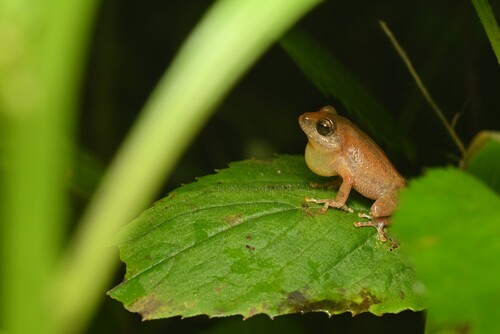
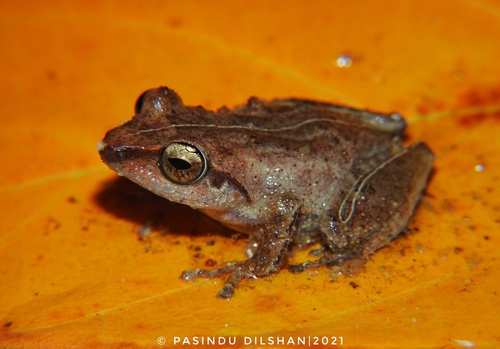
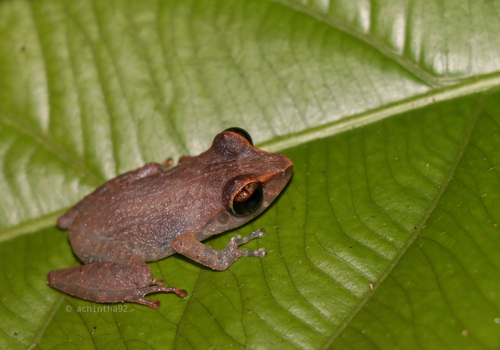
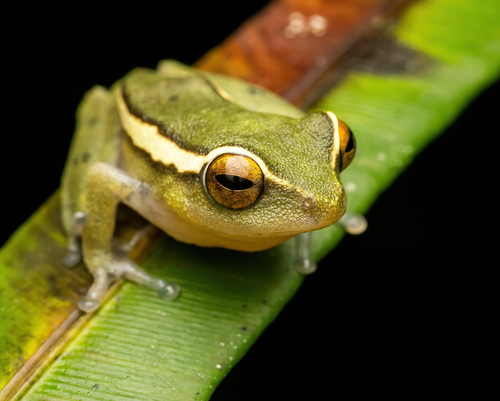
The adult male frog measures 21.3 – 24.7 mm in snout-vent length and the adult female frog about 26.0 mm long. The top and sides of the head are bright, luminous green in color. Some of these frogs have red spots on their backs, but most have black spots. The flanks are yellow in color. The middle of the body and the tops of the hind legs are yellow-brown in color. Parts of the mouth are yellow or white in color. The tops of the front legs are yellow green-yellow in color. There are white stripes on the outer edges of the front legs. The inner sides of the front legs are yellow. The belly is yellow.

This frog is strictly arboreal. It lives in cloud forests where the tree branches form a closed canopy. It lives in the lower branches and in shrubs. People have seen the male frogs sitting on plants 1–3 m above the ground. This frog can also live in lightly planted cardamom plots.

Scientists named this frog for Poppy Valentina Meyer because both her parents supported the Global Amphibian Assessment. Like other frogs in Pseudophilautus, P. poppiae undergoes direct development, hatching as a froglet with no free-swimming tadpole stage.

It is threatened by habitat loss. Scientists cite urbanization, grazing, and logging. Wikipedia →

Global Distribution

Parks Where Found

# Park Country Daily sighting probability
1 Sinharaja Forest Reserve 🇱🇰 Sri Lanka
~10%

More parks will be added in future updates.

Closest Relatives at Sinharaja Forest Reserve

Before you go

What are the chances of seeing a Poppy's Shrub Frog in Sinharaja Forest Reserve?

With luck

About 10% of wildlife watchers report a Poppy's Shrub Frog sighting in Sinharaja Forest Reserve on a given day, based on 16 verified sightings from GBIF citizen-science data from 2019 to 2026. It is the 23rd most-seen of the 25 amphibians we can rate there. Over three days the chance rises to about 40%, and over a week to about 70%, if each day is a fresh chance.

When is the best time to see a Poppy's Shrub Frog in Sinharaja Forest Reserve?

October

In that month about 30% of wildlife watchers report a Poppy's Shrub Frog in Sinharaja Forest Reserve on a given day, against under 5% in May, July, September and December, the lowest months. That is one of Sinharaja Forest Reserve's wettest months, with about 470 mm of rain against 150 mm in March.

What time of day is best to see a Poppy's Shrub Frog?

Between 7 and 10 pm

Across all the parks we cover, that three-hour window holds the most Poppy's Shrub Frog sightings with a recorded time, and about 9 in 10 of them come between 6 pm and 6 am: it is mostly seen at night.

Where else can you see a Poppy's Shrub Frog?

Only Sinharaja Forest Reserve, in our data

Sinharaja Forest Reserve is the only park on Wallace's Line with enough records to rate Poppy's Shrub Frog sightings: about 10% of wildlife watchers there report one on a given day.

Where does the Poppy's Shrub Frog sighting chance come from?

GBIF citizen-science records

It is estimated from how often the Poppy's Shrub Frog is recorded against all the amphibians logged in Sinharaja Forest Reserve (16 verified sightings from 2019 to 2026), calibrated against known sighting rates. Figures are rounded to the nearest 10% because citizen-science data supports honest approximations, not decimals, and months with records from fewer than five people show "—". How it works.

← Back to Sinharaja Forest Reserve