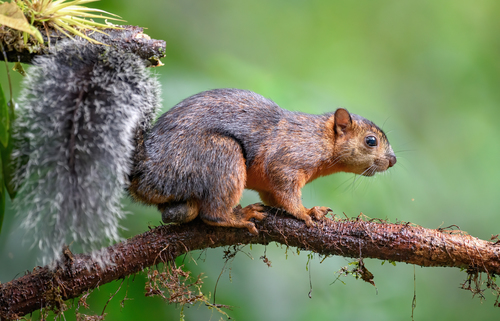
Andean Porcupine

Andean Porcupine

Coendou quichua

Silhouette: PhyloPic

Daily sighting probability ~10% · With luck
at Soberanía National Park

In 3 days ~30% in a week ~60%

22 Verified sightings at Soberanía National Park From 2019 to 2026
22 In 1 park
August Best month
☀️🌙 Day & Night When it's spotted

About the Andean Porcupine

The Andean porcupine (Coendou quichua) or Quichua porcupine is a species of rodent in the family Erethizontidae. It is found in the Andes of northern Ecuador and Colombia as well as in Panama. This porcupine is little known, but is probably arboreal, nocturnal and solitary like its relatives. The species is thought to be uncommon to rare and the population decreasing. It is threatened by deforestation, habitat fragmentation and agriculture.

Although it is morphologically distinctive, it has sometimes been described as a subspecies of the bicolored-spined porcupine (C. bicolor). However, genetic studies have shown it to be closest to the stump-tailed porcupine (C. rufescens). Rothschild's porcupine (C. rothschildi) of Panama was formerly considered a distinct species, but phylogenetic evidence indicates that both are synonymous.

The Andean porcupine is a medium-sized porcupine with a head-and-body length of between 332 and 420 mm (13.1 and 16.5 in) and a tail length of between 290 and 413 mm (11.4 and 16.3 in). A fully grown adult weighs in the region of 2 kg (4 lb). The nose is pink and large, and the eyes are small. The body is spiny all over, the evenly... Wikipedia →

Global Distribution

Parks Where Found

# Park Country Daily sighting probability
1 Soberanía National Park 🇵🇦 Panama
~10%

More parks will be added in future updates.

Zoos & Centres Where Found

# Zoo / Centre Country
1 Capron Park Zoo 🇺🇸 United States In captivity

Before you go

What are the chances of seeing an Andean Porcupine in Soberanía National Park?

With luck

About 10% of wildlife watchers report an Andean Porcupine sighting in Soberanía National Park on a given day, based on 22 verified sightings from GBIF citizen-science data from 2019 to 2026. It is the 21st most-seen of the 36 mammals we can rate there. Over three days the chance rises to about 30%, and over a week to about 60%, if each day is a fresh chance.

When is the best time to see an Andean Porcupine in Soberanía National Park?

August and September

In those months about 20% of wildlife watchers report an Andean Porcupine in Soberanía National Park on a given day, against under 5% in July, the lowest month. Those are among Soberanía National Park's wettest months, with about 310 mm of rain a month against 25 mm in February.

What time of day is best to see an Andean Porcupine?

Between 7 and 10 pm

Across all the parks we cover, that three-hour window holds the most Andean Porcupine sightings with a recorded time, and about half of them come between 6 pm and 6 am: it is seen both by day and at night.

Where else can you see an Andean Porcupine?

Only Soberanía National Park, in our data

Soberanía National Park is the only park on Wallace's Line with enough records to rate Andean Porcupine sightings: about 10% of wildlife watchers there report one on a given day.

Which relatives of the Andean Porcupine live in Soberanía National Park?

Same order: Rodentia

The closest relatives of the Andean Porcupine that you can see in Soberanía National Park (order Rodentia, Rodents) are Central American Agouti (about 70%), Lesser Capybara (about 30%) and Red-tailed Squirrel (about 30%), with each one's daily chance of a sighting.

Where does the Andean Porcupine sighting chance come from?

GBIF citizen-science records

It is estimated from how often the Andean Porcupine is recorded against all the mammals logged in Soberanía National Park (22 verified sightings from 2019 to 2026), calibrated against known sighting rates. Figures are rounded to the nearest 10% because citizen-science data supports honest approximations, not decimals, and months with records from fewer than five people show "—". How it works.

← Back to Soberanía National Park