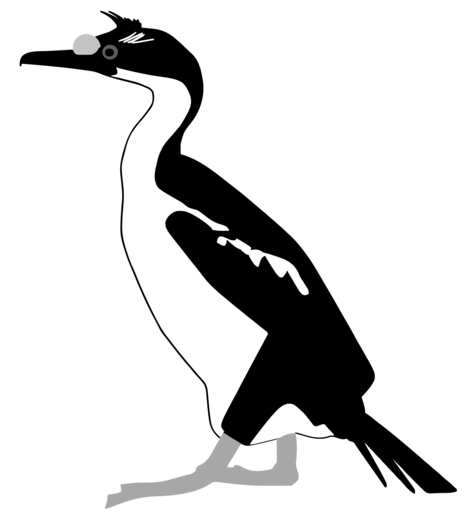
Imperial Shag

Imperial Shag

Leucocarbo atriceps

Silhouette: Edwin Price · PhyloPic

LCLeast ConcernNTVUENCR
Daily sighting probability ~90% · Very likely
at South Georgia and the South Sandwich Islands
1,091 Verified sightings at South Georgia and the South Sandwich Islands From 2019 to 2026
5,995 In all 6 parks
January Best month
☀️ Diurnal When it's spotted

About the Imperial Shag

The imperial shag or imperial cormorant (Leucocarbo atriceps) is a black-and-white cormorant native to southern South America, islands of the Subantarctic, and the Antarctic Peninsula, primarily in rocky coastal regions, but locally also at large inland lakes. Some taxonomic authorities, including the International Ornithologists' Union, place it in the genus Leucocarbo, others in the genus Phalacrocorax. It is also known as the blue-eyed shag, blue-eyed cormorant and by many other names, and is one of a larger group of cormorants called blue-eyed shags. The taxonomy is complex, and several types are treated as either subspecies or separate species.

The imperial shag was formally described in 1828 by the Royal Navy officer Phillip Parker King based on a specimen that he had collected in the Strait of Magellan of southern Chile. He placed the species in the genus Phalacrocorax and coined the binomial name Phalacrocorax atriceps, where the specific epithet combines the Latin ater meaning "black" with -ceps meaning "-capped" or "-headed". The imperial shag was formerly usually retained in the genus Phalacrocorax, but has also sometimes been placed in its own genus Notocarbo...

Wikipedia →

Sounds

Call0:43

United Kingdom · 2013

© Michele Peron · XC187942 · CC BY-NC-SA 4.0

Global Distribution

Parks Where Found

# Park Country Daily sighting probability
1 South Georgia and the South Sandwich Islands 🇬🇸 South Georgia and the South Sandwich Islands
~90%
2 Antarctic Peninsula & South Shetland Islands 🇦🇶 Antarctica
~80%
3 Falkland Islands 🇫🇰 Falkland Islands
~70%
4 Península Valdés 🇦🇷 Argentina
~70%
5 Tierra del Fuego National Park 🇦🇷 Argentina
~50%
6 Nahuel Huapi National Park 🇦🇷 Argentina
<5%

Closest Relatives at South Georgia and the South Sandwich Islands

No species of the same family or order lives in South Georgia and the South Sandwich Islands, so these are its closest relatives here: other birds.

Before you go

What are the chances of seeing an Imperial Shag in South Georgia and the South Sandwich Islands?

Very likely

About 90% of wildlife watchers report an Imperial Shag sighting in South Georgia and the South Sandwich Islands on a given day, based on 1,091 verified sightings from GBIF citizen-science data from 2019 to 2026. It is the 2nd most-seen of the 37 birds we can rate there.

When is the best time to see an Imperial Shag in South Georgia and the South Sandwich Islands?

January and October

In those months over 90% of wildlife watchers report an Imperial Shag in South Georgia and the South Sandwich Islands on a given day, against about 70% in May, the lowest month. July and August have too few records to rate.

What time of day is best to see an Imperial Shag?

Between 2 and 5 pm

Across all the parks we cover, that three-hour window holds the most Imperial Shag sightings with a recorded time, and about 8 in 10 of them come between 6 am and 6 pm: it is a daytime animal.

Is South Georgia and the South Sandwich Islands the best place to see an Imperial Shag?

Yes

Of the 6 parks where we can rate Imperial Shag sightings, South Georgia and the South Sandwich Islands has the highest daily chance: about 90%. Next come Antarctic Peninsula & South Shetland Islands (Antarctica, about 80%) and Falkland Islands (Falkland Islands, about 70%). All parks ranked.

Where does the Imperial Shag sighting chance come from?

GBIF citizen-science records

It is estimated from how often the Imperial Shag is recorded against all the birds logged in South Georgia and the South Sandwich Islands (1,091 verified sightings from 2019 to 2026), calibrated against known sighting rates. Figures are rounded to the nearest 10% because citizen-science data supports honest approximations, not decimals, and months with records from fewer than five people show "—". How it works.

← Back to South Georgia and the South Sandwich Islands