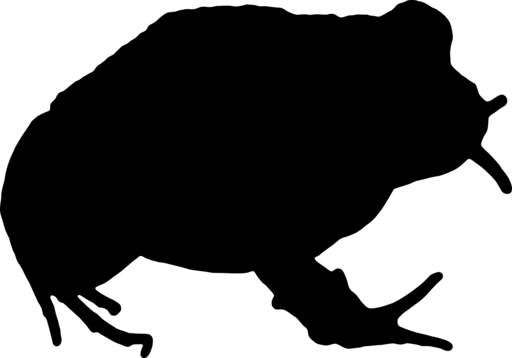
Great Barred Frog

Great Barred Frog

Mixophyes fasciolatus

Silhouette: Jose Carlos Arenas-Monroy · PhyloPic

LCLeast ConcernNTVUENCR Endemic
Daily sighting probability ~40% · Likely
at Springbrook National Park

In 3 days ~70% in a week >90%

115 Verified sightings at Springbrook National Park From 2019 to 2026
174 In all 2 parks
February Best month
🌙 Nocturnal When it's spotted

About the Great Barred Frog

The great barred frog (Mixophyes fasciolatus) is an Australian ground-dwelling frog of the genus Mixophyes. The great barred frog reaches a size of 8 centimetres and has large, powerful legs. It has a dark brown dorsal surface and a white ventral surface. The thighs are yellow blotched with black and it has parallel black bars along the legs. A dark line begins at the snout, passes through the eye and over the tympanum, and bends down behind the tympanum. Its feet are fully webbed and hands completely un-webbed. Its eyes are on top of the head and the tympanum is visible.

The tadpoles are quite large, reaching 8.5 centimetres long, and are grey-brown or gold-brown in colour. The great barred frog is a ground-dwelling frog which inhabits rainforests, Antarctic beech forests, or wet sclerophyll forests. This frog breeds in both streams and ponds, and it calls from the surrounding land. All the other frogs of the genus Mixophyes breed only in streams. The mating call is a very loud "wark-wark-wark" which is occasionally followed by a softer, slow trill "bwaaark-bwaaark".

The male and female great barred frog will enter the water for amplexus... Wikipedia →

Sounds

Recording0:35

Australia · 2023

© pimelea · iNaturalist · CC BY 4.0

Recording0:04

Australia · 2024

© Bobby · iNaturalist · CC BY-NC 4.0

Recording0:08

Australia · 2024

© gandalfbiginaturals · iNaturalist · CC BY-NC 4.0

Global Distribution

Parks Where Found

# Park Country Daily sighting probability
1 Springbrook National Park 🇦🇺 Australia
~40%
2 Lamington National Park 🇦🇺 Australia
~30%

Before you go

What are the chances of seeing a Great Barred Frog in Springbrook National Park?

Likely

About 40% of wildlife watchers report a Great Barred Frog sighting in Springbrook National Park on a given day, based on 115 verified sightings from GBIF citizen-science data from 2019 to 2026. It is the most-seen of the 11 amphibians we can rate there. Over three days the chance rises to about 70%, and over a week to over 90%, if each day is a fresh chance.

When is the best time to see a Great Barred Frog in Springbrook National Park?

December to February

In those months about 50% of wildlife watchers report a Great Barred Frog in Springbrook National Park on a given day, against about 10% in May and July–September, the lowest months. Those are among Springbrook National Park's wettest months, with about 160 mm of rain a month against 45 mm in August.

What time of day is best to see a Great Barred Frog?

Between 6 and 9 pm

Across all the parks we cover, that three-hour window holds the most Great Barred Frog sightings with a recorded time, and about 8 in 10 of them come between 6 pm and 6 am: it is mostly seen at night.

Is Springbrook National Park the best place to see a Great Barred Frog?

Yes

Of the 2 parks where we can rate Great Barred Frog sightings, Springbrook National Park has the highest daily chance: about 40%. Next come Lamington National Park (Australia, about 30%).

Where does the Great Barred Frog sighting chance come from?

GBIF citizen-science records

It is estimated from how often the Great Barred Frog is recorded against all the amphibians logged in Springbrook National Park (115 verified sightings from 2019 to 2026), calibrated against known sighting rates. Figures are rounded to the nearest 10% because citizen-science data supports honest approximations, not decimals, and months with records from fewer than five people show "—". How it works.

← Back to Springbrook National Park