Paradise Riflebird

Paradise Riflebird

Ptiloris paradiseus

Silhouette: Federico Pelliccioni · PhyloPic

Endemic
Daily sighting probability ~10% · With luck
at Springbrook National Park

In 3 days ~20% in a week ~50%

54 Verified sightings at Springbrook National Park From 2019 to 2026
2,027 In all 2 parks
August Best month
☀️ Diurnal When it's spotted

About the Paradise Riflebird

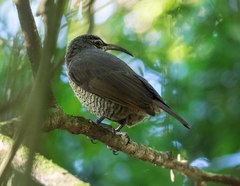
The paradise riflebird (Ptiloris paradiseus) is a passerine bird of the family Paradisaeidae. It is one of four riflebird species in the genus Ptiloris. It is found in subtropical, temperate rainforests in eastern Australia. The species is sexually dimorphic; the male is black with iridescent blue-green patches, while the female is gray-brown and white.

The paradise riflebird is frugivorous and insectivorous. During breeding season, males are promiscuous and perform solitary displays for females, which involves moving rapidly from side to side with the head tilted back, showing off the neck plumage.

The paradise riflebird was formally described in 1825 by the English naturalist William Swainson under the current binomial name Ptiloris paradiseus. It is one of the four riflebird species that are now placed in the genus Ptiloris. The common name "riflebird" comes from the likeness of their black velvety plumage to the uniform of the British Army Rifle Brigade.

There are no recognised subspecies of the paradise riflebird. It is similar in appearance to the other riflebird species, with males having similar iridescent blue-green patches and females appearing gray-brown with... Wikipedia →

Sounds

Song0:12

Australia · 2025

© Marc Anderson · XC1087218 · CC BY-NC-ND 4.0

Call0:06

Australia · 2019

© Mike fitzgerald · XC492220 · CC BY-NC-SA 4.0

Call0:36

Australia · 2016

© Greg McLachlan · XC336020 · CC BY-NC-SA 4.0

Global Distribution

Parks Where Found

# Park Country Daily sighting probability
1 Lamington National Park 🇦🇺 Australia
~50%
2 Springbrook National Park 🇦🇺 Australia
~10%

Before you go

What are the chances of seeing a Paradise Riflebird in Springbrook National Park?

With luck

About 10% of wildlife watchers report a Paradise Riflebird sighting in Springbrook National Park on a given day, based on 54 verified sightings from GBIF citizen-science data from 2019 to 2026. It is the 80th most-seen of the 136 birds we can rate there. Over three days the chance rises to about 20%, and over a week to about 50%, if each day is a fresh chance.

When is the best time to see a Paradise Riflebird in Springbrook National Park?

August

In that month about 20% of wildlife watchers report a Paradise Riflebird in Springbrook National Park on a given day, against under 5% in May and July, the lowest months. That is one of Springbrook National Park's driest months, with about 45 mm of rain against 210 mm in February.

What time of day is best to see a Paradise Riflebird?

Between 9 am and noon

Across all the parks we cover, that three-hour window holds the most Paradise Riflebird sightings with a recorded time, and about 9 in 10 of them come between 6 am and 6 pm: it is a daytime animal.

Is Springbrook National Park the best place to see a Paradise Riflebird?

2nd of 2

Of the 2 parks where we can rate Paradise Riflebird sightings, Springbrook National Park ranks 2nd at about 10%. The best odds are in Lamington National Park (Australia, about 50%).

Which relatives of the Paradise Riflebird live in Springbrook National Park?

Same order: Passeriformes

The closest relatives of the Paradise Riflebird that you can see in Springbrook National Park (order Passeriformes, Perching Birds) are Lewin's Honeyeater (about 80%), Eastern Whipbird (about 80%) and Pied Currawong (about 70%), with each one's daily chance of a sighting.

Where does the Paradise Riflebird sighting chance come from?

GBIF citizen-science records

It is estimated from how often the Paradise Riflebird is recorded against all the birds logged in Springbrook National Park (54 verified sightings from 2019 to 2026), calibrated against known sighting rates. Figures are rounded to the nearest 10% because citizen-science data supports honest approximations, not decimals, and months with records from fewer than five people show "—". How it works.

← Back to Springbrook National Park