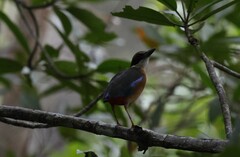
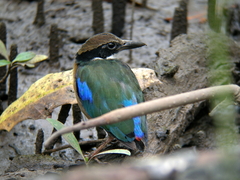
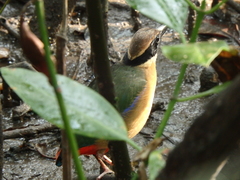
Mangrove Pitta

Mangrove Pitta

Pitta megarhyncha

Silhouette: Rachael Joakim · PhyloPic

LCNTNear ThreatenedVUENCR
Daily sighting probability ~10% · With luck
at Sundarbans National Park

In 3 days ~40% in a week ~60%

190 Verified sightings at Sundarbans National Park From 2019 to 2026
190 In 1 park
July Best month

About the Mangrove Pitta

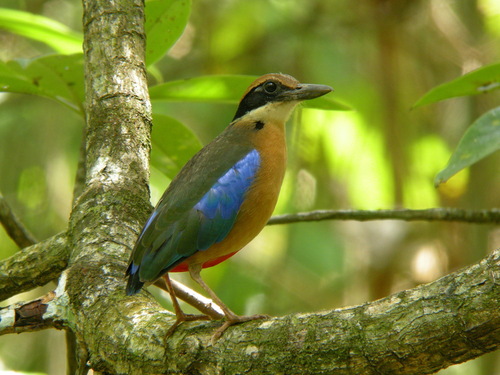
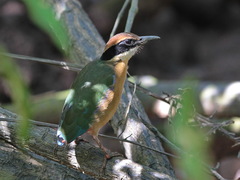
The mangrove pitta (Pitta megarhyncha) is a species of passerine bird in the family Pittidae native to the eastern Indian subcontinent and western Southeast Asia. It is part of a superspecies where it is placed with the Indian pitta, the fairy pitta and the blue-winged pitta but has no recognized subspecies. A colourful bird, it has a black head with brown crown, white throat, greenish upper parts, buff underparts and reddish vent area. Its range extends from India to Malaysia and Indonesia. It is found in mangrove and nipa palm forests where it feeds on crustaceans, mollusks and insects. Its call, sometimes rendered as wieuw-wieuw, is sung from a high perch on a mangrove tree.

The mangrove pitta was first described by German ornithologist Hermann Schlegel in 1863. Its species name is derived from the Ancient Greek words mega- "large", and rhynchos "beak". It forms a superspecies with the Indian pitta (P. brachyura), fairy pitta (P. nympha) and blue-winged pitta (P. moluccensis). Alternate common names include: Larger blue-winged/Malay pitta, Brève des palétuviers (in French), Große Blauflügelpitta (in German), and Pita de Manglar (in Spanish). There are no recognized... Wikipedia →
Sounds

Song0:36

Singapore · 2026

© Joan Theng · XC1093681 · CC BY-NC-SA 4.0

Alarm call0:28

Malaysia · 2025

© Ding Li Yong · XC1068118 · CC BY-NC-ND 4.0

Call0:19

Malaysia · 2022

© Wai Loon Wong · XC733476 · CC BY-NC-SA 4.0

Global Distribution

Parks Where Found

# Park Country Daily sighting probability
1 Sundarbans National Park 🇮🇳 India
~10%

More parks will be added in future updates.

Cities Where Found

# City Country Daily sighting probability
1 Singapore 🇸🇬 Singapore
<5%

Before you go

What are the chances of seeing a Mangrove Pitta in Sundarbans National Park?

With luck

About 10% of wildlife watchers report a Mangrove Pitta sighting in Sundarbans National Park on a given day, based on 190 verified sightings from GBIF citizen-science data from 2019 to 2026. It is the 69th most-seen of the 177 birds we can rate there. Over three days the chance rises to about 40%, and over a week to about 60%, if each day is a fresh chance.

When is the best time to see a Mangrove Pitta in Sundarbans National Park?

July

In that month about 50% of wildlife watchers report a Mangrove Pitta in Sundarbans National Park on a given day, against under 5% in October to January, the lowest months. That is one of Sundarbans National Park's wettest months, with about 480 mm of rain against 15 mm in January. May and June have too few records to rate.

Where else can you see a Mangrove Pitta?

Only Sundarbans National Park, in our data

Sundarbans National Park is the only park on Wallace's Line with enough records to rate Mangrove Pitta sightings: about 10% of wildlife watchers there report one on a given day.

Which relatives of the Mangrove Pitta live in Sundarbans National Park?

Same order: Passeriformes

The closest relatives of the Mangrove Pitta that you can see in Sundarbans National Park (order Passeriformes, Perching Birds) are Large-billed Crow (about 60%), Oriental Magpie-Robin (about 50%) and Bronzed Drongo (about 50%), with each one's daily chance of a sighting.

Where does the Mangrove Pitta sighting chance come from?

GBIF citizen-science records

It is estimated from how often the Mangrove Pitta is recorded against all the birds logged in Sundarbans National Park (190 verified sightings from 2019 to 2026), calibrated against known sighting rates. Figures are rounded to the nearest 10% because citizen-science data supports honest approximations, not decimals, and months with records from fewer than five people show "—". How it works.

← Back to Sundarbans National Park