Bank Cormorant

Bank Cormorant

Phalacrocorax neglectus

Silhouette: L. Shyamal · PhyloPic

LCNTVUENEndangeredCR
Daily sighting probability ~10% · With luck
at Table Mountain National Park

In 3 days ~20% in a week ~40%

473 Verified sightings at Table Mountain National Park From 2019 to 2026
482 In all 2 parks
October Best month
☀️ Diurnal When it's spotted

About the Bank Cormorant

The bank cormorant (Phalacrocorax neglectus), also known as Wahlberg's cormorant, is a medium-sized cormorant that is endemic to Namibia and the western seaboard of South Africa, living in and around coastal waters; it is rarely recorded more than 15 km offshore.

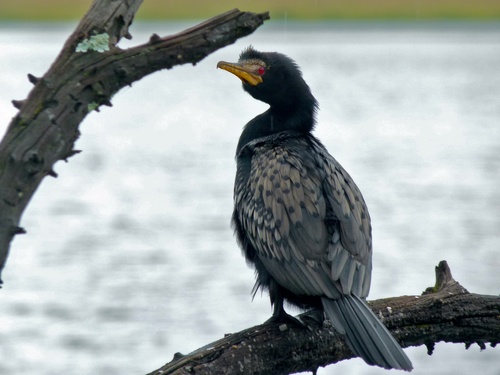
The bank cormorant is a heavy-bodied bird, roughly 75 cm in length. It is generally black in appearance with a bronze sheen, though the wings are a dark brown rather than a true black. Adults have a small crest on their heads, and normally have a white rump. Pale eyes in an all black face are considered to be distinctive for adults, with immature birds having dark eyes.

A prime food for these birds is the cape rock lobster Jasus lalandii, and their feeding distribution closely matches the kelp beds where these lobsters live, though the birds will also take a variety of other crustacean and fish prey, notably bearded goby Sufflogobius bibarbatus.

The birds may breed at any time of the year, laying two or three chalky-white eggs in a nest constructed from seaweed and guano. Numbers of these birds have been declining sharply in recent decades, partly because of commercial fishing... Wikipedia →

Global Distribution

Parks Where Found

# Park Country Daily sighting probability
1 Table Mountain National Park 🇿🇦 South Africa
~10%
2 West Coast National Park 🇿🇦 South Africa
<5%

Cities Where Found

# City Country Daily sighting probability
1 Cape Town 🇿🇦 South Africa
<5%

Zoos & Centres Where Found

# Zoo / Centre Country
1 Southern African Foundation for the Conservation of Coastal Birds 🇿🇦 South Africa In captivity

Before you go

What are the chances of seeing a Bank Cormorant in Table Mountain National Park?

With luck

About 10% of wildlife watchers report a Bank Cormorant sighting in Table Mountain National Park on a given day, based on 473 verified sightings from GBIF citizen-science data from 2019 to 2026. It is the 93rd most-seen of the 223 birds we can rate there. Over three days the chance rises to about 20%, and over a week to about 40%, if each day is a fresh chance.

When is the best time to see a Bank Cormorant in Table Mountain National Park?

March and June–November

In those months about 10% of wildlife watchers report a Bank Cormorant in Table Mountain National Park on a given day, against under 5% in April–May and December–February, the lowest months.

What time of day is best to see a Bank Cormorant?

Between 9 am and noon

Across all the parks we cover, that three-hour window holds the most Bank Cormorant sightings with a recorded time, and nearly all of them come between 6 am and 6 pm: it is a daytime animal.

Is Table Mountain National Park the best place to see a Bank Cormorant?

Yes

Of the 2 parks where we can rate Bank Cormorant sightings, Table Mountain National Park has the highest daily chance: about 10%. Next come West Coast National Park (South Africa, under 5%).

Which relatives of the Bank Cormorant live in Table Mountain National Park?

Same genus: Phalacrocorax

The closest relatives of the Bank Cormorant that you can see in Table Mountain National Park (genus Phalacrocorax, Typical Old World Cormorants) are Cape Cormorant (about 30%) and Great Cormorant (about 30%), with each one's daily chance of a sighting.

Where does the Bank Cormorant sighting chance come from?

GBIF citizen-science records

It is estimated from how often the Bank Cormorant is recorded against all the birds logged in Table Mountain National Park (473 verified sightings from 2019 to 2026), calibrated against known sighting rates. Figures are rounded to the nearest 10% because citizen-science data supports honest approximations, not decimals, and months with records from fewer than five people show "—". How it works.

← Back to Table Mountain National Park