Cape Cormorant

Cape Cormorant

Phalacrocorax capensis

Silhouette: L. Shyamal · PhyloPic

LCNTVUENEndangeredCR
Daily sighting probability ~30% · Possible
at Table Mountain National Park

In 3 days ~60% in a week ~90%

2,963 Verified sightings at Table Mountain National Park From 2019 to 2026
3,725 In all 7 parks
June Best month
☀️ Diurnal When it's spotted

About the Cape Cormorant

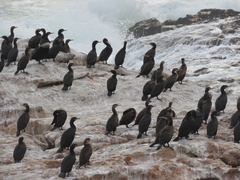
The Cape cormorant (Phalacrocorax capensis), also known as the Cape shag, is a member of the cormorant family. It is endemic to the southwestern coast of Africa, and classified as "Endangered" by the IUCN. The Cape cormorant is most closely related to the great cormorant and Japanese cormorant.

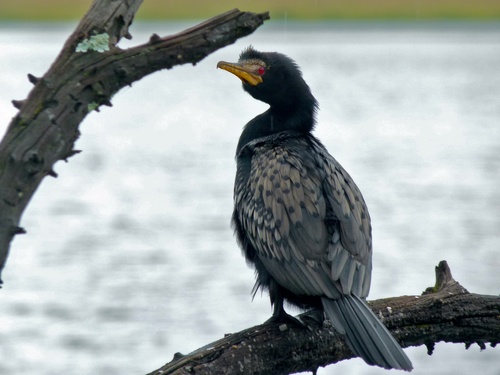
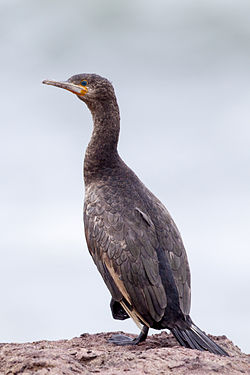
The Cape cormorant is a blue-black bird with a glossy shine. The entire body follows the same coloration. There is little to no sexual dimorphism, with both males and females measuring 61–64 cm and weighing 1.1-1.3 kg, along with a similar plumage. The beak is dark grey-black, and a deep yellow-orange gular pouch can be observed. The eyes are turquoise with a greenish eye-ring around them.

Both non-breeding and immature adults have duller plumage, with a brown throat for immature adults. Juveniles are browner than immature adults, with grey eyes and a black, white, or speckled gular pouch. Males and females have a wingspan of around 260 mm. For breeding adults, the wings are bottle green.

The Cape cormorant is one of the 12 species in the genus Phalacrocorax, one of the 7 genera in the family Phalacrocoracidae. Phalacrocorax diverged from its... Wikipedia →

Sounds

Call0:38

South Africa · 2017

© Peter Boesman · XC392619 · CC BY-NC-ND 4.0

Global Distribution

Parks Where Found

# Park Country Daily sighting probability
1 Table Mountain National Park 🇿🇦 South Africa
~30%
2 West Coast National Park 🇿🇦 South Africa
~20%
3 Garden Route National Park 🇿🇦 South Africa
~20%
4 De Hoop Nature Reserve 🇿🇦 South Africa
~10%
5 Addo Elephant National Park 🇿🇦 South Africa
~10%
6 Namib-Naukluft National Park 🇳🇦 Namibia
<5%
7 iSimangaliso Wetland Park 🇿🇦 South Africa
<5%

Cities Where Found

# City Country Daily sighting probability
1 Cape Town 🇿🇦 South Africa
~10%
2 Luanda 🇦🇴 Angola
~10%
3 Durban 🇿🇦 South Africa
<5%

Before you go

What are the chances of seeing a Cape Cormorant in Table Mountain National Park?

Possible

About 30% of wildlife watchers report a Cape Cormorant sighting in Table Mountain National Park on a given day, based on 2,963 verified sightings from GBIF citizen-science data from 2019 to 2026. It is the 26th most-seen of the 223 birds we can rate there. Over three days the chance rises to about 60%, and over a week to about 90%, if each day is a fresh chance.

When is the best time to see a Cape Cormorant in Table Mountain National Park?

June

In that month about 40% of wildlife watchers report a Cape Cormorant in Table Mountain National Park on a given day, against about 20% in April, August and December–January, the lowest months. That is one of Table Mountain National Park's wettest months, with about 110 mm of rain against 15 mm in February.

What time of day is best to see a Cape Cormorant?

Between noon and 3 pm

Across all the parks we cover, that three-hour window holds the most Cape Cormorant sightings with a recorded time, and nearly all of them come between 6 am and 6 pm: it is a daytime animal.

Is Table Mountain National Park the best place to see a Cape Cormorant?

Yes

Of the 7 parks where we can rate Cape Cormorant sightings, Table Mountain National Park has the highest daily chance: about 30%. Next come West Coast National Park (South Africa, about 20%) and Garden Route National Park (South Africa, about 20%).

Which relatives of the Cape Cormorant live in Table Mountain National Park?

Same genus: Phalacrocorax

The closest relatives of the Cape Cormorant that you can see in Table Mountain National Park (genus Phalacrocorax, Typical Old World Cormorants) are Great Cormorant (about 30%) and Bank Cormorant (about 10%), with each one's daily chance of a sighting.

Where does the Cape Cormorant sighting chance come from?

GBIF citizen-science records

It is estimated from how often the Cape Cormorant is recorded against all the birds logged in Table Mountain National Park (2,963 verified sightings from 2019 to 2026), calibrated against known sighting rates. Figures are rounded to the nearest 10% because citizen-science data supports honest approximations, not decimals, and months with records from fewer than five people show "—". How it works.

← Back to Table Mountain National Park