Forest Shrew

Forest Shrew

Myosorex varius

Silhouette: Becky Barnes · PhyloPic

LCLeast ConcernNTVUENCR
Daily sighting probability <5% · Rare
at Table Mountain National Park

In 3 days ~10% in a week ~20%

21 Verified sightings at Table Mountain National Park From 2019 to 2026
21 In 1 park
June Best month
☀️ Diurnal When it's spotted

About the Forest Shrew

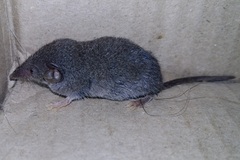
The forest shrew (Myosorex varius) is a species of shrew in the mouse shrew family, Soricidae. It is found in Lesotho, South Africa, and Eswatini. Its natural habitats include temperate forests, dry savanna, Mediterranean-type shrubby vegetation, and temperate grassland. The term "forest shrews" in the plural is sometimes confusingly used to collectively refer to a different genus, Sylvisorex.

The forest shrew grows to a length around 12.5 cm (5 in) with a tail of 4.3 cm (1.7 in) and an average mass of about 12 g (0.4 oz). In KwaZulu-Natal and the Drakensberg region, the males are larger than the females, but in the Cape Colony, the sexes are of similar sizes. This shrew is covered in short, dense fur, dark grey or brown above and paler underneath.

The forest shrew is native to South Africa, Lesotho, and Eswatini. In upland areas, it is often the commonest small mammal, but it is less common in coastal areas. It is found in a wide range of primary and secondary habitats, including forests, grassland, scrub, semidesert, karoo, and fynbos.

The forest shrew excavates a shallow burrow or takes over the burrow of another small... Wikipedia →

Global Distribution

Parks Where Found

# Park Country Daily sighting probability
1 Table Mountain National Park 🇿🇦 South Africa
<5%

More parks will be added in future updates.

Cities Where Found

# City Country Daily sighting probability
1 Cape Town 🇿🇦 South Africa
<5%

Closest Relatives at Table Mountain National Park

No species of the same family or order lives in Table Mountain National Park, so these are its closest relatives here: other mammals.

Before you go

What are the chances of seeing a Forest Shrew in Table Mountain National Park?

Rare

Under 5% of wildlife watchers report a Forest Shrew sighting in Table Mountain National Park on a given day, based on 21 verified sightings from GBIF citizen-science data from 2019 to 2026. It is the 30th most-seen of the 39 mammals we can rate there. Over three days the chance rises to about 10%, and over a week to about 20%, if each day is a fresh chance.

When is the best time to see a Forest Shrew in Table Mountain National Park?

June and December–January

In those months about 10% of wildlife watchers report a Forest Shrew in Table Mountain National Park on a given day, against under 5% in February–May and July–November, the lowest months.

What time of day is best to see a Forest Shrew?

Between 8 and 11 am

Across all the parks we cover, that three-hour window holds the most Forest Shrew sightings with a recorded time, and about 9 in 10 of them come between 6 am and 6 pm: it is a daytime animal.

Where else can you see a Forest Shrew?

Only Table Mountain National Park, in our data

Table Mountain National Park is the only park on Wallace's Line with enough records to rate Forest Shrew sightings: under 5% of wildlife watchers there report one on a given day.

Where does the Forest Shrew sighting chance come from?

GBIF citizen-science records

It is estimated from how often the Forest Shrew is recorded against all the mammals logged in Table Mountain National Park (21 verified sightings from 2019 to 2026), calibrated against known sighting rates. Figures are rounded to the nearest 10% because citizen-science data supports honest approximations, not decimals, and months with records from fewer than five people show "—". How it works.

← Back to Table Mountain National Park