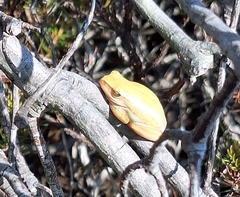
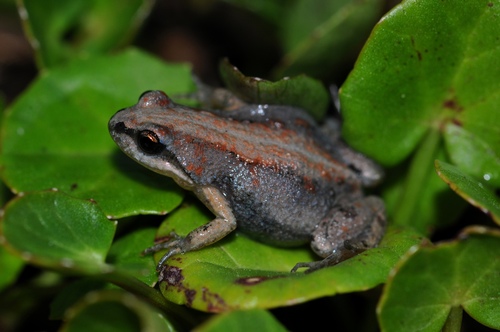
Horstock's Reed Frog

Horstock's Reed Frog

Hyperolius horstockii

Silhouette: Jose Carlos Arenas-Monroy · PhyloPic

LCLeast ConcernNTVUENCR Endemic
Daily sighting probability <5% · Rare
at Table Mountain National Park

In 3 days ~10% in a week ~30%

45 Verified sightings at Table Mountain National Park From 2019 to 2026
45 In 1 park
October Best month
☀️🌙 Day & Night When it's spotted

About the Horstock's Reed Frog

The arum frog, arum lily reed frog, Horstock's arum-frog, arum lily frog, or Horstock's reed frog (Hyperolius horstockii) is a species of frog in the family Hyperoliidae. It is endemic to South Africa. Adults grow to 40 mm in length. They have bright orange feet and can change their colour to camouflage themselves.

The top of the body is cream to brown, sometimes with small black spots. A distinctive, pale, dorsolateral line runs from the snout along the flanks, with a dark-brown lateral band underneath. A fine, dark line usually separates the pale line from the brown band. The concealed surfaces of limbs, webbing, and discs are orange to red. Underneath, the frog is creamy white and slightly granular. The gular flap in males is bright ochre. their pupils are horizontal.

Tadpoles reach 40 mm. They are brown with longitudinal, darker bands on their tails. The arum frog is found in the southern coastal plain of South Africa from Cape Town in the Western Cape to Port Elizabeth in the Eastern Cape.

Its natural habitats are Mediterranean-type shrubby vegetation, rivers, swamps, intermittent freshwater lakes, freshwater marshes, intermittent... Wikipedia →

Sounds

Recording0:15

South Africa · 2023

© Kayla Knight · iNaturalist · CC BY-NC 4.0

Recording0:27

South Africa · 2022

© celinehh · iNaturalist · CC BY-NC 4.0

Recording0:09

South Africa · 2020

Marius Burger · iNaturalist · CC0

Global Distribution

Parks Where Found

# Park Country Daily sighting probability
1 Table Mountain National Park 🇿🇦 South Africa
<5%

More parks will be added in future updates.

Cities Where Found

# City Country Daily sighting probability
1 Cape Town 🇿🇦 South Africa
~10%

Zoos & Centres Where Found

# Zoo / Centre Country
1 Two Oceans Aquarium 🇿🇦 South Africa In captivity

Closest Relatives at Table Mountain National Park

Before you go

What are the chances of seeing a Horstock's Reed Frog in Table Mountain National Park?

Rare

Under 5% of wildlife watchers report a Horstock's Reed Frog sighting in Table Mountain National Park on a given day, based on 45 verified sightings from GBIF citizen-science data from 2019 to 2026. It is the 14th most-seen of the 18 amphibians we can rate there. Over three days the chance rises to about 10%, and over a week to about 30%, if each day is a fresh chance.

When is the best time to see a Horstock's Reed Frog in Table Mountain National Park?

June and September–October

In those months about 10% of wildlife watchers report a Horstock's Reed Frog in Table Mountain National Park on a given day, against under 5% in July–August and November–May, the lowest months.

What time of day is best to see a Horstock's Reed Frog?

Between 9 am and noon

Across all the parks we cover, that three-hour window holds the most Horstock's Reed Frog sightings with a recorded time, and about 7 in 10 of them come between 6 am and 6 pm: it is seen both by day and at night.

Where else can you see a Horstock's Reed Frog?

Only Table Mountain National Park, in our data

Table Mountain National Park is the only park on Wallace's Line with enough records to rate Horstock's Reed Frog sightings: under 5% of wildlife watchers there report one on a given day.

Where does the Horstock's Reed Frog sighting chance come from?

GBIF citizen-science records

It is estimated from how often the Horstock's Reed Frog is recorded against all the amphibians logged in Table Mountain National Park (45 verified sightings from 2019 to 2026), calibrated against known sighting rates. Figures are rounded to the nearest 10% because citizen-science data supports honest approximations, not decimals, and months with records from fewer than five people show "—". How it works.

← Back to Table Mountain National Park