
Table Mountain Ghost Frog

Table Mountain Ghost Frog

Heleophryne rosei

Silhouette: Dmitry Bogdanov (vectorized by T. Michael Keesey) · PhyloPic

LCNTVUENEndangeredCR Endemic
Daily sighting probability <5% · Rare
at Table Mountain National Park

In 3 days ~10% in a week ~30%

77 Verified sightings at Table Mountain National Park From 2019 to 2026
77 In 1 park
February Best month
☀️ Diurnal When it's spotted

About the Table Mountain Ghost Frog

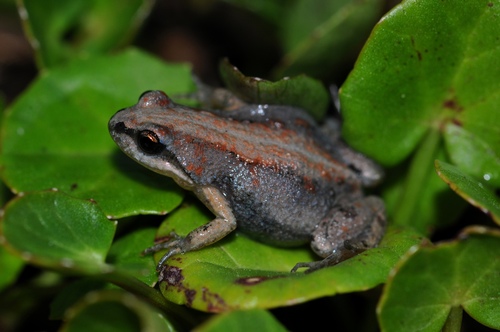
Rose's ghost frog (Heleophryne rosei), or Table Mountain ghost frog, is a species of frog in the family Heleophrynidae endemic to South Africa. It is a medium-sized species with purple or brown blotches on a pale green background and large discs on its fingers and toes. It has a very restricted range, being only known from the slopes of parts of Table Mountain. The tadpoles live in permanent streams but these are in danger of drying up because of the establishment of pine plantations. Because of its small range and changes in its habitat, this frog is listed as endangered by the International Union for Conservation of Nature.

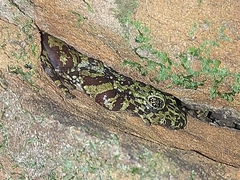
This is a moderately sized frog, with the larger female up to 60 mm (2.4 in) and the smaller male up to 50 mm (2.0 in) in length. The colouration of adults is striking, often a pale green background with purple to brown blotches. The fingers and toes have large, triangular terminal discs. A rudimentary thumb is present as a distinct inner metacarpal tubercle. The feet are half webbed, with one phalanx of the fifth toe free of web. The tadpole has neither an upper nor lower jaw sheath, but up to 17 rows of posterior labial teeth. The tadpole also... Wikipedia →

Global Distribution

Parks Where Found

# Park Country Daily sighting probability
1 Table Mountain National Park 🇿🇦 South Africa
<5%

More parks will be added in future updates.

Closest Relatives at Table Mountain National Park

Before you go

What are the chances of seeing a Table Mountain Ghost Frog in Table Mountain National Park?

Rare

Under 5% of wildlife watchers report a Table Mountain Ghost Frog sighting in Table Mountain National Park on a given day, based on 77 verified sightings from GBIF citizen-science data from 2019 to 2026. It is the 14th most-seen of the 18 amphibians we can rate there. Over three days the chance rises to about 10%, and over a week to about 30%, if each day is a fresh chance.

When is the best time to see a Table Mountain Ghost Frog in Table Mountain National Park?

February–March and November–December

In those months about 10% of wildlife watchers report a Table Mountain Ghost Frog in Table Mountain National Park on a given day, against under 5% in January and April–October, the lowest months. Those are among Table Mountain National Park's driest months, with about 25 mm of rain a month against 110 mm in June.

What time of day is best to see a Table Mountain Ghost Frog?

Between 11 am and 2 pm

Across all the parks we cover, that three-hour window holds the most Table Mountain Ghost Frog sightings with a recorded time, and about 8 in 10 of them come between 6 am and 6 pm: it is a daytime animal.

Where else can you see a Table Mountain Ghost Frog?

Only Table Mountain National Park, in our data

Table Mountain National Park is the only park on Wallace's Line with enough records to rate Table Mountain Ghost Frog sightings: under 5% of wildlife watchers there report one on a given day.

Which relatives of the Table Mountain Ghost Frog live in Table Mountain National Park?

Same order: Anura

The closest relatives of the Table Mountain Ghost Frog that you can see in Table Mountain National Park (order Anura, Frogs and Toads) are Western Leopard Toad (about 40%), Cape River Frog (about 40%) and Clicking Stream Frog (about 30%), with each one's daily chance of a sighting.

Where does the Table Mountain Ghost Frog sighting chance come from?

GBIF citizen-science records

It is estimated from how often the Table Mountain Ghost Frog is recorded against all the amphibians logged in Table Mountain National Park (77 verified sightings from 2019 to 2026), calibrated against known sighting rates. Figures are rounded to the nearest 10% because citizen-science data supports honest approximations, not decimals, and months with records from fewer than five people show "—". How it works.

← Back to Table Mountain National Park