Black-browed Barbet

Black-browed Barbet

Psilopogon oorti

Silhouette: Vijay Cavale (photo), John E. McCormack, Michael G. Harvey, Brant C. Faircloth, Nicholas G. Crawford, Travis C. Glenn, Robb T. Brumfield & T. Michael Keesey · PhyloPic

LCLeast ConcernNTVUENCR
Daily sighting probability <5% · Rare
at Taman Negara National Park

In 3 days <5% in a week ~10%

10 Verified sightings at Taman Negara National Park From 2019 to 2026
637 In all 3 parks
March Best month
🌅 Crepuscular When it's spotted

About the Black-browed Barbet

The black-browed barbet (Psilopogon oorti) is an Asian barbet native to Peninsular Malaysia and Sumatra, where it inhabits foremost forests between 600 and 2,000 m (2,000 and 6,600 ft) altitude. It is listed as Least Concern on the IUCN Red List because of its wide distribution and stable population.

Bucco oortii was the scientific name proposed by Salomon Müller in 1835 who described a barbet specimen collected in Sumatra. It was placed in the genus Megalaima proposed by George Robert Gray in 1842 who suggested to use this name instead of Bucco.

Molecular phylogenetic research of Asian barbets revealed that Megalaima species form a clade, which also includes the fire-tufted barbet, the only species placed in the genus Psilopogon at the time. Barbets formerly placed in this genus were therefore reclassified in the genus Psilopogon.

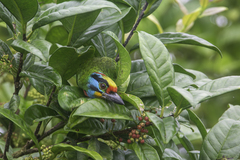
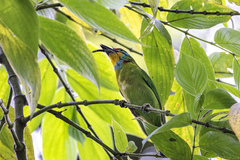
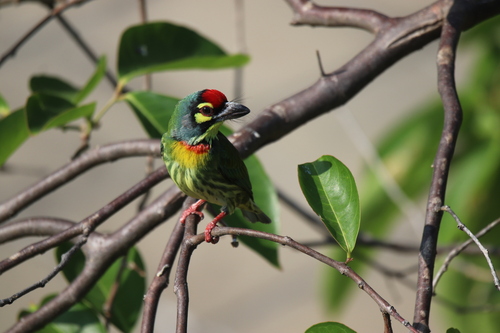
The black-browed barbet is mostly green with a yellow blue-bordered throat. It has black streaks above the eyes and red patches above its bill, lores, throat and nape. One female measured was 21.5 cm (8.5 in) long and weighed 62 g (2.2 oz).

The black-browed barbet inhabits montane and dipterocarp... Wikipedia →

Sounds

Song0:25

Malaysia · 2025

© Ding Li Yong · XC1024113 · CC BY-NC-ND 4.0

Call0:07

Malaysia · 2026

© Kim Chuah Lim · XC1147208 · CC BY-NC-SA 4.0

Song1:04

Malaysia · 2024

© Greg Irving · XC918087 · CC BY-NC-SA 4.0

Global Distribution

Parks Where Found

# Park Country Daily sighting probability
1 Kerinci Seblat National Park 🇮🇩 Indonesia
~70%
2 Gunung Leuser National Park 🇮🇩 Indonesia
<5%
3 Taman Negara National Park 🇲🇾 Malaysia
<5%

Before you go

What are the chances of seeing a Black-browed Barbet in Taman Negara National Park?

Rare

Under 5% of wildlife watchers report a Black-browed Barbet sighting in Taman Negara National Park on a given day, based on 10 verified sightings from GBIF citizen-science data from 2019 to 2026. It is the 251st most-seen of the 293 birds we can rate there. Over three days the chance rises to under 5%, and over a week to about 10%, if each day is a fresh chance.

When is the best time to see a Black-browed Barbet in Taman Negara National Park?

Any time of year

In every month with enough records, under 5% of wildlife watchers report a Black-browed Barbet in Taman Negara National Park on a given day, so our monthly data shows no clear season.

What time of day is best to see a Black-browed Barbet?

Between 2 and 5 am

Across all the parks we cover, that three-hour window holds the most Black-browed Barbet sightings with a recorded time, and about half of them come between 6 pm and 6 am: it is most active around dawn and dusk.

Is Taman Negara National Park the best place to see a Black-browed Barbet?

3rd of 3

Of the 3 parks where we can rate Black-browed Barbet sightings, Taman Negara National Park ranks 3rd at under 5%. The best odds are in Kerinci Seblat National Park (Indonesia, about 70%) and Gunung Leuser National Park (Indonesia, under 5%).

Which relatives of the Black-browed Barbet live in Taman Negara National Park?

Same genus: Psilopogon

The closest relatives of the Black-browed Barbet that you can see in Taman Negara National Park (genus Psilopogon, Typical Asian Barbets) are Gold-whiskered Barbet (about 40%), Red-throated Barbet (about 30%) and Yellow-crowned Barbet (about 30%), with each one's daily chance of a sighting.

Where does the Black-browed Barbet sighting chance come from?

GBIF citizen-science records

It is estimated from how often the Black-browed Barbet is recorded against all the birds logged in Taman Negara National Park (10 verified sightings from 2019 to 2026), calibrated against known sighting rates. Figures are rounded to the nearest 10% because citizen-science data supports honest approximations, not decimals, and months with records from fewer than five people show "—". How it works.

← Back to Taman Negara National Park