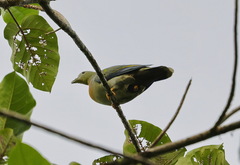
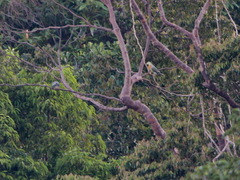
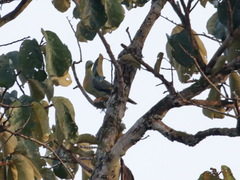
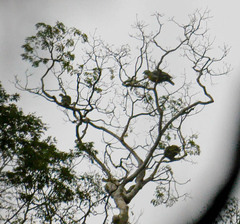
Large Green-Pigeon

Large Green-Pigeon

Treron capellei

Silhouette: Sheatherius · PhyloPic

LCNTVUVulnerableENCR
Daily sighting probability ~20% · Possible
at Taman Negara National Park

In 3 days ~60% in a week ~80%

313 Verified sightings at Taman Negara National Park From 2019 to 2026
438 In all 4 parks
August Best month
☀️ Diurnal When it's spotted

About the Large Green-Pigeon

The large green pigeon (Treron capellei) is a species of bird in the family Columbidae. It is found in Brunei, Indonesia, Malaysia, Myanmar, and Thailand. Its natural habitat is subtropical or tropical moist lowland forests. It is threatened by habitat loss.

The population of the large green pigeon is estimated to be at approximately 15,000 to 30,000 individuals across its range in Southeast Asia. This bird inhabits primary and secondary evergreen rainforests, almost always in the lowland but may inhabit foothills of up to 1,500 metres (4,900 ft) high. Small flocks generate in the high canopies of the rainforest in search of fruiting trees. Although this bird is primarily active during the day, nocturnal movements have been noticed.

The largest threat to the large green pigeon is the deforestation of its forest home. Large amounts of its original habitat have been cut down due to illegal logging and making way for palm oil plantations which have also had a devastating effect on other species.

BirdLife Species Factsheet. 3D specimen Wikipedia →

Sounds

Song0:08

Indonesia · 2019

© Matt Slaymaker · XC530095 · CC BY-NC-SA 4.0

Call0:16

Malaysia · 2014

© Marc Anderson · XC176179 · CC BY-NC-ND 4.0

Call0:10

Indonesia · 1997

© Martjan Lammertink · XC20585 · CC BY-NC-ND 2.5

Global Distribution

Parks Where Found

# Park Country Daily sighting probability
1 Taman Negara National Park 🇲🇾 Malaysia
~20%
2 Danum Valley Conservation Area 🇲🇾 Malaysia
<5%
3 Kinabatangan Wildlife Sanctuary 🇲🇾 Malaysia
<5%
4 Sepilok 🇲🇾 Malaysia
<5%

Before you go

What are the chances of seeing a Large Green-Pigeon in Taman Negara National Park?

Possible

About 20% of wildlife watchers report a Large Green-Pigeon sighting in Taman Negara National Park on a given day, based on 313 verified sightings from GBIF citizen-science data from 2019 to 2026. It is the 44th most-seen of the 293 birds we can rate there. Over three days the chance rises to about 60%, and over a week to about 80%, if each day is a fresh chance.

When is the best time to see a Large Green-Pigeon in Taman Negara National Park?

August

In that month about 40% of wildlife watchers report a Large Green-Pigeon in Taman Negara National Park on a given day, against under 5% in November, the lowest month.

What time of day is best to see a Large Green-Pigeon?

Between 6 and 9 am

Across all the parks we cover, that three-hour window holds the most Large Green-Pigeon sightings with a recorded time, and about 8 in 10 of them come between 6 am and 6 pm: it is a daytime animal.

Is Taman Negara National Park the best place to see a Large Green-Pigeon?

Yes

Of the 4 parks where we can rate Large Green-Pigeon sightings, Taman Negara National Park has the highest daily chance: about 20%. Next come Danum Valley Conservation Area (Malaysia, under 5%) and Kinabatangan Wildlife Sanctuary (Malaysia, under 5%).

Which relatives of the Large Green-Pigeon live in Taman Negara National Park?

Same genus: Treron

The closest relatives of the Large Green-Pigeon that you can see in Taman Negara National Park (genus Treron, Green-Pigeons) are Little Green-Pigeon (about 40%) and Thick-billed Green-Pigeon (about 30%), with each one's daily chance of a sighting.

Where does the Large Green-Pigeon sighting chance come from?

GBIF citizen-science records

It is estimated from how often the Large Green-Pigeon is recorded against all the birds logged in Taman Negara National Park (313 verified sightings from 2019 to 2026), calibrated against known sighting rates. Figures are rounded to the nearest 10% because citizen-science data supports honest approximations, not decimals, and months with records from fewer than five people show "—". How it works.

← Back to Taman Negara National Park