Roulroul

Roulroul

Rollulus rouloul

Silhouette: Andy Wilson · PhyloPic

LCNTVUVulnerableENCR
Daily sighting probability <5% · Rare
at Taman Negara National Park

In 3 days ~10% in a week ~30%

62 Verified sightings at Taman Negara National Park From 2019 to 2026
74 In all 3 parks
August Best month
☀️ Diurnal When it's spotted

About the Roulroul

The crested partridge (Rollulus rouloul), also known as the crested wood partridge, roul-roul, red-crowned wood partridge, green wood quail, and green wood partridge is a gamebird in the pheasant family Phasianidae of the order Galliformes, gallinaceous birds. It is the only member of the genus Rollulus.

This small partridge is a resident breeder in lowland rainforests in south Burma, south Thailand, Malaysia, Sumatra and Borneo. Its nest is a ground scrape lined with leaves, which is concealed under a heap of leaf litter. Five or six white eggs are incubated for 18 days.

Unusually for a galliform species, the young are fed bill-to-bill by both parents instead of pecking from the ground, and although precocial, they roost in the nest while small. The crested partridge is a rotund short-tailed bird, 25 cm (9.8 in) in length, with the male marginally larger than the female. Both sexes have a scarlet patch of bare skin around the eye and red legs without a spur or hind toe.

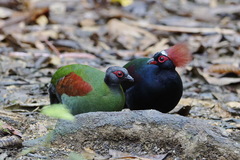
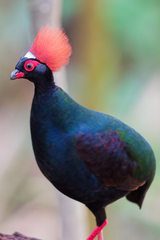
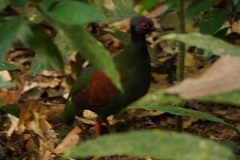
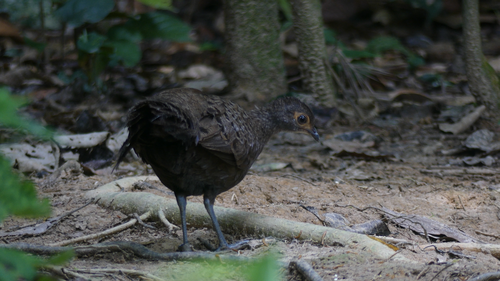
The male is metallic green above with glossy dark blue underparts and a brownish wing panel. The head is adorned with a tall red crest, a white forehead spot and black frontal bristles. The female has pea-green body plumage apart from the brown wing coverts. She has a slate-grey head with the bristles but no spot or crest. The bill is all-dark. Young birds are duller versions of the adult of the same sex. The song is a mournful whistled si-ul.

The crested partridge is usually seen singly or in pairs as it uses its feet to probe the forest floor for fruit, seeds and invertebrates. When disturbed, it prefers to run but if necessary it flies a short distance on its rounded wings.

There is some concern about the effect of habitat destruction on this bird, especially with regard to logging. However, it seems to be somewhat more adaptable than other southeast Asian pheasants. As of 2021, the crested wood partridge is evaluated as Vulnerable on the IUCN Red List of Threatened Species. It is listed on Appendix III of CITES. Wikipedia →

Sounds

Call1:08

Malaysia · 2026

© Ding Li Yong · XC1092145 · CC BY-NC-ND 4.0

Song0:16

Malaysia · 2015

© Marc Anderson · XC266127 · CC BY-NC-ND 4.0

Call0:30

Malaysia · 2025

© Nick Talbot · XC1015667 · CC BY-NC-SA 4.0

Global Distribution

Parks Where Found

# Park Country Daily sighting probability
1 Taman Negara National Park 🇲🇾 Malaysia
<5%
2 Way Kambas National Park 🇮🇩 Indonesia
<5%
3 Danum Valley Conservation Area 🇲🇾 Malaysia
<5%

Zoos & Centres Where Found

# Zoo / Centre Country
1 Disney's Animal Kingdom 🇺🇸 United States In captivity
2 Ragunan Zoo 🇮🇩 Indonesia In captivity
3 Pairi Daiza 🇧🇪 Belgium In captivity
4 ZooParc de Beauval 🇫🇷 France In captivity
5 Copenhagen Zoo 🇩🇰 Denmark In captivity
6 Planckendael Zoo 🇧🇪 Belgium In captivity
7 North Carolina Zoo 🇺🇸 United States In captivity
8 Zoo Pilsen 🇨🇿 Czechia In captivity
9 Aquarium de Lyon 🇫🇷 France In captivity
10 Harewood House 🇬🇧 United Kingdom In captivity
11 Zoo Miami 🇺🇸 United States In captivity
12 Toronto Zoo 🇨🇦 Canada In captivity
13 Minnesota Zoo 🇺🇸 United States In captivity
14 Columbus Zoo and Aquarium 🇺🇸 United States In captivity
15 Bronx Zoo 🇺🇸 United States In captivity
16 Sedgwick County Zoo 🇺🇸 United States In captivity
17 Omaha’s Henry Doorly Zoo and Aquarium 🇺🇸 United States In captivity
18 Milwaukee County Zoo 🇺🇸 United States In captivity
19 Toledo Zoo 🇺🇸 United States In captivity
20 Marwell Zoo 🇬🇧 United Kingdom In captivity
21 Wildgatter Oberrabenstein 🇩🇪 Germany In captivity
22 Colchester Zoo 🇬🇧 United Kingdom In captivity
23 Burgers' Ocean 🇳🇱 Netherlands In captivity
24 Dierenpark Hoenderdaell 🇳🇱 Netherlands In captivity
25 Primarily Primates 🇺🇸 United States In captivity
26 Duke Lemur Center 🇺🇸 United States In captivity
27 Moody Gardens 🇺🇸 United States In captivity
28 Tanganyika Wildlife Park 🇺🇸 United States In captivity
29 Fort Worth Zoo 🇺🇸 United States In captivity
30 Gatorland 🇺🇸 United States In captivity
31 Lisbon Zoo 🇵🇹 Portugal In captivity
32 Memphis Zoo 🇺🇸 United States In captivity
33 Natur- und Tierpark Goldau 🇨🇭 Switzerland In captivity
34 Wildlands 🇳🇱 Netherlands In captivity
35 Wilhelma 🇩🇪 Germany In captivity
36 Zoo Opole 🇵🇱 Poland In captivity
37 Zoologischer Garten Magdeburg 🇩🇪 Germany In captivity
38 Mesker Park Zoo and Botanic Garden 🇺🇸 United States In captivity
39 Zoo Atlanta 🇺🇸 United States In captivity
40 Riverbanks Zoo 🇺🇸 United States In captivity
41 Cleres Zoological Park 🇫🇷 France In captivity
42 Little Rock Zoo 🇺🇸 United States In captivity
43 Tiergarten Straubing 🇩🇪 Germany In captivity
44 John Ball Zoo 🇺🇸 United States In captivity
45 Wetheriggs Zoo and Animal Sanctuary 🇬🇧 United Kingdom In captivity
46 Gladys Porter Zoo 🇺🇸 United States In captivity
47 Paphos Zoo 🇨🇾 Cyprus In captivity
48 Loro Parque 🇪🇸 Spain In captivity
49 Happy Hollow Park & Zoo 🇺🇸 United States In captivity
50 Reid Park Zoo 🇺🇸 United States In captivity

Before you go

What are the chances of seeing a Roulroul in Taman Negara National Park?

Rare

Under 5% of wildlife watchers report a Roulroul sighting in Taman Negara National Park on a given day, based on 62 verified sightings from GBIF citizen-science data from 2019 to 2026. It is the 162nd most-seen of the 293 birds we can rate there. Over three days the chance rises to about 10%, and over a week to about 30%, if each day is a fresh chance.

When is the best time to see a Roulroul in Taman Negara National Park?

February, July–September and November–December

In those months about 10% of wildlife watchers report a Roulroul in Taman Negara National Park on a given day, against under 5% in January, March–June and October, the lowest months.

What time of day is best to see a Roulroul?

Between 6 and 9 am

Across all the parks we cover, that three-hour window holds the most Roulroul sightings with a recorded time, and about 8 in 10 of them come between 6 am and 6 pm: it is a daytime animal.

Is Taman Negara National Park the best place to see a Roulroul?

Yes

Of the 3 parks where we can rate Roulroul sightings, Taman Negara National Park has the highest daily chance: under 5%. Next come Way Kambas National Park (Indonesia, under 5%) and Danum Valley Conservation Area (Malaysia, under 5%).

Which relatives of the Roulroul live in Taman Negara National Park?

Same family: Phasianidae

The closest relatives of the Roulroul that you can see in Taman Negara National Park (family Phasianidae, Pheasants, Grouse, and Allies) are Bornean Crested Fireback (about 20%), Great Argus (about 20%) and Red Junglefowl (about 10%), with each one's daily chance of a sighting.

Where does the Roulroul sighting chance come from?

GBIF citizen-science records

It is estimated from how often the Roulroul is recorded against all the birds logged in Taman Negara National Park (62 verified sightings from 2019 to 2026), calibrated against known sighting rates. Figures are rounded to the nearest 10% because citizen-science data supports honest approximations, not decimals, and months with records from fewer than five people show "—". How it works.

← Back to Taman Negara National Park